Leopoldo Marechal - Adam Buenosayres
Здесь есть возможность читать онлайн «Leopoldo Marechal - Adam Buenosayres» весь текст электронной книги совершенно бесплатно (целиком полную версию без сокращений). В некоторых случаях можно слушать аудио, скачать через торрент в формате fb2 и присутствует краткое содержание. Год выпуска: 2015, Издательство: McGill-Queen's University Press, Жанр: Классическая проза, на английском языке. Описание произведения, (предисловие) а так же отзывы посетителей доступны на портале библиотеки ЛибКат.
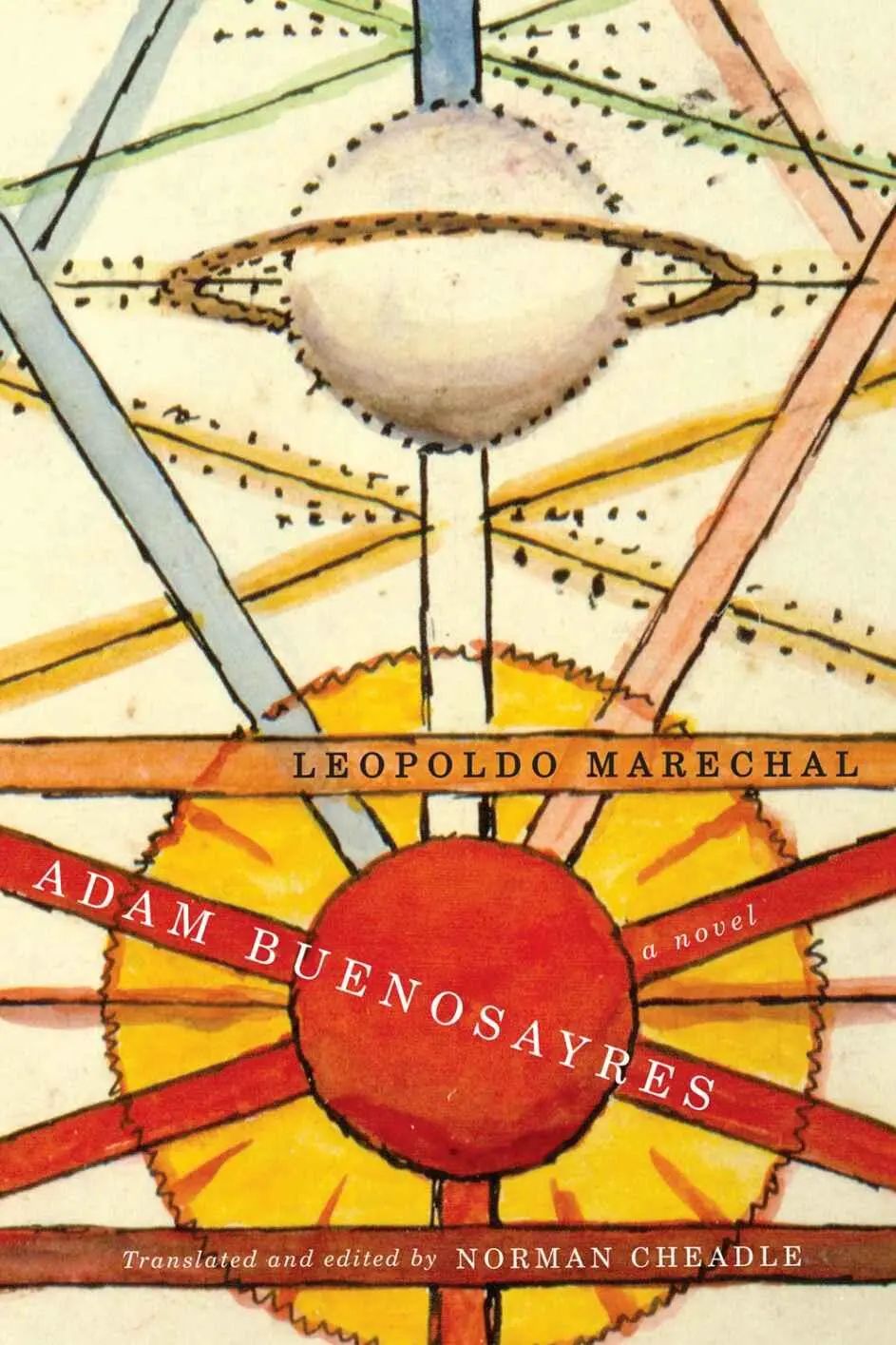
- Название:Adam Buenosayres
- Автор:
- Издательство:McGill-Queen's University Press
- Жанр:
- Год:2015
- ISBN:нет данных
- Рейтинг книги:5 / 5. Голосов: 1
-
Избранное:Добавить в избранное
- Отзывы:
-
Ваша оценка:
Adam Buenosayres: краткое содержание, описание и аннотация
Предлагаем к чтению аннотацию, описание, краткое содержание или предисловие (зависит от того, что написал сам автор книги «Adam Buenosayres»). Если вы не нашли необходимую информацию о книге — напишите в комментариях, мы постараемся отыскать её.
Adam Buenosayres — читать онлайн бесплатно полную книгу (весь текст) целиком
Ниже представлен текст книги, разбитый по страницам. Система сохранения места последней прочитанной страницы, позволяет с удобством читать онлайн бесплатно книгу «Adam Buenosayres», без необходимости каждый раз заново искать на чём Вы остановились. Поставьте закладку, и сможете в любой момент перейти на страницу, на которой закончили чтение.
Интервал:
Закладка:
— Tra-la-la, tra-la-la! sang the slug, now creeping up the wall.
Then the astrologer turned to me:
— Let’s leave him here to climb the wall and bust a gut, he growled. Now I’ll show you the fifth sector.
An autumnal, saffron-coloured meadow beneath an opaque, ashen sky. To the north, a line of copperish trees, hugging themselves and shivering. To the south, a volcano dead from the cold. To the east, a non-descript swatch of sea. To the west, a mossy medieval castle; on its battlements, grave and alert, men in red hunting tunics, each grasping a horn not as yet blown. And running across the meadow, women both young and mature, dressed as Asiatic goddesses or as prostitutes of ancient, lavish fiefdoms; coiffed in the style of Ceres, Mithra, Astarte; adorned with pearls snatched by the Malay diver from the ocean depths, with gems brought forth by the unhappy miner, with gold and platinum stolen from the bowels of the earth, with tropical feathers of all sorts, and with the pelt of every beast, fierce or meek, ever to have been stalked by hunters, from the snows of Mongolia to the torrid zone of Africa. That is what I saw when I entered the fifth scene.
— Who are those luxurious women? I asked Schultz.
— The Ultras, he answered. Ultra-courtesans, ultra-poetesses, ultraintellectuals: super-females, as finely tuned as lutes.
— What?
— They are the ones who, by dint of sighs, ruined the varnish of hours. The ones who twisted and spun the fleece of melancholy. Who got tipsy on ineffable nostalgias every Tuesday afternoon between six and seven. Who stood before luxurious mirrors and parodied the thirty-two postures of the rational soul. Who tried with their fallopian horns to produce the pure sound of the intellect. The ones who…
— Enough, already! I interrupted. And what are they doing in this inferno?
— Alas! sighed Schultz. There you see them, trying to look like Sappho and imitating the pose of Lysistrata. If you draw near, you’ll hear them debating arduous problems in philosophy, art, or economics. But it’s easy to see they speak only through their sex.
— What is their punishment?
— You’ll see when the huntsmen sound their horns.
As I waited for events to unfold, I turned my attention back to the superfemales. Some were walking with a kind of measured step, crunching dead leaves underfoot, and with the austere aspect of women who drag fatality on a leash behind them (I can’t swear to it, but I thought I saw among them Marta Ruiz, that fire amid ashes!). Others (and I clearly saw Ruth of The Golden Ant) hugged their lyres of gilded cardboard and seemed to be intoning sublime odes to the water in the east, to the volcano in the south. The rest of the women, their voluminous dresses sweeping behind them, went running after pink, yellow, and green flags, and harangued one another (wasn’t that Ethel Amundsen?) or belligerently brandished toy popguns. Only then did I notice the excessive theatricality of both scenario and actors — a hyperbolic falseness that seemed intentional. I was just thinking about this when one of the women approached. Astonished and confused, I was about to cry out her name, but the astrologer Schultz, in the nick of time, covered my mouth with his hand and prevented my indiscretion. Meanwhile, the Ultra had planted herself in front of us with that majesty I’d admired so many times in the visible Buenos Aires. She was as tall as Schultz, opulent in curves, and lean of face; her jet-black hair was adorned with artificial sprigs of cedron, poppy, and laurel; two silver snails nibbled at the pink lobes of her ears; and she was dressed, or undressed, in a close-fitting nightgown down to her feet, which were shod in some indefinable shade of saffron or autumn. But most noteworthy of all was that she bore, like Themis, a balance-scale made of gold; and on each of its plates was a human brain.
— Here I have the two brains, the Ultra informed us. This one, the man’s, weighs 1,160 grams. The other one, the woman’s, weighs 1,000. Do you gentlemen think that a measly 160 grams of grey matter justifies the odious condition of inferiority men impose on us?
— Now, Titania, don’t get yourself into a flap, responded Schultz condescendingly.
The black eyes of the Ultra flashed in fury:
— That’s just what I can’t stand in you men! she shouted. That way you have of listening to us with patronizing indulgence. Are women not intellectual creatures?
— Hmm, said the astrologer. Metaphysics doubts it.
— Loathsome wretch! whined the Ultra, shaking her fist in Schultz’s face. A man who thinks nothing of eating flowers out of the vases on the table.
But the astrologer looked at her with the severity of a judge and said:
— Let the accused maintain decorum! Renounce your intellectual urges
— they probably won’t impress the jury anyway — and tell the truth. Victim of a fervour not at all intellectual, did you or did you not outrageously troll the American continent?
— So what? rejoined the Ultra defiantly.
— Is it true that local production wasn’t enough for you, so you went fishing in other continents and managed to attract numerous male specimens, all of them refined in the use and abuse of intelligence? 41
— I had to do my research, objected the Ultra.
— And something else, insisted Schultz. Let the accused declare whether or not she persisted, on her return to Argentina, in the ridiculous, dangerous, and fortunately useless task of trying to refine the peons of her estancia , forcing upon them Honneger’s concertos, novels by D.H. Lawrence and André Gide, as well as Freudian doctrine. 42
— Brutish peasants! muttered the Ultra. They used to fall asleep at the first chord or sentence. Impossible to get a single line of Mallarmé into their thick skulls.
Schultz clucked his disapproval and then said to me:
— What I find hardest to take about Titania is her detestable mania for subordinating things of the spirit to the vague, exquisite, ineffable titillations of her “sensibility.” There isn’t a single piece of music, not a metaphysical idea or psychological observation, that she doesn’t immediately refer to her all-embracing sympathetic nervous system.
— Ah, monster! shrieked the Ultra in a splendid fit of anger. A man who goes out at night and sniffs the tramps asleep on the street.
She said no more, for the huntsmen in the battlements unexpectedly blew their horns in a spirited call to arms. It was just one blast, but when the super-females heard it they stopped dead in their tracks for an instant. Dropping their lyres and banners, they all ran toward the woods and waited in front of the copperish trees. No less hastily ran Titania, abandoning — alas! — her illustrious scales, the train of her long dress sweeping along dead foliage. A second trumpet blast sounded, but deeper this time, as though calling for the kill. Forthwith, a drove of white, black, and pink unicorns came galloping out from among the trees, manes flying in the breeze, horns poised at the ready. Whinnying feverishly, they charged the super-females and bored them up to the hilt. 43The melee of women and beasts, of shrieks and neighs, was soon shrouded in a reddish dust-cloud, the details of the encounter obscured. Then from the battlements another blast of the huntsmen’s horns signalled retreat. The unicorns returned to their forest glade, their horns reddened. The Ultras got to their feet, adjusted their dresses, and again took up their banners and lyres. In the moss-green castle the huntsmen dozed off.
— That’s about all there is to see here, said the astrologer then, leading me away by the hand.
Like a man who leaves one nightmare to embark upon another, I followed Schultz to the sixth infernal sector. The new scene looked a lot like the “mazes” one finds in amusement parks, with their twists and turns, their distorting mirrors, and the way their design, no matter how childish, insinuates a promise of getting inevitably lost. Although Schultz had let me know we were now in the Labyrinth of Solitary Souls, no human presence could be seen in the corridors. Two or three times I thought I saw either a furtive shadow slipping through some narrow passage or a heel disappearing round a corner of the maze. But I didn’t see a single complete image — not so much as a profile fleetingly glimpsed in some mirror. Later, when recapitulating the whole adventure, the astrologer confessed to me that the circulation system of this labyrinthine sector, whose discreet orderliness I couldn’t get over, had been entirely inspired by a certain establishment non sancta , located on the rue de Provence in Paris, which in his youth he had frequented no less studiously than passionately.
Читать дальшеИнтервал:
Закладка:
Похожие книги на «Adam Buenosayres»
Представляем Вашему вниманию похожие книги на «Adam Buenosayres» списком для выбора. Мы отобрали схожую по названию и смыслу литературу в надежде предоставить читателям больше вариантов отыскать новые, интересные, ещё непрочитанные произведения.









Обсуждение, отзывы о книге «Adam Buenosayres» и просто собственные мнения читателей. Оставьте ваши комментарии, напишите, что Вы думаете о произведении, его смысле или главных героях. Укажите что конкретно понравилось, а что нет, и почему Вы так считаете.