Leopoldo Marechal - Adam Buenosayres
Здесь есть возможность читать онлайн «Leopoldo Marechal - Adam Buenosayres» весь текст электронной книги совершенно бесплатно (целиком полную версию без сокращений). В некоторых случаях можно слушать аудио, скачать через торрент в формате fb2 и присутствует краткое содержание. Год выпуска: 2015, Издательство: McGill-Queen's University Press, Жанр: Классическая проза, на английском языке. Описание произведения, (предисловие) а так же отзывы посетителей доступны на портале библиотеки ЛибКат.
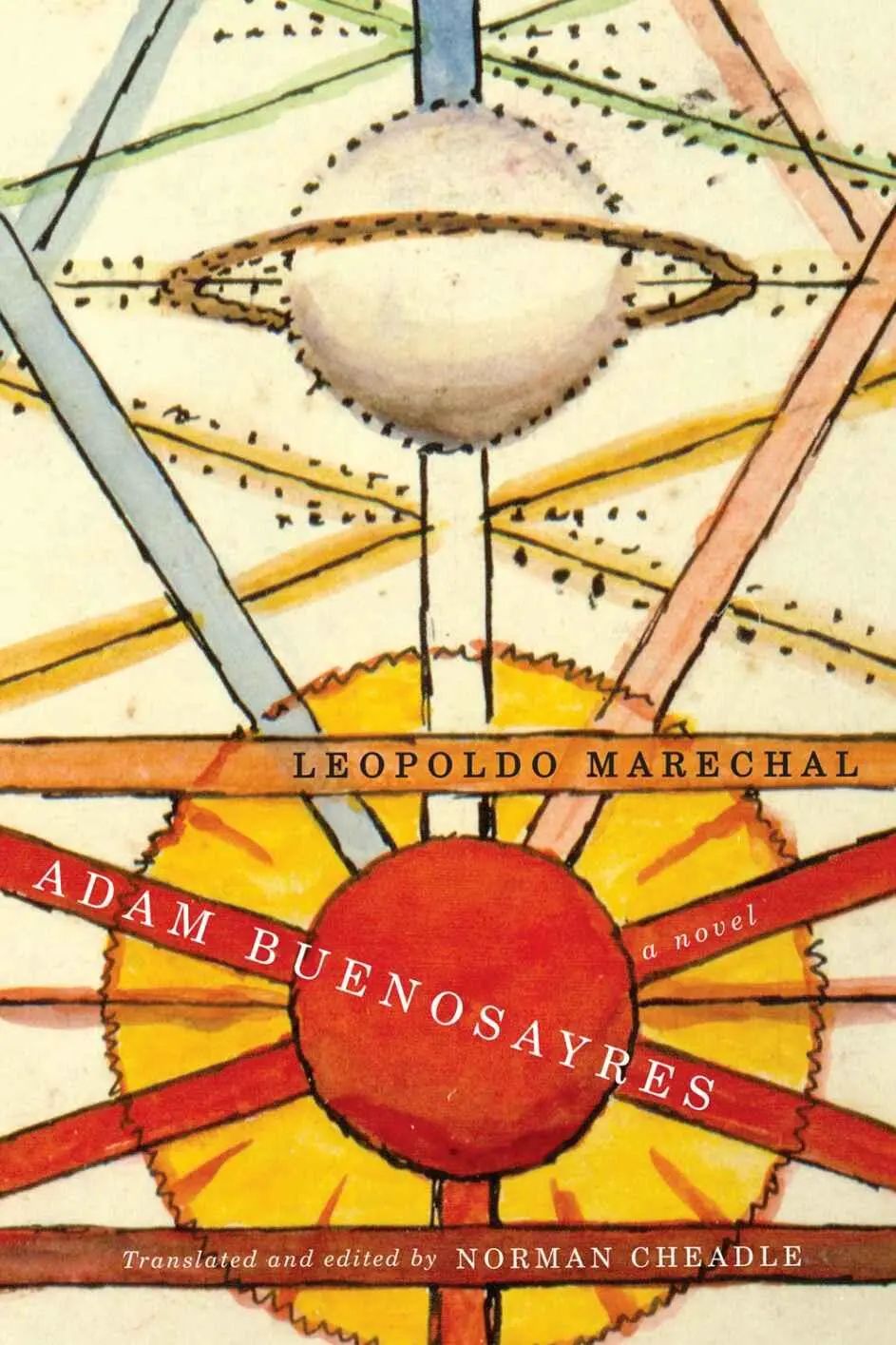
- Название:Adam Buenosayres
- Автор:
- Издательство:McGill-Queen's University Press
- Жанр:
- Год:2015
- ISBN:нет данных
- Рейтинг книги:5 / 5. Голосов: 1
-
Избранное:Добавить в избранное
- Отзывы:
-
Ваша оценка:
Adam Buenosayres: краткое содержание, описание и аннотация
Предлагаем к чтению аннотацию, описание, краткое содержание или предисловие (зависит от того, что написал сам автор книги «Adam Buenosayres»). Если вы не нашли необходимую информацию о книге — напишите в комментариях, мы постараемся отыскать её.
Adam Buenosayres — читать онлайн бесплатно полную книгу (весь текст) целиком
Ниже представлен текст книги, разбитый по страницам. Система сохранения места последней прочитанной страницы, позволяет с удобством читать онлайн бесплатно книгу «Adam Buenosayres», без необходимости каждый раз заново искать на чём Вы остановились. Поставьте закладку, и сможете в любой момент перейти на страницу, на которой закончили чтение.
Интервал:
Закладка:
Ever since then my life has had a well-defined direction, a well-placed hope in the vision of The One who, redeemed by the work of my loving mind, breathes in my mind and is nourished by my substance, 14rose that eludes death. She not only triumphs in her now immutable springtime, but she continues to transform and grow, according to the dimensions of my soul’s own desire: rose that eludes death, flower without autumn, mirror mine, whose perfect form and unique name I shall know some day, if, as I hope, there is a day when man’s thirst finds the right water and its true spring. 15
BOOK SEVEN
(Journey to the Dark City of Cacodelphia)
I
On Saturday April 30, 192–, in the lowlands of Saavedra, at midnight, the astrologer Schultz and I set out on the memorable journey I now propose to recount. Our itinerary was to include, according to the astrologer’s nomenclature, a descent into Cacodelphia, city of torment, and an ascent to Calidelphia, city of glory. 1Needless to say, the mere announcement of that journey had plunged me into doubt, hesitation, and not a few reservations, aware as I was that for some time Schultz had been pondering a trip to hell in order to explore its sinister realms, a descent undertaken by precious few heroes even in antiquity, and by not a one, as far as I know, in the vulgar, prosaic age we live in now. Just a couple of hours earlier, I recall, we were sitting in Schultz’s studio, where I was still grumbling and making last-ditch objections. The astrologer listened in silence, moving with absolute calm amid handwritten manuscripts and volumes lying open, celestial spheres and zodiacs, astrological tables, and other paraphernalia that stuffed his studio.
— Let’s suppose for a moment the two mythological cities might actually exist, I joked. Even if we were crazy enough to follow in the footsteps of Ulysses, Aeneas, 2Alighieri, and other infernal tourists, what merit do we have that would make us worthy of such an adventure?
— I have the merit of my science, and you the merit of your penitence, Schultz answered with much gravity.
I fell silent in surprise and confusion for, although I didn’t exactly know what Schultz’s science entailed, I was well aware of the lugubrious state I’d been floundering in for some time, its chief symptom an indefinable aridity, and I thought I’d kept this a jealously guarded secret. Recovering from my astonishment, I turned to Schultz with a question on my lips; but at that instant the astrologer was examining a ball of twine held between his fingers.
— What do you reckon is the diameter of an ombú? he asked doubtfully.
— Listen, I answered laughing, what the heck have ombú trees got to do with anything?
— You’ll find out, he said. I’m talking about the one we discovered the other night in the outback of Saavedra.
Then, recalling the scene with the magus and the ombú and the bonfire burning amongst the tree’s black spurs, I mentally assessed the thickness of its trunk.
— Five feet or so, I said at last. Maybe a bit more.
Schultz nodded. Scratching with a pencil, he figured out how long a circumference would correspond to that diameter. Then, unravelling a portion of twine, he measured out a length equal to the circumference he’d calculated, marked the spot with a knot, added to the measured-out length three units from who knows what bizarre metrical system, cut it off with his famous black-handled penknife, and finally put both knife and string in his pocket, all with the air of someone performing a liturgical ceremony. The job finished, he let himself fall back into an antediluvian armchair.
— I’m going to set you straight on two points, he announced, as if during his manoeuvres with the string he’d been considering my final arguments. First of all, we won’t be undertaking a voyage to Tartarus, as metaphysicians understand the term. Pshaw! That would be too ambitious, at least for you.
— Thanks! I interrupted, feeling a prick of resentment.
— Which means, Schultz concluded, that if you imagine you’re going to play a pathetic, dime-store Orpheus at my expense, you’d best renounce that illusion right now.
I couldn’t help laughing out loud.
— Gladly! I answered. So, what’s the second point?
In his antediluvian armchair, with legs crossed and arms hanging loose, the astrologer was the very image of indolence.
— Cacodelphia and Calidelphia, he said, are not mythological cities. They really exist.
— Sure, I grumbled, just like your blessèd broody angels.
— What’s more, insisted Schultz, the two cities conjoined form a single city. Or better yet, they are two aspects of the same city. And that Urb, visible only to the eyes of the intellect, is the counterfigure of the visible Buenos Aires. 3Is that clear?
— Clear as mud.
I report our colloquium in so much detail, giblets and all, so readers may get an exact impression of the spirit in which Schultz and I tackled that singular adventure; and above all, because such a frivolous beginning was to contrast seriously with the extraordinary nature of the episodes to follow. But before recounting them, I should perhaps sketch a profile of the astrologer Schultz, the journey’s instigator and guide.
Standing nearly six-foot-six, the astrologer had a long, skinny body, a wide brow, and silvery hair. His severe face was afflicted with a sort of earthy pallor, approaching the colour of tubers, and was animated by the light of grey eyes whose gaze would suddenly fall upon you like a fistful of ashes. It was just about as impossible to calculate his age as to square the circle, for while some thought he was fast approaching the third childhood, others didn’t hesitate to give him all the years of Methuselah; and still others, refraining from laborious speculation, credited him with the simple, straightforward immortality of the crab. One thing I can say is that Schultz sometimes showed traces of an infinite decrepitude, no doubt the result of certain astral oppositions. At other moments, under more favourable signs, he was capable of fits of mad glee, and he would dance the entire night away at the Tabarís Cabaret; 4or he would hang out in neighbourhood general stores, singing lewd songs that even the prudent tough-guys from Villa Ortúzar couldn’t hear without blushing. And here I must put special emphasis on his moral nature, equally contradictory: it was true that the general orientation of his conduct lent him a certain ascetic tone with regard to the vulgar appetites (many people swore, for example, that Schultz’s sole nourishment was the nectar of flowers, and that his relations with women bordered on the ineffable, consisting in an exchange of more or less vagarious fluids). But it was no less certain that Gildo’s Grill (corner of Rivadavia and Azcuénaga) had more than once witnessed him voluptuously attack a heap of steaming entrails, cow’s kidneys, and bull’s testicles, and that he was wont to fall into ecstatic perorations before certain feminine thighs, whose perfection he attributed to Jupiter’s classical munificence. As for the astrologer’s wisdom, popular opinion was equally divided. Some imagined he was at the ultimate stage of Vedic initiation. Others thought he must be afloat in the sublime realms of theosophical fiddle-faddle. And then there were those who, too suspicious by half, revered him as the most doleful humourist ever to have drawn breath by the shores of the River Plate.
II
It was with this strange Virgil 5that I hit the road for Saavedra one more time, on the aforementioned day and year, not long before midnight. By his allusions to the ombú I understood what place the astrologer had in mind, and I was afraid we’d have to cross for a second time the rugged region we had braved forty-eight hours earlier. But Schultz, always foresighted, took me on a long detour around that solitary plain, so that our second incursion began at the exact spot where the first had ended.
Читать дальшеИнтервал:
Закладка:
Похожие книги на «Adam Buenosayres»
Представляем Вашему вниманию похожие книги на «Adam Buenosayres» списком для выбора. Мы отобрали схожую по названию и смыслу литературу в надежде предоставить читателям больше вариантов отыскать новые, интересные, ещё непрочитанные произведения.





Обсуждение, отзывы о книге «Adam Buenosayres» и просто собственные мнения читателей. Оставьте ваши комментарии, напишите, что Вы думаете о произведении, его смысле или главных героях. Укажите что конкретно понравилось, а что нет, и почему Вы так считаете.