Leopoldo Marechal - Adam Buenosayres
Здесь есть возможность читать онлайн «Leopoldo Marechal - Adam Buenosayres» весь текст электронной книги совершенно бесплатно (целиком полную версию без сокращений). В некоторых случаях можно слушать аудио, скачать через торрент в формате fb2 и присутствует краткое содержание. Год выпуска: 2015, Издательство: McGill-Queen's University Press, Жанр: Классическая проза, на английском языке. Описание произведения, (предисловие) а так же отзывы посетителей доступны на портале библиотеки ЛибКат.
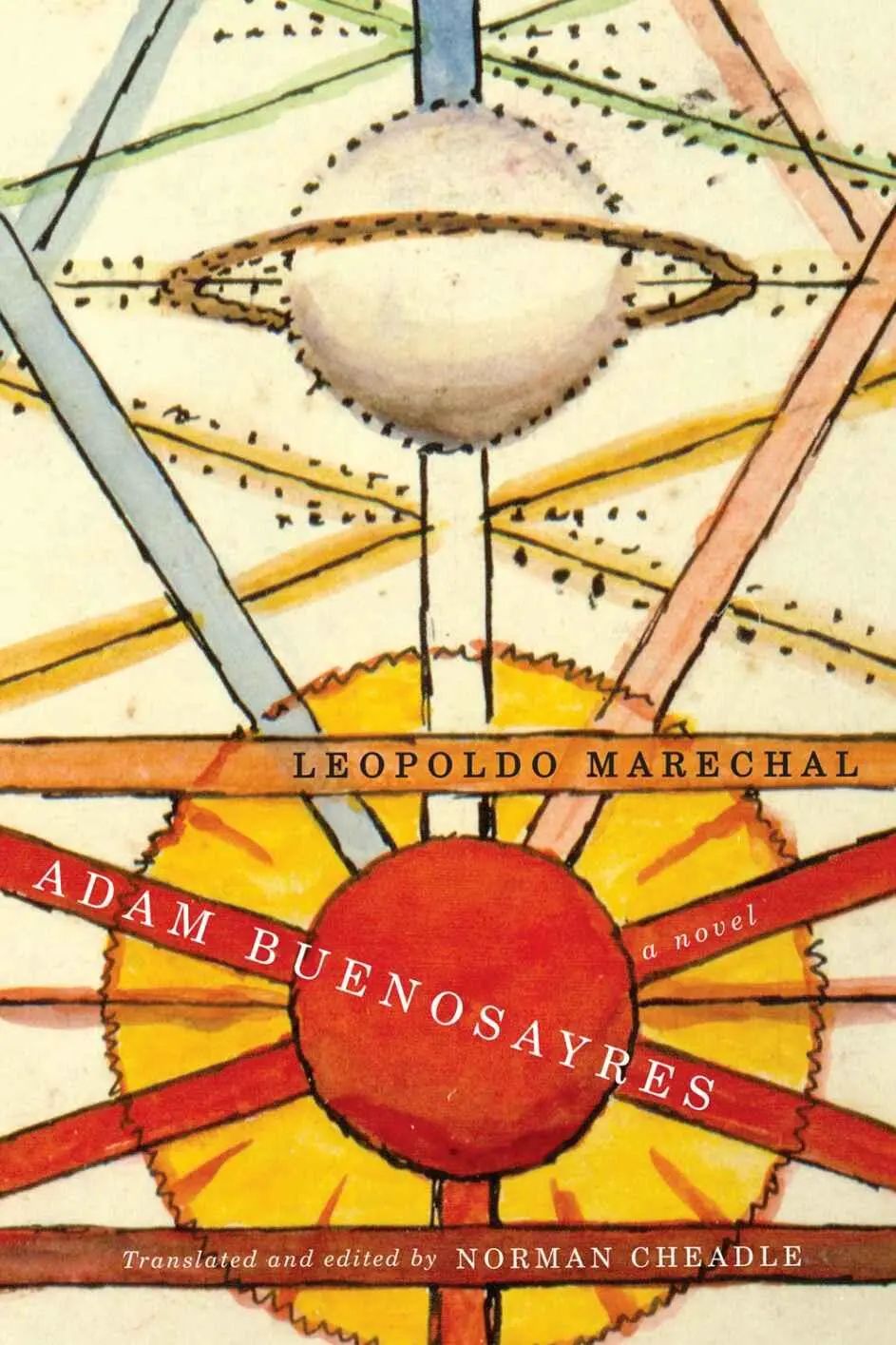
- Название:Adam Buenosayres
- Автор:
- Издательство:McGill-Queen's University Press
- Жанр:
- Год:2015
- ISBN:нет данных
- Рейтинг книги:5 / 5. Голосов: 1
-
Избранное:Добавить в избранное
- Отзывы:
-
Ваша оценка:
Adam Buenosayres: краткое содержание, описание и аннотация
Предлагаем к чтению аннотацию, описание, краткое содержание или предисловие (зависит от того, что написал сам автор книги «Adam Buenosayres»). Если вы не нашли необходимую информацию о книге — напишите в комментариях, мы постараемся отыскать её.
Adam Buenosayres — читать онлайн бесплатно полную книгу (весь текст) целиком
Ниже представлен текст книги, разбитый по страницам. Система сохранения места последней прочитанной страницы, позволяет с удобством читать онлайн бесплатно книгу «Adam Buenosayres», без необходимости каждый раз заново искать на чём Вы остановились. Поставьте закладку, и сможете в любой момент перейти на страницу, на которой закончили чтение.
Интервал:
Закладка:
Then, beginning to walk, The One led us into her resplendent vegetal domain. In the time of my childhood, when I came upon a colour print or read some novelistic episode, I would long for the miracle of inhabiting those luminous realms invented by art. I recall having approached that ideal on a few memorable days, later, during my youth. But never, as on that afternoon, had I so felt the strange beatitude of living in poetry. And never had reality been so exalted before my eyes, to the point of becoming a set of pure forms and graceful, singing numbers. The three of us chatted in the garden, the glowing noonday sun burnishing our skin like a strong ointment, and made our way through the dense legions of flowers, bathed in an ecstatic light flecked now and then by a bird’s wing or the volatile gold of a butterfly. We walked next to the wall clothed in honeysuckle, where iridescent-throated doves cooed with no trace of fear: theirs was the music of the garden, and along with the elytron beetles hidden amid the herbs and the bumblebees, their chant filled our ears. The realm of The One was a world in lasting harmony: the death of a single insect would have upset its delicate balance. The One, pausing frequently, spoke to us of her garden, without looking at us, as though in an intimate soliloquy. It was like learning everything anew, but with no effort at all and with the living certainty of music. For the Woman guiding us through the garden had her own way of naming things: she would say “bird” and the essence of the bird appeared in the mind of her listener in a hitherto unknown light, as if The One somehow had the virtue of recreating the bird merely by saying its name.
Who, then, spoke of love? It was Friend. 10We were sitting, the three of us, on a rustic bench, in the shade of a willow whose verdant fronds grazed our hair: the strong aroma of heliotropes beneath the sun induced in us an inchoate inebriation more of the mind than of the body; and ever since that afternoon I occasionally tell myself that if the mind had a scent it would be comparable to the dry, ardent, chaste perfume of heliotropes. But who, then, spoke of love? It was Friend. The first thing he pointed out was the loving virtue thanks to which the Lover, with eyes turned toward the Beloved, forgets himself, exchanges his form for the form of what is loved, dies by degrees to his own life, and comes to life again in the life of the Other; until finally the Lover transforms into the Beloved. As the Friend spoke, my eyes looked into The One’s eyes, with an easy boldness I cannot explain. Then it was my turn to speak, but rather than talk about my own feelings, I related the drama of the Lover converted to the Beloved who hides or flees or ignores the Lover. With a vehemence that must have seemed strange in that garden setting, I depicted the anguish of the Lover who, dying within himself, finds no resurrection in the life of the Other. The One remained silent, although her eyes, looking into mine, emitted the clearest light, indefinable for me then, but whose true value I understood later.
I don’t know how long that unique dialogue went on between two voices and one gaze; nor is it my purpose to divulge all that was said on that midday occasion beneath a willow in Saavedra. I shall only say that, all of a sudden, the laughter and shouting of young men erupted into the garden. The frightened doves scattered in a flutter of wings. It seemed to me some magic circle was being broken, or the doorway to a secret was stealthily closing.
XII
There followed more light-filled days during which I visited the woman of Saavedra so many times that I believed myself arrived at the pinnacle of happiness. But one afternoon, when care seemed as far away as can be, I clearly realized that my repose was nearing its end and the dawn of anxiety was nigh. We were walking in the garden, at the hour when the shadows lengthen, and we chanced upon the greenhouse where sun-shy flowers resided: the white roses there intoxicated us with their perfume, and she too was a white rose, a rose of damp velvet. Her voice must have had some intimate affinity with water, for it was liquid, diaphanously resonant, like the well-water back in Maipú, when a stone fell in and aroused recondite music. Being alone in the floral nursery brought us closer together than ever. It was my great opportunity and my inevitable risk, because at her side I suddenly felt the birth of an anguish that would never leave me, as if at the moment of our greatest closeness there was already opening between us an irremediable distance, just as two heavenly bodies, as they reach their maximum degree of proximity, simultaneously touch the first degree of their separation. The grotto-like light, eroding shapes and forms, managed to exalt them miraculously; and the form of The One assumed for me a painful relief, a plenitude which, once glimpsed, made me shake with anguish, as if so much grace, so slightly supported, suddenly revealed to me how perilous her fragility was. And again the admonitory drums of the night began to beat in my soul, and before my terrified eyes I watched as The One withered and fell among the roses, she as mortal as they.
And baleful voices began to cry from within me: “Look at the fragility of what you love!” A fit of weeping overcame me then, which I desperately tried to stifle, not only because it betrayed, in the presence of The One, a side of my being that no one, not even I, could look at without trembling; but also because I was frightened by the absolute impossibility of giving her an explanation for my weeping. But she hadn’t missed the advent of my tears, and she said to me: “Adam Buenosayres, why are you crying?” Here, at the risk of seeming otiose, I need to express the effect those two little words had upon me: for the first time, I was hearing from her lips the letters of my name. When she encunciated “Adam Buenosayres,” I felt myself named as never before, as though witnessing for the first time the complete revelation of my being and the exact colour of my destiny. And when she then asked me, “Why are you crying?” she did so as though for all eternity she had known why, but with such sweetness that I wept all the harder and, without a word of reply, ran out of the greenhouse and fled through the crowd of flowers.
The voice of alarm raised within me that afternoon would never again fall silent. It sounded two or three times more, when I came into contact with the woman of Saavedra. But it arose so urgently, so distressing was its cry, that I could not bear to hear it and stopped my visits to the garden, clinging to the circle of my much-wept-over solitude. Distancing myself, I was losing her in the garden, but at the same time, it turned out, I was recovering her in thought, and more frequently, with more precision, with more dangerous intimacy. In those days, I admired no grace, assessed no perfection, discerned no truth that did not take me back in memory to The One and to the inevitable meditation on her death. And though such mournful ideas were interrupted when sleep overcame my body, I would then descend into a world of phantoms where the same funereal liturgy was rendered in terrible visions, the same grief rehearsed which, while awake, I felt only in premonitions.
Then I conceived of the incredible enterprise. Perhaps it was the venerable terror, or the fecundity of my lament, or the cry of never-extinguished hope. In any case, I was moved to undertake the difficult labour of enchantment, the strange work of alchemy — the transmutation of the woman of Saavedra. No doubt it was that: the heroic desire to put up a dike against the ineluctable, and to preserve in spirit what in matter was already flowing unstoppably deathward. Such was the extraordinary, prudential labour initiated by my cares in those days: seeing how vulnerable her resplendent beauty was in mortal clay, I set about extracting from that woman all the durable lines, volumes, and colours, all the grace of her form; and with these same elements (though now rescued from matter) I recontructed her in my soul according to weight, number, and measure. And I forged her form such that henceforth it would be free of all contingency and emancipated from all grief. I recall describing the details of such an astonishing operation in a necessarily obscure poem written at about that time; my friends didn’t understand the poem’s true scope and spun the most diverse conjectures. My hope is that, should their eyes chance upon these lines some day, my friends will remember the poem and finally discern its obscure meaning; I hope they’ll see why in the last phase I called the transmuted woman: Niña-que-ya-no-puede-suceder , “Girl-who-can-no-longer-happen.” 11
Читать дальшеИнтервал:
Закладка:
Похожие книги на «Adam Buenosayres»
Представляем Вашему вниманию похожие книги на «Adam Buenosayres» списком для выбора. Мы отобрали схожую по названию и смыслу литературу в надежде предоставить читателям больше вариантов отыскать новые, интересные, ещё непрочитанные произведения.







Обсуждение, отзывы о книге «Adam Buenosayres» и просто собственные мнения читателей. Оставьте ваши комментарии, напишите, что Вы думаете о произведении, его смысле или главных героях. Укажите что конкретно понравилось, а что нет, и почему Вы так считаете.