Leopoldo Marechal - Adam Buenosayres
Здесь есть возможность читать онлайн «Leopoldo Marechal - Adam Buenosayres» весь текст электронной книги совершенно бесплатно (целиком полную версию без сокращений). В некоторых случаях можно слушать аудио, скачать через торрент в формате fb2 и присутствует краткое содержание. Год выпуска: 2015, Издательство: McGill-Queen's University Press, Жанр: Классическая проза, на английском языке. Описание произведения, (предисловие) а так же отзывы посетителей доступны на портале библиотеки ЛибКат.
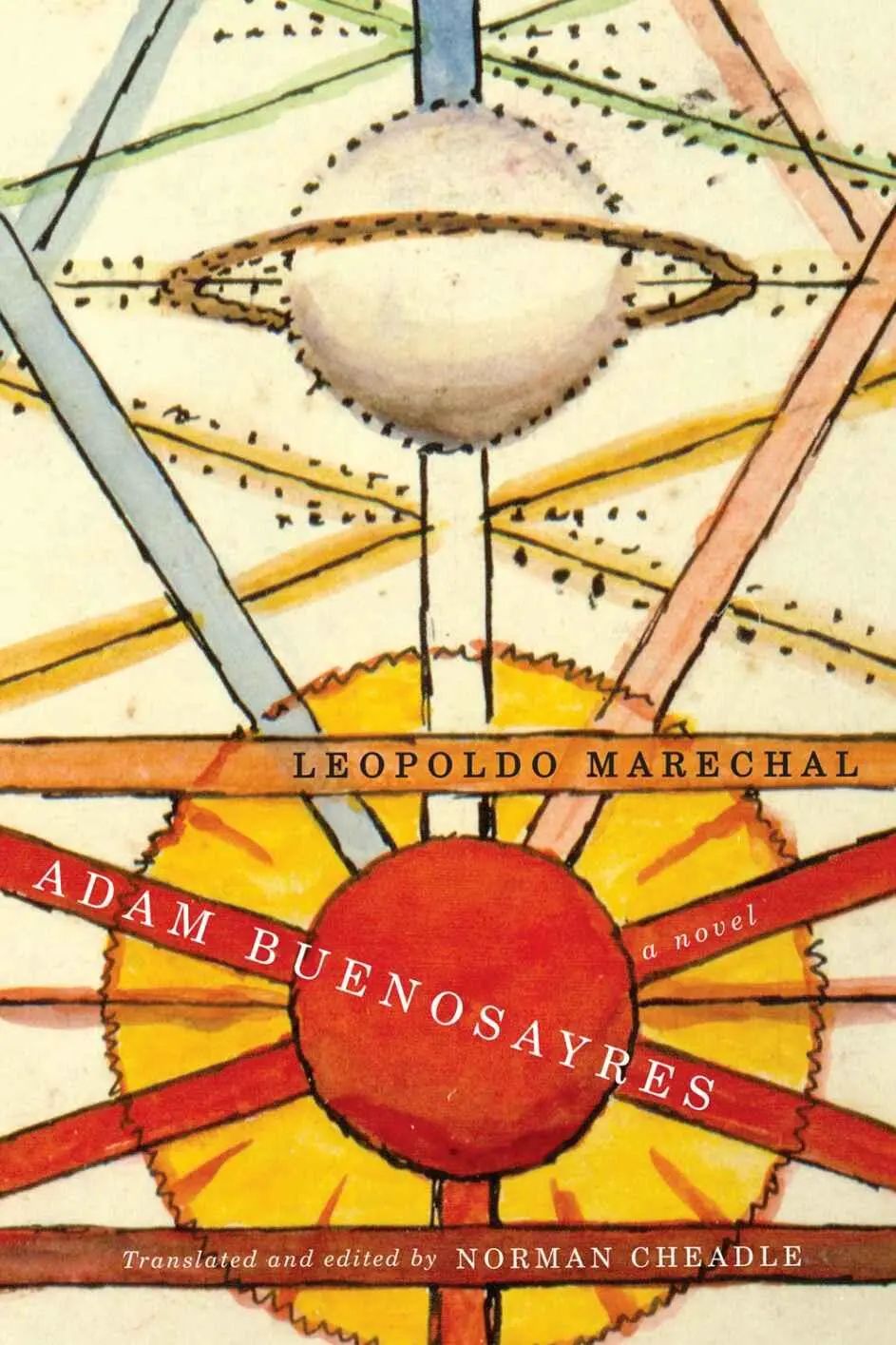
- Название:Adam Buenosayres
- Автор:
- Издательство:McGill-Queen's University Press
- Жанр:
- Год:2015
- ISBN:нет данных
- Рейтинг книги:5 / 5. Голосов: 1
-
Избранное:Добавить в избранное
- Отзывы:
-
Ваша оценка:
Adam Buenosayres: краткое содержание, описание и аннотация
Предлагаем к чтению аннотацию, описание, краткое содержание или предисловие (зависит от того, что написал сам автор книги «Adam Buenosayres»). Если вы не нашли необходимую информацию о книге — напишите в комментариях, мы постараемся отыскать её.
Adam Buenosayres — читать онлайн бесплатно полную книгу (весь текст) целиком
Ниже представлен текст книги, разбитый по страницам. Система сохранения места последней прочитанной страницы, позволяет с удобством читать онлайн бесплатно книгу «Adam Buenosayres», без необходимости каждый раз заново искать на чём Вы остановились. Поставьте закладку, и сможете в любой момент перейти на страницу, на которой закончили чтение.
Интервал:
Закладка:
(Note: The following chapters bring the Blue-Bound Notebook to a close. They were written, no doubt, by Adam Buenosayres after his definitive tertulia in Saavedra. The manuscript lies before me now, awaiting transcription. But before continuing, I contemplate its tormented lines, full of scratched-out phrases and corrected words, altogether different from the handwriting in the first part of the Notebook, whose exquisiteness speaks of an artist’s slow, painstaking work. This last part begins with an extravagant fable or apologue. It goes like this:)
XIII
It comes to pass — not every year — that Springtime, tired perhaps of lying dormant in the sap of trees or the blood of animals, shakes off the vapours of sleep and says to herself that it’s now time to dance upon the earth. In vain the heads of astronomers swivel in denial; in vain the almanacs, perturbed, warn her the time to dance is not yet come. Mindless of such wholesome counsel, Springtime sallies forth into the world: her bugle plays reveille for the flowers, her dance arouses a profusion of prematurely sprouting leaves. This does come to pass, but not every year; and in the orchard of Maipú a certain young peach tree did not know this (I was a child then, and spy of hidden gestures). It happened once that — while the elderly peach trees, experienced in the exercise of prudence, were still asleep and ignoring the deceitful song of spring — the young peach tree opened its blossoms (thus did my love misjudge time!) and exposed them to the benevolent critique of the sparrow. But it wasn’t long before the frost returned (silly little fable); and that year the young peach tree, its blossoms whimpering, learned the exact date of its springtime. Thus does my love, weeping, learn its lesson.
In the last part of the Notebook, I gave an account of the alchemical work I’d initiated with the virtues of that laudable woman, redeeming them from the devastation I perceived already in progress and translating them to the intimate retreat of my soul, where they might acquire the stability of things spiritual. I say now that no sooner had I begun than the inevitable doubling of The One took place, producing the necessary opposition between the earthly woman, who was being reduced to nothing, and the celestial woman, whom my soul was building up in her secret workshop. And since the construction of one was being done with the remains of the other, it was not long before I noticed that as the spiritual creature grew in size and virtue, the terrestrial creature diminished in inverse proportion, until it arrived at its limit of nothingness. Thus did “the death of The One” impose itself upon my mind with the rigour of a necessity. And its date must have been, in my eyes, as foreseeable as that of an event in the heavens.
Nevertheless, no sooner had I received this news than a deep chord detonated in my being and something vital was left forever wounded. I’ll never forget the nocturnal hour when, crossing the threshold of Saavedra and wending my way among the throng of astonished faces filling the vestibule, I came, as in a dream, upon the narrow box containing the remains of The One; yes, the coffin of walnut wood whose edges marked for her an unbreachable limit. She was swathed in the brightest of linens. Her sisters had combed her flaxen hair, crowned her brow with a ring of little white flowers, and placed between her stiff hands an ivory rosary and the book of her first communion, just as they would have adorned her for her wedding. Yet the whole of her spoke of such appalling distance that, when I looked at her, my being became unhinged and its inner voices began their woeful lament, to the point of nearly bursting out loud, finally finding an outlet in sweet avenues of tears. Afterward, I remember an all-night wake whose infinity seemed to deny any new dawn; and a whirlwind of bare faces sobbing in the candlelight, unsightly yet beautiful in the terrible shamelessness of their grief; and the house full of weeping or — what amounted to the same thing — fraught silences; and then a lassitude of limbs, a hunkering down of lights and a drowsiness of tired animal; and at last the break of day, insisted upon by imbecile roosters, but indecisive and apathetic, as though fearing that not enough pain remained in humankind to fill another day on earth. And I’ll not speak now of the stupor experienced by eyes before the dawn light no one had summoned; nor of the brilliance of the funeral procession of lacquered coaches and horses’ hooves; nor of that unbearably slow journey through Buenos Aires whose indifference stung like an insult; nor of the cradle of red clay which lovelessly received that vanquished body of a girl; nor of the return trip without her, from solitude, amid solitude, unto solitude.
XIV
Listless days ensued, filing by like automatons in front of my being, every morning bringing their tired old collection of pawed-over junk, every evening taking it away. Indifferent to the play of exterior images, my mind empty and my will paralyzed, I recall how stupid and rigid seemed the chill mechanics of time, the obligatory waking-up and the useless return to sleep, each time the earth emerged from or re-entered its cone of shadow. Night-time, however, brought with sleep the sweet parody of death, and the dark delight of reviving in a subtle world made of images that arose in another space and came into being in another time, witnessed by another awareness in my being. But in my dreamspace The One’s death, too, was reconstructed according to other laws; and it attained a fine-tuned intensity so painful that I would wake up suddenly, still filled with fragments of images and voices. Then, opening my ears and holding my breath, I would listen to the furniture creak, the wind sigh in the paradise trees on Monte Egmont Street, and someone else moaning in dreams in the other room, sounds and whispers of sounds that overwhelmed me with anguish, as if my nerves extended beyond my skin and branched out through the house to pick up its most intimate vibrations.
But on the last of those nights I had an extraordinary dream whose meaning, impressed upon my defeated mind, opened up a path from which my mind will surely not henceforth swerve. I seemed to be in rickety boat, standing on its poorly fitted planks, and paddling ceaselessly over the waters of a lagoon. The devastated body of The One lay across the bow of the boat, wearing the same clothes and accoutrements as in her final night in Saavedra. Still paddling, I contemplated her womanly form, my soul racked by a tearless pity whose sweetness I cannot now depict, while the paddle, cutting through the dead waters, stirred up terrible odours and sliced into phosphorescent chunks of dead meat that swirled and sank into the depths. Next it seemed the boat came to rest at a jetty as dark as ink. I took up the woman’s body in my arms and went up some sort of stairs until I came to a door that opened soundlessly before me. Then, it seemed, Someone behind the door held his arms outstretched toward me and I deposited in them the dead body, which was soon borne away into the interior gloom. When I tried to follow, it seemed, an invincible force pinned my heels at the threshold, and the door slowly closed, separating my heart from those remains I’d brought over the waters. Wounded to the point of deep distress, I seemed to shout out terrible words and beat my fists against the closed door; since there was no echo of a response, my blows and shouts became more violent, until I seemed to feel behind me the presence of someone staring at me fixedly. I turned around then and made out the shape of an old and ragged man whose face seemed not unfamiliar. Looking at me mercifully, he said: “Let death take its own.” 12And since I asked him who he was, the old man answered: “I am he who has moved, moves, and will move your steps.” Then I seemed to recognize the same voice that had spoken to me, both when awake and asleep, so many times before; and, as if the sense of all my actions in this world were owing to that voice, when I heard it issue from the man’s mouth, my eyes shed convulsive tears. Seeing which, he told me: “Pay no more mind to multitudinous images, and seek the single, true face of The One.” Not understanding the meaning of his obscure words, I seemed to hear others from the man’s lips coming into my mind, words ordering me to pursue the work of the heavenly woman, whose praises the man sang so passionately that, caught up in a rare exultation, I suddenly awoke, the flavour of that music in the ears of my soul. 13
Читать дальшеИнтервал:
Закладка:
Похожие книги на «Adam Buenosayres»
Представляем Вашему вниманию похожие книги на «Adam Buenosayres» списком для выбора. Мы отобрали схожую по названию и смыслу литературу в надежде предоставить читателям больше вариантов отыскать новые, интересные, ещё непрочитанные произведения.










Обсуждение, отзывы о книге «Adam Buenosayres» и просто собственные мнения читателей. Оставьте ваши комментарии, напишите, что Вы думаете о произведении, его смысле или главных героях. Укажите что конкретно понравилось, а что нет, и почему Вы так считаете.