Leopoldo Marechal - Adam Buenosayres
Здесь есть возможность читать онлайн «Leopoldo Marechal - Adam Buenosayres» весь текст электронной книги совершенно бесплатно (целиком полную версию без сокращений). В некоторых случаях можно слушать аудио, скачать через торрент в формате fb2 и присутствует краткое содержание. Год выпуска: 2015, Издательство: McGill-Queen's University Press, Жанр: Классическая проза, на английском языке. Описание произведения, (предисловие) а так же отзывы посетителей доступны на портале библиотеки ЛибКат.
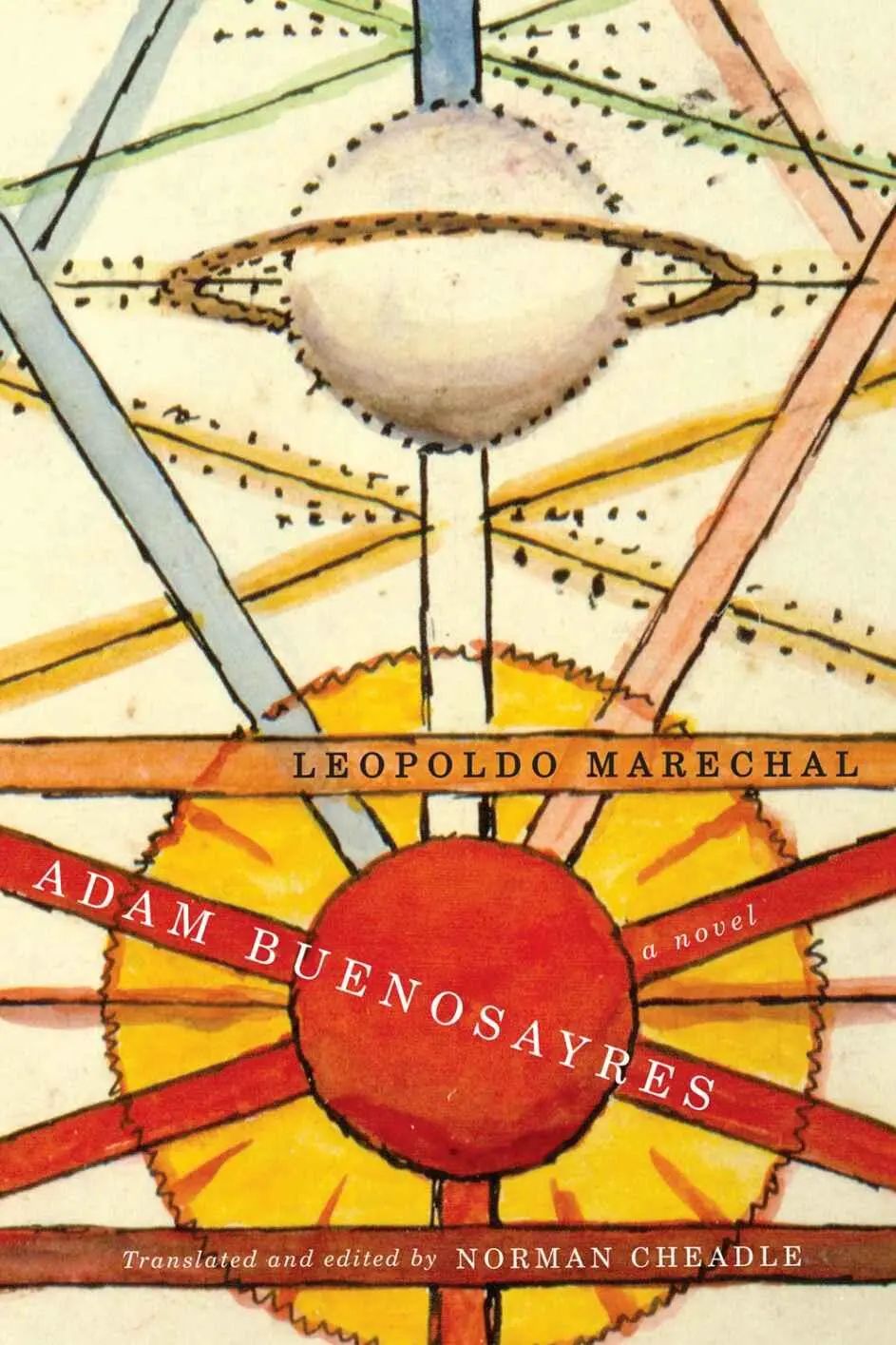
- Название:Adam Buenosayres
- Автор:
- Издательство:McGill-Queen's University Press
- Жанр:
- Год:2015
- ISBN:нет данных
- Рейтинг книги:5 / 5. Голосов: 1
-
Избранное:Добавить в избранное
- Отзывы:
-
Ваша оценка:
Adam Buenosayres: краткое содержание, описание и аннотация
Предлагаем к чтению аннотацию, описание, краткое содержание или предисловие (зависит от того, что написал сам автор книги «Adam Buenosayres»). Если вы не нашли необходимую информацию о книге — напишите в комментариях, мы постараемся отыскать её.
Adam Buenosayres — читать онлайн бесплатно полную книгу (весь текст) целиком
Ниже представлен текст книги, разбитый по страницам. Система сохранения места последней прочитанной страницы, позволяет с удобством читать онлайн бесплатно книгу «Adam Buenosayres», без необходимости каждый раз заново искать на чём Вы остановились. Поставьте закладку, и сможете в любой момент перейти на страницу, на которой закончили чтение.
Интервал:
Закладка:
VII
From that point on, my soul knew a state that belonged to neither life nor death, but rather to a frontier position where life and death were both similar and different one from the other. I found myself between two nights: the night below, that is, of the world that I was abandoning and whose forms, colours, and sounds now seemed very far away; and the night above, in which my eyes espied not the slightest sign of dawn. Placed between one night and the other, I say that my eyes never left the second night, as though they were awaiting I know not what future day. For my soul, despite her state of unmoored abandon, felt in a mysterious way that she was a captive, just as though she had chanced to take the invisible hook of an invisible fisherman who was tugging from on high. And finding myself in this state one night, cloistered in my sleepless room and bent over a book of obscure science whose useless characters danced before my eyes, I fell into a deep sleep, in which such marvellous things appeared to me that the recollection of them still leaves my mind hanging in suspense:
I found myself in a strange place, different from any I had ever seen on earth: a kind of barren landscape, cold and gloomy as an astral region. In dreams, I seemed to be suffering the same nocturnal oppression that tormented me when awake, but my suffering was so infinitely subtle that my whole being was but a studious gaze wandering over its own desolation. Suddenly, without clearly understanding, I sensed two attentive eyes staring at me from behind. When I turned my face toward that place, I saw the Man who had appeared to me so many times in dreams. He contemplated me for a long while, clothed more by his own youth and beauty than by his noble garments. And so much mercy did I read in those eyes that my own started to fill with tears. When the Man saw this, his lips parted and he said: “Why are you weeping?” 4I gave no answer, but cried even harder because of the double charity in that voice and in those eyes. Then I saw him raise his arm toward the heights and heard his command: “Look!” Following the direction of his arm, I raised my brow and seemed to see, as if pinned up in the blackness above, a great sphere of glass similar to a heavenly animal in its form and colour, but of such vivid transparency that not a single point of its mass was invisible. And, amazingly, that star had as an axis the naked body of a woman, which commanded the four directions of the sphere: the head to the north, feet to the south, right arm to the east, the left to the west. Nevertheless, I understood in my dream-state that as soon as my eyes looked up toward the prodigious vision, they wanted to lower again, as though they refused to contemplate it. Seeing this, the Lord of the night repeated his command: “Look!” Giving in to his voice, I again laid my eyes on the sphere. And something new happened then: as I studied that enigmatic figure of woman, I felt an ancient disquiet reawaken in my spirit; it came as a flux of voices I’d thought were forever dead, or as the resurrection of the image of happiness I’d interred in the first autumn of my soul. Bygone enthusiasms, lost tastes, warlike fervours, and songs of freshness held sway over me again at the mere contemplation of the woman crucified on the sphere. As a result, in my dream, I was reconstituted, my former being restored, until I was oblivious to the night and to the Lord who had invited me to such marvels. Then a great anguish came over me: I suddenly observed that the sphere was not immobile but in motion around the woman, like a planet on its axis. I watched as the sphere, like the moon entering its waning phase, began to decrease little by little, stealing away my delight in that vision, until the sphere was entirely hidden in the first darkness.
What I felt next is not easy to communicate in language: it was like the end of me, my self’s plunge into some annihilating abyss; and though in the course of my life I’d had several experiences that felt like death, what came over me in the dream seemed the deepest, the most terrible one of all. Suddenly, in the midst of my foundering, it seemed that the voice of the Man, taking hold of me and drawing me up from the abyss, commanded me for the third time: “Look!” And raising my eyes, I saw a halfring of silver, similar to the moon when it begins to wax; little by little it swelled until the original sphere was reconstituted, as though the celestial body I’d seen disappear were again advancing toward another full moon. And this time, it seemed to me, the sphere was not spinning in silence but producing a deep sound, like a bow drawn across a string. And from the immensity of the night, I heard a hundred forms of music rising and falling as they responded to the sound of the sphere, as though, by responding to that sound, all was harmonized in a graceful chord of unity. But when my eyes reached the image of the woman crucified on the sphere, on the cross of its axis and equator, my entire being, all will and understanding and sense, surrendered utterly to her. In truth, she was not the same lady I had seen earlier; nor was she different, but rather something like a sublimation of the other one. But while the woman was not different in and of herself, she differed in the effects she produced in my spirit; for it dawned on me as I watched her that henceforth I would not be able to look elsewhere, because my contemplation was born in her and in her it remained, irrevocably. And I felt that my heart burned in her fire, like fragrant wood; I felt that, in dying in myself, I was reborn in that admirable woman with a life whose savour, though tasted in dreams, will never be erased from the tongue of my soul. Afterward, the spell seemed to break when it occurred to me that the light shining from the woman of the sphere was not hers, but that it came from some sun, not yet visible to me, of which she would be the moon or mirror. And when I removed my gaze from the woman to search in the darkness for the unknown sun that must have been illuminating her, I suddenly woke up and found myself in the dark solitude of my cloister, in the wind that had blown out my lamp and was strewing papers across my table. I remember that a cock crowed in the foggy distance, and that through my window I saw the morning star shining at some thirty degrees above the horizon.
With this dream, I bring to a close the story of my soul in its abstract aspect, in order to recount now the advent of The One for whom I write these lines, and to whom the following paragraphs will be dedicated, as the dawn is to the day or the flower to the fruit.
VIII
It was springtime in Buenos Aires the day and the hour when she first appeared to me; her real name will not be written in these pages, since it was given her at birth by men and women who knew not how to name her in a suitably loving idiom. While I dare not declare that at the hour of our meeting the wisteria and the peach tree at her house were in bloom only for her and me, I shall nevertheless sing praises to the Great Harmony that brings together in a single chord the grace of a woman and the beauty of the earth on the day men call their first, according to the numbers of love.
As I recall, I was in the garden at Saavedra, in the company of the friend who had introduced me, and of the women of the house, all young and of gracious aspect. My friend was talking with the women in one of those Buenos Aires conversations in which clever words are used to both hide and reveal all. 5And I remained silent, smiling at my interlocutors, but in reality given over to the magic of the garden, within whose confines the afternoon and the silence were one and the same person. And there I was, at once distant and near the friendly voices, when the extraordinary creature of my tale appeared on the path of the mimosas: she was approaching as if tarrying, so slow was her gait at that moment precious to memory. But her smile went before her like an emissary. Since her dress was the colour of azure, dissipating in the subtle air, it is no surprise that I took her for a vision and wondered if the afternoon had not been personified in that exceedingly sweet womanly figure. Hearing my name from her sister, she inclined her brow and lowered her eyes in greeting. So absorbed was I in the task of admiring her, and so unusual was the commotion her presence caused in my spirit, that I was incapable of response. However, though my tongue was mute, a familiar voice now rose above the new tumult in my heart; as if finally to answer the vital question my being had been circling for some time, the voice seemed to exclaim: “There is the wing’s direction and the polestar of the dove!”
Читать дальшеИнтервал:
Закладка:
Похожие книги на «Adam Buenosayres»
Представляем Вашему вниманию похожие книги на «Adam Buenosayres» списком для выбора. Мы отобрали схожую по названию и смыслу литературу в надежде предоставить читателям больше вариантов отыскать новые, интересные, ещё непрочитанные произведения.











Обсуждение, отзывы о книге «Adam Buenosayres» и просто собственные мнения читателей. Оставьте ваши комментарии, напишите, что Вы думаете о произведении, его смысле или главных героях. Укажите что конкретно понравилось, а что нет, и почему Вы так считаете.