Leopoldo Marechal - Adam Buenosayres
Здесь есть возможность читать онлайн «Leopoldo Marechal - Adam Buenosayres» весь текст электронной книги совершенно бесплатно (целиком полную версию без сокращений). В некоторых случаях можно слушать аудио, скачать через торрент в формате fb2 и присутствует краткое содержание. Год выпуска: 2015, Издательство: McGill-Queen's University Press, Жанр: Классическая проза, на английском языке. Описание произведения, (предисловие) а так же отзывы посетителей доступны на портале библиотеки ЛибКат.
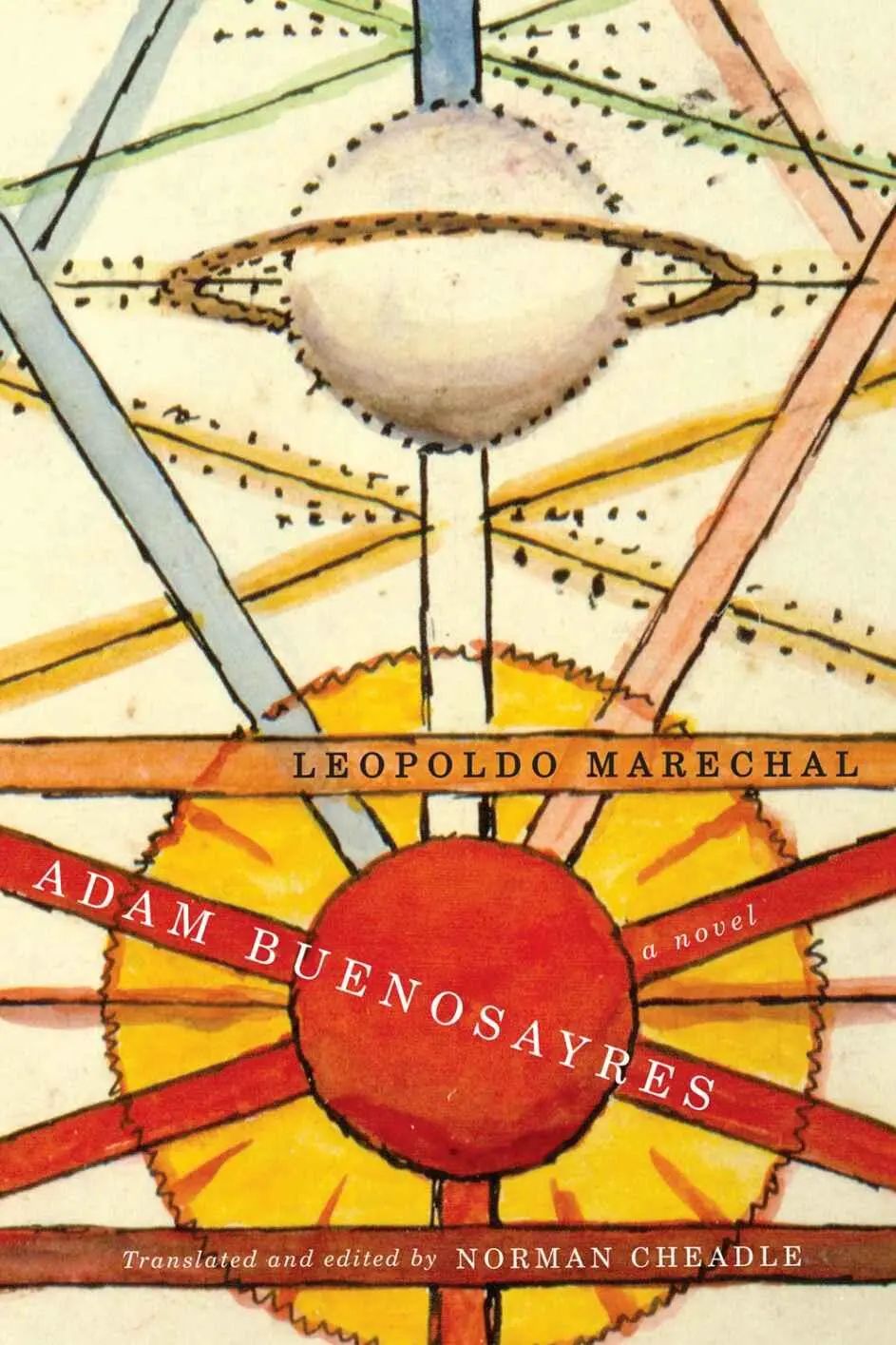
- Название:Adam Buenosayres
- Автор:
- Издательство:McGill-Queen's University Press
- Жанр:
- Год:2015
- ISBN:нет данных
- Рейтинг книги:5 / 5. Голосов: 1
-
Избранное:Добавить в избранное
- Отзывы:
-
Ваша оценка:
Adam Buenosayres: краткое содержание, описание и аннотация
Предлагаем к чтению аннотацию, описание, краткое содержание или предисловие (зависит от того, что написал сам автор книги «Adam Buenosayres»). Если вы не нашли необходимую информацию о книге — напишите в комментариях, мы постараемся отыскать её.
Adam Buenosayres — читать онлайн бесплатно полную книгу (весь текст) целиком
Ниже представлен текст книги, разбитый по страницам. Система сохранения места последней прочитанной страницы, позволяет с удобством читать онлайн бесплатно книгу «Adam Buenosayres», без необходимости каждый раз заново искать на чём Вы остановились. Поставьте закладку, и сможете в любой момент перейти на страницу, на которой закончили чтение.
Интервал:
Закладка:
Around that time, as I recall, my heart (due to its vigilance or the tension of waiting and hoping) was so full it would dissolve in tears at the slightest brush, like a moist little leaf at the lightest breeze. A mere look from man or woman, the timbre of a voice passing by, a colour or a gesture were enough to set off a sweet flood of tears in my heart. And it was because, by coming out of herself now and contemplating the world with eyes of love, the soul not only suffered but also came to suffer with , as though she were suddenly finding in the countenance of the other creatures something reflecting, resembling, or corresponding to her own enigma. And, I recall, it was around then that I had an extraordinary dream, whose exact meaning I grasped only later:
I found myself in an immense wasteland and in the middle of a night so deep that not a vestige of form or colour could be distinguished in either earth or sky. And as I tried to advance through the desolate place, it seemed to me huge columns of darkness were plummeting noiselessly down upon my head, and I could not lift my feet free of the sandy ground I was walking on; all of which plunged me, struggling, into a desperation as limitless as the nocturnal wasteland holding me prisoner. Thus lost in that clime of terror, I seemed to see a marvellous human figure suddenly rise up beside me and begin to look at me in a way no earthly eye had ever done. The face of that admirable gentleman was resplendent with so much light, so much power was in his beauty, and so much glory in his majesty, that my whole being was moved and began to forget its terrors, converted entirely to the grace in that vision. And I felt, in my dream, that in the presence of this Man there awoke in my memory the notion of I know not what lost flavours, what faraway music. And I felt, upon recognizing him, that my mind knew itself for the first time in the Man, and my will wanted to surrender, offer itself to him as a banner of love. Then, it seemed, he spoke to me in a fiery idiom, and since I did not understand the words of fire issuing from his mouth, the Man began to walk in the blackness, and I followed him, afraid of losing him. Then I seemed to see a miracle unfold: no sooner had the Man stopped walking than burning suns, pink moons, and golden comets took shape behind him, in the pure sky, until the night was transformed into a splendid noontide; and the wasteland, at the mere touch of his feet, turned into a most pleasant garden where, amid the flowers, thronged bright and nimble beings who, seeking one another, joined to dance in a thousand rounds. And it seemed that my eyes, upon seeing such beauty as was manifest in the garden, began to wander away from the Man leading me, and that my heels began to tarry near the circles of dance; until I felt as though I were caught up in the whirlwind of the fiesta and completely given over to its magic and madness. But, at the peak of my rapture, a chill wind seemed to blow over the garden, and forms, colours, and sounds all grew suddenly old; and the earth withered like the leaf of a tree; and suns, comets, and moons were going out like lamps at the end of a party. It happened then that, finding myself again in the night and on the barren plain, I looked for the Man who had previously appeared before my eyes. And as I did not find him, I wept, in my dream, with so much sorrow that at last I awoke and saw the reality of my lament.
V
I know not how much longer my soul lived that way, making real in dreams what wakefulness denied her. And still she knew not whether she waited in hope or despair, when there dawned for her a day exceedingly beautiful and open to all revelations. She was waiting, as I said, with her ear attuned to the world’s sounds, when suddenly it seemed to her that invisible brass instruments rang out in the springtime and that all creatures, putting aside their silence, began to raise their voices and express themselves in an idiom both direct and passionate. That language had the mettle of the voice of beauty, the “voice that calls.” And since the call of beauty is the call of love, and love tends toward happiness, it is no wonder my soul felt moved and jubilantly saluted the advent of those voices. What good fortune! So very recently, the soul had been wanting a call of love that might set her in motion, and now here were thousands of calls resounding in her ears, as though the earth had begun to sing through the myriad mouths of her creatures! So very recently, the soul, alone, had been asking for a Friend who might relieve her solitude, and now she recognized, in all those calls, the voices of a hundred friends inviting her from without!
Thus did my soul emerge from her first immobility, on a day not lost to memory. When she steered her movement toward creatures exterior to herself, her course did not follow a straight line but spiralled outward, plucking her from her centre, leading her further and further away in ever-widening revolutions around the centre. And I emphasize the nature of her movement so that my reader (should these pages of mine ever have one) may follow the soul on her path of love and surmount the obscurity, more apparent than real, of her story. 3I said she distanced herself from her centre in each revolution of the spiral; I say now that, from call to call and from love to love, she went so far away that she eventually lost and forgot herself. In forgetting her own essence, she was converted to the essence of what she loved; a singular being, she found herself divided into the multiplicity of her loves.
VI
If the strings I plucked so vehemently in those days were still faithful to my hands, at this point of the story I would raise a song of labyrinthine loves, a disorderly drunk of a song, tottering like a grape-picker at noon. Tumbling here, getting up again there, never steady on her feet of wind, wondrously lost among her loves, thus walked my soul for so many years. I said that she forgot her form so as to take on the form of what she loved. And, through an astonishing deceit, she thenceforth gave the name “life” to that which meant her own death; in the belief that she was living, she went on dying in every one of her loves. But a science of travel was developing within her: a wisdom based on the negative gesture with which creatures responded to her loving solicitude. For, in creaturely loves, she sought happiness, a terminus, a place of repose; but it turned out that her appetite was not assuaged, nor her pleasure fulfilled. Hence, she now began to understand the failure of her loves. Now, my soul knew her movement was legitimate; and, assessing the situation, she came to suspect the failure was due not to the nature of her movement but to its direction. And she started to wonder now whether her vocation to love might not be incalculably disproportionate to the love of creatures.
Little by little, whether as a result of her fatigue or her maturity in the art of disappointment, my soul began to check her movements, to restrain herself, to tarry. Until she came to a halt by herself at the centre of the labyrinth. And just as the hunter who, upon realizing he’s lost deep in a wood fearfully pauses and tries to retrace his steps, so did my soul urgently feel the need to make the return trip back to her first intimacy. I have already recounted how she strayed from her essence following a centrifugal spiral, a movement that in one sense took her away from her centre, but in another sense maintained her in orbit around that centre and subject always to the law of its attraction. Now I declare that, to that same gravitational force, my soul owed not only the limit of her dispersion but also the will to return, which was initiated according to the trajectory of a centripetal spiral whose effects were not long in showing themselves. For, if the soul had been divided in the multiplicity of her loves, now, upon escaping from the prison gilded by creatures, she was recovering her dispersed parts and reconstructing her graceful unity. And if, in wandering from her centre, she lost intelligence of herself, in returning she found her own image already there before her; facing that image, her mind came back to life, as if for a second springtime of meditation. She was returning: she returned at last. Until finally she was immobile before her centre.
Читать дальшеИнтервал:
Закладка:
Похожие книги на «Adam Buenosayres»
Представляем Вашему вниманию похожие книги на «Adam Buenosayres» списком для выбора. Мы отобрали схожую по названию и смыслу литературу в надежде предоставить читателям больше вариантов отыскать новые, интересные, ещё непрочитанные произведения.











Обсуждение, отзывы о книге «Adam Buenosayres» и просто собственные мнения читателей. Оставьте ваши комментарии, напишите, что Вы думаете о произведении, его смысле или главных героях. Укажите что конкретно понравилось, а что нет, и почему Вы так считаете.