Leopoldo Marechal - Adam Buenosayres
Здесь есть возможность читать онлайн «Leopoldo Marechal - Adam Buenosayres» весь текст электронной книги совершенно бесплатно (целиком полную версию без сокращений). В некоторых случаях можно слушать аудио, скачать через торрент в формате fb2 и присутствует краткое содержание. Год выпуска: 2015, Издательство: McGill-Queen's University Press, Жанр: Классическая проза, на английском языке. Описание произведения, (предисловие) а так же отзывы посетителей доступны на портале библиотеки ЛибКат.
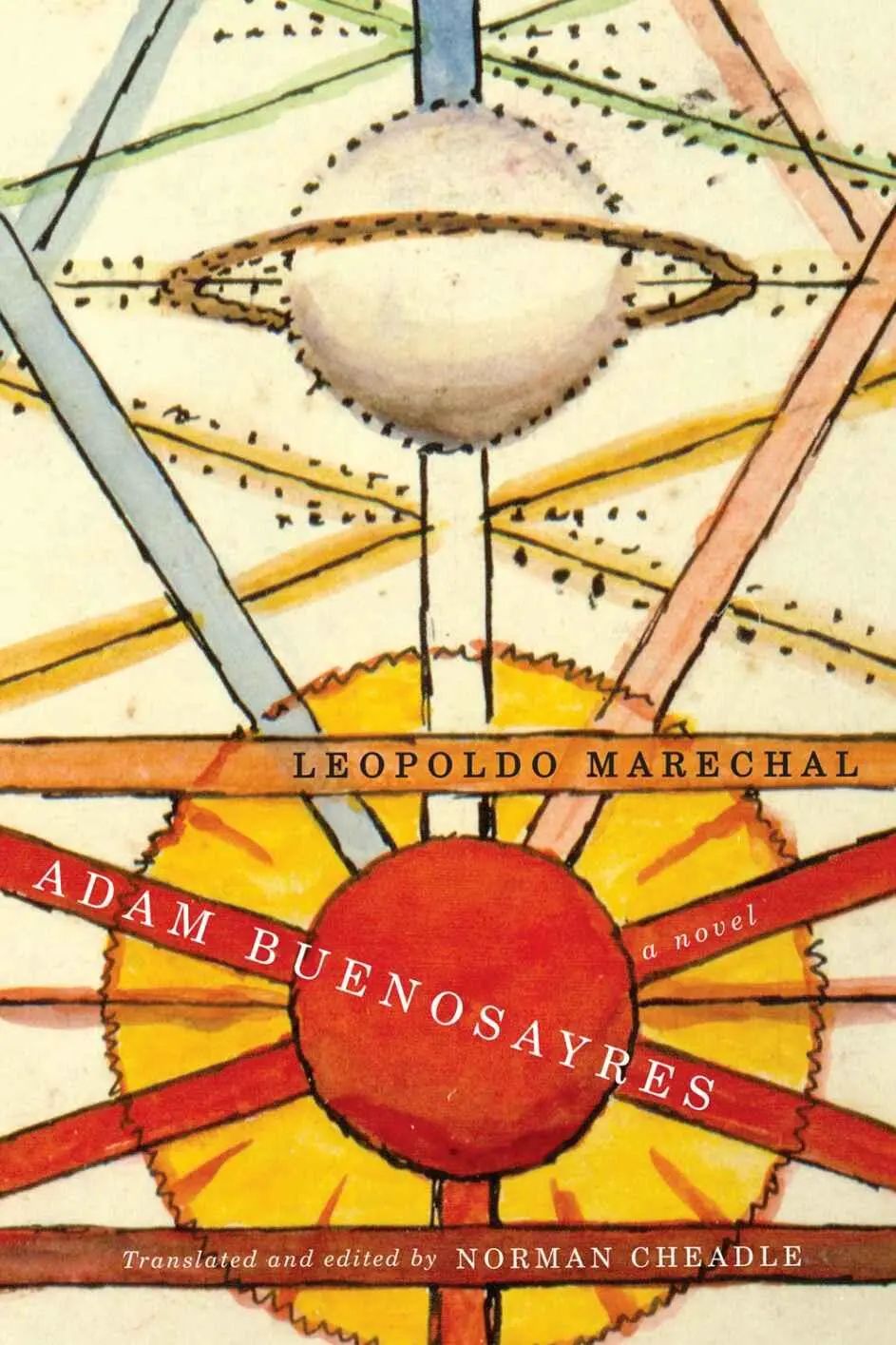
- Название:Adam Buenosayres
- Автор:
- Издательство:McGill-Queen's University Press
- Жанр:
- Год:2015
- ISBN:нет данных
- Рейтинг книги:5 / 5. Голосов: 1
-
Избранное:Добавить в избранное
- Отзывы:
-
Ваша оценка:
Adam Buenosayres: краткое содержание, описание и аннотация
Предлагаем к чтению аннотацию, описание, краткое содержание или предисловие (зависит от того, что написал сам автор книги «Adam Buenosayres»). Если вы не нашли необходимую информацию о книге — напишите в комментариях, мы постараемся отыскать её.
Adam Buenosayres — читать онлайн бесплатно полную книгу (весь текст) целиком
Ниже представлен текст книги, разбитый по страницам. Система сохранения места последней прочитанной страницы, позволяет с удобством читать онлайн бесплатно книгу «Adam Buenosayres», без необходимости каждый раз заново искать на чём Вы остановились. Поставьте закладку, и сможете в любой момент перейти на страницу, на которой закончили чтение.
Интервал:
Закладка:
At the same time, those emotions were gradually awakening a lively urge to express myself, an irrepressible desire to speak the same creaturely language with which I was becoming enamoured. Already, in the garden and orchard of Maipú, I had noticed that beauty inspired two phases of inspiration, and I observed their unfolding within me: a euphoria melting into tears, and the birth of a musical idea striving to emerge from within and become manifest. Since I at first had no art whatsoever at my disposal, I resorted to incoherent words or free-form phrases, not for what they meant in themselves, naturally, but rather for the intentional value I assigned them, according to the case. Thus a single phrase, solely for its musical power of suggestion, might translate the most conflicting emotions of my spirit. For example, “the rose, the pure rose, the emaciated rose” was a phrase I used to utter in all the nuances of grief or jubilation. Later, art succeeded chaos, and musical order replaced incoherence. I won’t enumerate here the many hardships and sleepless nights that the practice of song cost me. I’ll recall only that one morning, reading my composition in class, Don Bruno exclaimed to the children: “Adam Buenosayres is a poet.” The pupils stared at me without understanding. But I knew very well what those grave words meant and I blushed with embarrassment, as if stripped naked in public. I was fourteen years old.
III
Anecdotes of the usual sort will not abound in this Notebook, for its purpose has been to trace the story not of a man, but of his soul. And if the previous paragraph was illustrated by a few childhood episodes, it is because they reveal the two or three movements of my soul which, from an early age, become reiterated with varying intensity throughout the history of that soul. The depiction of these movements will henceforth demand, then, the idiom of geometry, or the imprecision of the symbol, or the colours of visions and dreams. All of which means my work will resemble the development of a theorem or the consideration of an enigma.
I said at the outset that my soul, as soon as she found her first solitude, went motionless at the centre of the wheel. And since from there she observed all creatures moving gracefully and obeying an exact rhythm, my soul began to wonder what would be her own movement, her natural rhythm, given that movement and rhythm was in all things, from the round animals of the sky that I saw moving at night to the tiniest creatures whose movements I studied in the orchard at Maipú. Nevertheless, whether because no one was guiding her or because she had not yet reached maturity, my soul had no answer and no way to ask for one. And the uncertainty of her destiny then began to afflict her in such a way that finally, in looking at herself, her eyes filled with tears; which occasioned both astonishment and the dawn of wisdom, as if the thread of her lament and that of her meditation started at the same time and thenceforth were as one; for, in weeping, the soul discovered she had not been born to weep and, in suffering, attained suddenly her vocation for joy. True, she was unaware of the origin and purpose of that vocation, for no one had told her; her misery wanted her to discover it for herself, by falling and getting back up, a thousand times in the darkest of labyrinths.
For the time being, though at the price of her lament, the soul knew her natural vocation. And knowing it, she not surprisingly wondered about the cause of a heartache such as hers, which was so contrary to the instinct for happiness tugging at her incessantly. Thus, contemplating her sorrow and regarding herself one day in the bitter mirror of her tears, she saw herself alone and immobile; and as her lament intensified at the sight of such solitude and repose, the soul clearly understood she had not been born to be alone or to live motionless, and this gave her a new subject to consider. For, if solitude was not for her, then this was proof that she had a companion, in the person of either a loved one or a friend; and if sadness was countering her vocation for delight, it was but a short step to understand that the terminus of her search for happiness was in that Friend for whom her solitude clamoured. At this point, she was beset by new doubts, as she wondered whether it was up to her to seek out the unknown Friend, or whether it was the Friend who ought to come to the soul in solitude. But right away she noticed that her repose was as painful as her solitude; when she rejected the stillness in which she found herself, she not only discovered she was destined to travel but also saw the figure of the Friend as the end and goal of her possible movement.
Much had my soul gained by thus beginning her meditation, and much yarn remained to be unwound from the skein. Now, certainly, she understood the possibility in her movement; but she was still ignorant of her natural means of transport, since in looking at herself again and again, she found in herself neither wing nor foot nor wheel with which to move. On the other hand, even if she had found the means of mobility she needed, she would not have known which direction to take, since she knew nothing at all about the Friend — neither his name, nor his form, nor his virtue, nor his abode. Henceforth the soul wandered as if lost between two unknowns: that of her own movement and that of the intuited Friend. But she could see no solution either within herself or without; which was why she embarked upon a long and studious vigil, always alone in the group of gathered beings, always immobile in the circle of those who moved. And so I wish to paint her, with a finger on her temple and her eyes moist, faithful to herself like the rose amid its thorns. For thus she was, on that beautiful and terrible day of her springtime, when she looked at herself and saw the wing of a dove being born.
A dove’s wing sprouted from her shoulder, I say, and the novelty of her feathers amazed the soul at first and stimulated the exercise of her mind, as she reflected now on the sign of the wing, now on the number of the dove. And if the nascent wing spoke to her of the potential for flight, the number of the dove announced she was destined to love. So it was that she at last discovered the nature of her movement in the loving transports so clearly being promised her. But she was not long in noticing that the loving transport requires not only a moveable Lover but also an immobile Beloved; nor did she take long to observe that, if the capacity of the Lover was in all certainty within her, the figure of the Beloved remained hidden from her, as though the wing’s moment were still far away.
IV
Henceforth my soul lived in a twilight state that might equally have been the prelude to a night or the dawn of a morning. While her understanding had enlightened her will, pointing out to it not only a means of transport but also the necessary existence of a Beloved toward whom she ought to move, the will was nevertheless unable to emerge from its immobility; for, even though it knew of him, it did not yet know the flavour of the Beloved; and since it was missing the flavour, its appetite was as if vacant; and when the appetite is vacant, the will does not stir itself; above all when its wing is that of a dove. I say, then, that her will remained motionless. At the same time, she held her peace, and her mind was falling asleep for lack of any new subject on which to place its attention. For this reason, the soul found herself doubly immobile, with no other action than that of her wakeful eyes and no other life than her impatience. She clearly divined, however, that if the Beloved existed (as her understanding let her know), he would not fail to show himself at some point, nor to call her name. Now, the soul did not know her true name; nor was she acquainted with the voice of the Beloved who would pronounce that name; and yet she was quite sure she would recognize the name and the voice as soon as they made themselves heard. As she waited for that to come to pass, she revolved around herself, listening closely to the murmurs of the earth; and as she revolved, she extended her wing of love, like one who lets a feather flutter in the air so as to find out from what quarter the wind may come. But everything around her was mute; no calls came from the earth, and the soul had no invitations.
Читать дальшеИнтервал:
Закладка:
Похожие книги на «Adam Buenosayres»
Представляем Вашему вниманию похожие книги на «Adam Buenosayres» списком для выбора. Мы отобрали схожую по названию и смыслу литературу в надежде предоставить читателям больше вариантов отыскать новые, интересные, ещё непрочитанные произведения.










Обсуждение, отзывы о книге «Adam Buenosayres» и просто собственные мнения читателей. Оставьте ваши комментарии, напишите, что Вы думаете о произведении, его смысле или главных героях. Укажите что конкретно понравилось, а что нет, и почему Вы так считаете.