Hannah Smith - Erdogan Rising
Здесь есть возможность читать онлайн «Hannah Smith - Erdogan Rising» — ознакомительный отрывок электронной книги совершенно бесплатно, а после прочтения отрывка купить полную версию. В некоторых случаях можно слушать аудио, скачать через торрент в формате fb2 и присутствует краткое содержание. Жанр: unrecognised, на английском языке. Описание произведения, (предисловие) а так же отзывы посетителей доступны на портале библиотеки ЛибКат.
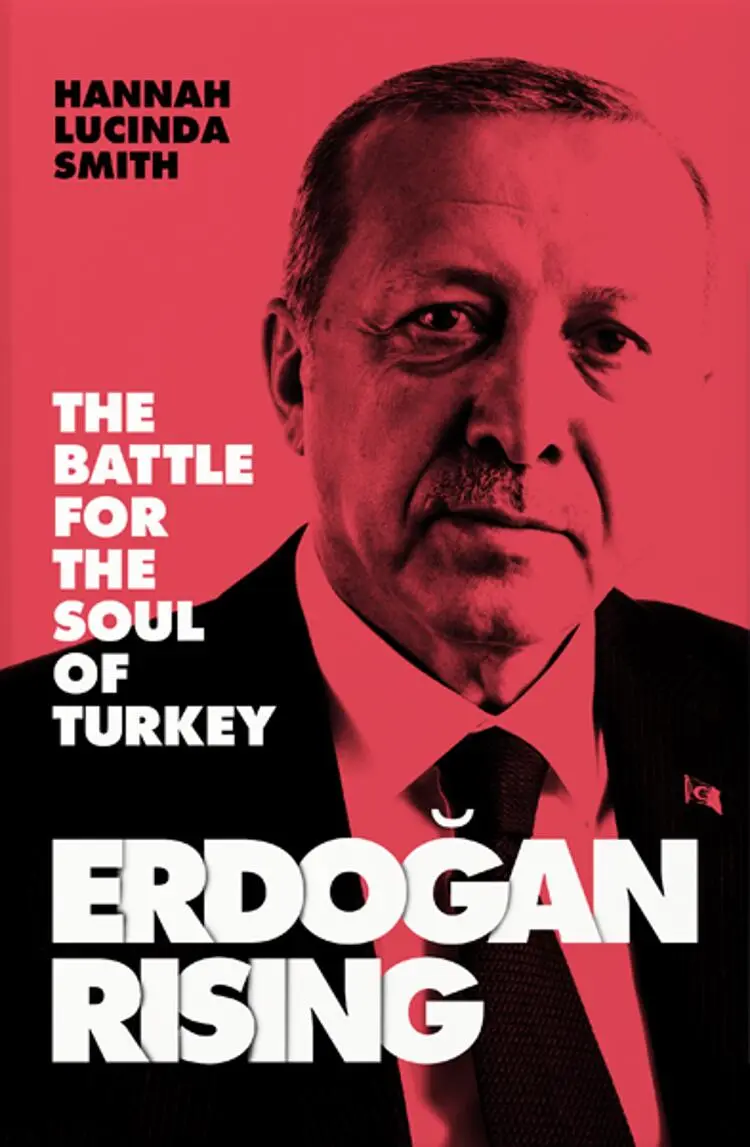
- Название:Erdogan Rising
- Автор:
- Жанр:
- Год:неизвестен
- ISBN:нет данных
- Рейтинг книги:4 / 5. Голосов: 1
-
Избранное:Добавить в избранное
- Отзывы:
-
Ваша оценка:
Erdogan Rising: краткое содержание, описание и аннотация
Предлагаем к чтению аннотацию, описание, краткое содержание или предисловие (зависит от того, что написал сам автор книги «Erdogan Rising»). Если вы не нашли необходимую информацию о книге — напишите в комментариях, мы постараемся отыскать её.
Erdogan Rising — читать онлайн ознакомительный отрывок
Ниже представлен текст книги, разбитый по страницам. Система сохранения места последней прочитанной страницы, позволяет с удобством читать онлайн бесплатно книгу «Erdogan Rising», без необходимости каждый раз заново искать на чём Вы остановились. Поставьте закладку, и сможете в любой момент перейти на страницу, на которой закончили чтение.
Интервал:
Закладка:
‘I remember that after the Berlin wall came down and the Soviet Union disintegrated, there were hopes from Turkish nationalists and even centre-right parties to bring in their brothers through Central Asia under the Turkish umbrella, sort of a near abroad for Turkey,’ says a US lobbyist who has previously worked for the AKP government. ‘They were going to go as far east as the Chinese border. Those hopes were quickly dashed because seventy years of communism takes its toll – their plans did not work out. But there was still a soft power idea more modestly expressed. The Gülenists were seen as a useful tool. And the Gülenists wanted to do it. It was a win-win situation, and it only became a liability later. It’s funny because for years it was a Turkish foreign policy priority to get these schools up and running. Now the priority is to close them down.’
In those early AKP years Erdoğan was happy to piggyback on the Gülenists’ established networks. His party was electorally strong but institutionally weak, and facing a hostile state and military dominated by the Kemalists. There were few AKP people working within the bureaucracy – this was, after all, the party that had risen from the fringes, and was only now making its way to the centre. The army wanted to bring Erdoğan down. Much of the judiciary wanted to bring him down. The only way he – and his party – could survive was to build alliances.
‘After the AKP came to power in 2002, I, like many others, was hearing informal reporting that the Gülenists were being recruited more and more in some government departments, especially in the police and the judiciary,’ says one former parliamentary deputy. ‘I tried to collect some information on such informal reporting, but I couldn’t get much reliable results. In one case I talked to an ex-Minister of Interior who had recently left that position, asking if it were true that large numbers of Gülenists were being recruited to the police. He said yes, to some extent it was true, but rhetorically asked “what could I do when those people performed much better than others in the entrance tests and examinations?”’
The liberals
Erdoğan’s alliance with the Gülenists was only one among many. The AKP was also reaching out to liberal, anti-army activist groups, and to members of the secular opposition who had grown tired of their stale old parties. Many joined up with the AKP right at the start in 2001. Süleyman Sarıbaş, a lawyer who had been a deputy in Turgut Özal’s Anavatan Party (Motherland Party, or ANAP) since 1983, signed up shortly before the elections of November 2002. Erdoğan personally approached him to join the party. Sarıbaş agreed, despite some misgivings about Erdoğan’s character.
‘I regarded Erdoğan as a civilian, but he never completely retained Western values,’ Sarıbaş says. ‘He was emotional and easily scared. Timid. His lifestyle was something between an urban lifestyle and the provincial rural lifestyle. He was very much in the middle. I will give you one example. He would pull out his Swiss army knife from his pocket and clean his teeth with it. He is a villager in that sense. But he has been raised in Istanbul and he is very urban at the same time. In the period I met him, he was being judged. He had court cases against him. He was afraid about being arrested. After he became the chairperson of the AKP there was a court case against him about his property. He seemed to have too much property and it was not clear how he had managed to own it all. He said that it was the gold belonging to his children that he had exchanged. At about five p.m. we went to see the prosecutor and he wanted to put him under arrest. They were about to close the court. The judge arrived a little bit late on that day. We waited for half an hour for the judge to arrive. Erdoğan was white at the fear of being arrested.’
Sarıbaş joined the AKP because it seemed, in 2002, to offer a reformist agenda. Within three years he had left it again, part of the party’s first mass wave of resignations. He was one of thirteen deputies who quit between February and April 2005, throwing the AKP into its first real crisis. Erdoğan was already showing himself to be ‘fretful and ill-tempered’, according to an AFP report on the mass exit of members. On resigning, Sarıbaş said that the party was not truly committed to EU-focused reform, and that its inner workings were corrupt and authoritarian. Musa Kart, a cartoonist at Cumhuriyet , a secularist newspaper, depicted the prime minister as a cat tangled in a ball of yarn as the crisis in his party grew. Erdoğan sued him for $3,500. He also called the defectors ‘the rotten apples in the bag’.
The mass of remaining deputies seemed willing to overlook any growing disquiet about Erdoğan’s character. The AKP survived its 2005 crisis, and two years later scored a huge victory over its old enemy, the army – and over the CHP, the largest opposition bloc in parliament. In May that year, the generals threatened a coup over the nomination of AKP founder Abdullah Gül as president. The constitutional court took up the thread and started a case to close down the AKP. Gül is a moderate Islamist and a pro-European. The army’s problem with having him as president? His wife wears the Islamic headscarf.
Erdoğan called their bluff and called a snap election. The AKP won overwhelmingly, affirming the people’s support for the democratically elected government over the self-appointed secularist saviours. Tens of CHP deputies and hundreds of rank-and-file members left their party and joined the AKP.
‘The AKP between 2002 and 2007 seemed to be following a reformist political line,’ says Haluk Özdalga, a CHP deputy who was among those who crossed the floor. ‘We had extensive consultations with party people, and a majority supported the idea of going over to the AKP. In Ankara, which is my political district, a couple of hundred CHP members followed with us, and they gradually got various elected positions within the AKP organisations. This flow of members from the CHP to the AKP continued until approximately 2011. I consider myself as a social democrat, and at that time the AKP stood ideologically closer to me than the CHP. That may sound a little unusual for those not knowing the CHP and the AKP of that time. Many social democratic politicians in Europe at that time felt the same way. The AKP appeared to be structurally a more democratic party, not dominated by a single person.’
Another of the nine who joined in 2007 was Ertuğrul Günay, a CHP veteran who had left the party in 2004 and was in parliament as an independent. Günay believed he saw in the AKP the promise of a new type of Turkish politics. Erdoğan appointed him minister of culture.
‘It was directly from Erdoğan that I received a proposal to join the AKP,’ Günay says. ‘After a few meetings, and after consulting my friends, I accepted. During its first term in government the party was promising on the issues of democracy, social welfare and pluralism. CHP as the only opposition party in the parliament followed a much more conservative line about the issues of EU and pluralism – I know many “leftists” from the CHP who thought that the EU would divide Turkey. I had hoped that with the AKP, a new social movement in Turkey would form itself, leading to the rise of a progressive politics that would be at peace with the values of the people.’
Erdoğan at that time was a man willing to take criticism, to listen to others, and to learn: ‘well-intentioned and sincere about democracy’, according to Günay. One diplomat said that in his early years as prime minister Erdoğan would arrive at meetings with a stack of notecards on the issues to be discussed. Another said that he was ‘one amongst many important people in the system … more equal than anybody else but there were other players who argued with him, whether Abdullah Gül, Abdüllatif şener [another AKP founder, who left the party in 2007], or Ali Babacan [economy minister]. These other voices were from smart individuals, who had come into government with a lot more experience on a world stage than Erdoğan. He relied on them. He trusted them and respected their advice and judgement.’
Читать дальшеИнтервал:
Закладка:
Похожие книги на «Erdogan Rising»
Представляем Вашему вниманию похожие книги на «Erdogan Rising» списком для выбора. Мы отобрали схожую по названию и смыслу литературу в надежде предоставить читателям больше вариантов отыскать новые, интересные, ещё непрочитанные произведения.








Обсуждение, отзывы о книге «Erdogan Rising» и просто собственные мнения читателей. Оставьте ваши комментарии, напишите, что Вы думаете о произведении, его смысле или главных героях. Укажите что конкретно понравилось, а что нет, и почему Вы так считаете.