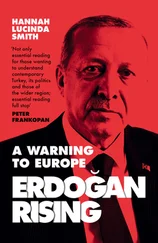
Hannah Smith - Erdogan Rising
Здесь есть возможность читать онлайн «Hannah Smith - Erdogan Rising» — ознакомительный отрывок электронной книги совершенно бесплатно, а после прочтения отрывка купить полную версию. В некоторых случаях можно слушать аудио, скачать через торрент в формате fb2 и присутствует краткое содержание. Жанр: unrecognised, на английском языке. Описание произведения, (предисловие) а так же отзывы посетителей доступны на портале библиотеки ЛибКат.
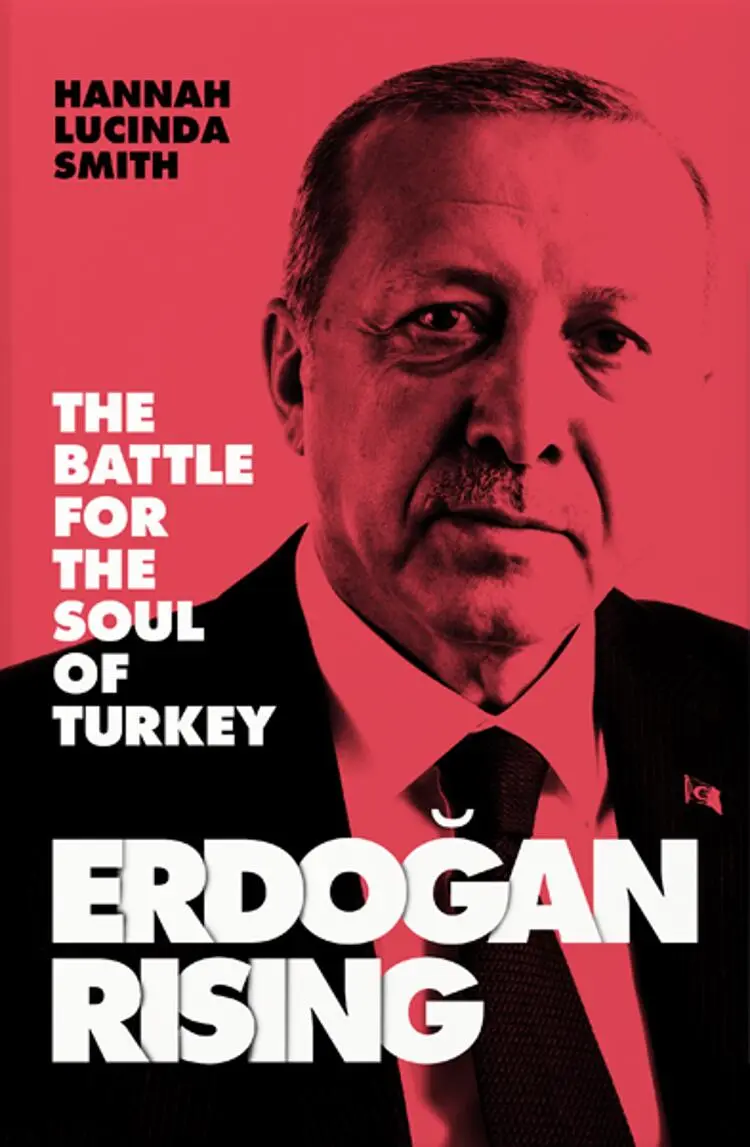
- Название:Erdogan Rising
- Автор:
- Жанр:
- Год:неизвестен
- ISBN:нет данных
- Рейтинг книги:4 / 5. Голосов: 1
-
Избранное:Добавить в избранное
- Отзывы:
-
Ваша оценка:
Erdogan Rising: краткое содержание, описание и аннотация
Предлагаем к чтению аннотацию, описание, краткое содержание или предисловие (зависит от того, что написал сам автор книги «Erdogan Rising»). Если вы не нашли необходимую информацию о книге — напишите в комментариях, мы постараемся отыскать её.
Erdogan Rising — читать онлайн ознакомительный отрывок
Ниже представлен текст книги, разбитый по страницам. Система сохранения места последней прочитанной страницы, позволяет с удобством читать онлайн бесплатно книгу «Erdogan Rising», без необходимости каждый раз заново искать на чём Вы остановились. Поставьте закладку, и сможете в любой момент перейти на страницу, на которой закончили чтение.
Интервал:
Закладка:
Seçgin is part of a wave of pious businessmen who have made it big in Erdoğan’s Turkey. Halalbooking.com, the business he co-founded in 2009, is an online holiday booking service aimed at observant Muslims. It is a fast-growing market; Halalbooking.com is currently valued at $60–70 million.
In May 2017 – the start of his most successful season to date – I accompany Seçgin on a tour of the halal resorts of Antalya alongside two dozen businessmen and women, all of them European Muslims. Thirty-six-year-old Songül, a stylish German-Turk from the city of Bremen, donned the Islamic headscarf and started practising her religion by the book six years ago after the birth of her two daughters. It was only then that she realised the dearth of lifestyle brands aimed at middle-class Muslims – and so she became one of the pioneers. Songül started her online bookings business in 2016, and still had only one competitor in the online halal tourism sector in Germany a year on.
‘It was a boutique industry before, all very expensive,’ says Songül. ‘You would either hire a private villa or go to exclusive resorts where it costs around four thousand euros for a family holiday for one week.’
Over four days, Seçgin leads us on a tour of the new wave in pious holidaymaking – the mass-market halal hotels. The Bera, the first to be awarded halal status in Turkey, is our first stop. The sweet smell of hookah smoke wafts through the cavernous lobby, and a wide panorama of Istanbul’s Bosphorus Bridge with a mosque in the foreground hangs behind reception. The Bera is owned by a conglomerate with ties to Erdoğan: when he was mayor of Istanbul, the municipality sold it a piece of prime real estate in the heart of the city for a fraction of its true value. The television screens are showing ATV, a pro-Erdoğan channel, and Yeni şafak and Sabah , its newspaper equivalents, are propped up in a rack by the door. On leaving, I am handed a gift: an encyclopaedia of Ottoman history.
Otherwise, The Bera is just like any other package resort: filled with hyped-up small children and parents who look as if they’ve been craving this holiday since they flew home from the last. I ask a couple from Preston who are slumped in the lobby’s comfy chairs as their two tiny girls scoot around whether they thought twice about a holiday in Turkey after the coup attempt and terrorist attacks.
‘We’ve not really heard about those,’ the mother tells me, clearly wishing I would move on so she can relax. ‘We just came here last year and we liked it, so we decided to come again.’
The food at the buffet is halal – but otherwise no different to any other resort. In my comfortable, clean room I find not a Gideon Bible and a minibar stocked with beer and wine but a Quran and a Qibla , an arrow stuck to the ceiling to show the direction of Mecca. At reception in the women’s spa and beach area I am frisked by a (female) security guard and stripped of my phone and camera before being gestured through smoked-glass doors. Through the changing rooms and treatment suites, the path leads out onto a fifty-metre stretch of beach surrounded by billowing curtains of fabric hung between flagpoles thirty metres high. You cannot see out to the sea – the view is blocked by the sails, although the water can still lap in underneath. The women wear reasonably conservative bikinis on this boxed-off beach, even after being freed of the male gaze. I ask one if it bothers her that she cannot contemplate the horizon as she sunbathes.
‘But if it was open, the men could look at us as they come past on boats and jet-skis,’ she replies.
In the lobby that evening, as we relax with tea and flavoured tobacco, I ask Seçgin how the drop in visitor numbers to Turkey since last year’s coup attempt has affected his business. He looks at me as if I were crazy.
‘Drop?’ he replies. ‘Last year we doubled our business, and this year we doubled again!’
By 2017, Turkey has risen to become the world’s third most popular destination for halal travellers, a four-place rise on the year before (only Malaysia and the UAE score higher). In a global halal tourism market now worth $151 billion annually, Turkey dominates the beach-holiday sector. The country accounts for a disproportionate amount of the hotels listed on Halalbooking.com, not out of a conscious effort on Seçgin’s part but simply because Turkey is the place with the best-developed concept of what an all-inclusive halal holiday means. This, after all, is an evolution of the model the Turks have been fine-tuning on booze-soaked European tourists since the 1980s.
‘Turkey is the centre of package resorts,’ Seçgin continues. ‘At the lower end there are the mass-market resorts. And at the high end in the halal market there’s the Angels Resort, where the rooms start at three hundred and fifty euros a night. I have one customer from Ukraine this year – he booked six weeks there and spent thirty-one thousand euros!’
But this is Turkey. And here, the sacred always comes with a side serving of the profane.
The original pioneer of the country’s now-booming Islamic leisure sector is the unlikely Fadıl Akgündüz, who goes by the nickname ‘Jet’ and is a conman of such confidence that every time he is released from prison he starts plotting his next swindle. Most recently, he served fifteen months for a libel conviction after he claimed that the governor of an Aegean province had tried to assassinate him in a car crash. Before that, he defrauded hundreds with dodgy timeshare deals, and back in the late 1990s he collected millions of pounds from investors, many of them Turks in the European diaspora, for a construction project in Ankara that never materialised. Before that, though, he launched his first and only successful project: Turkey’s first halal holiday resort.
The Caprice Hotel in the Aegean seaside town of Didim is a monstrosity of glass and plastic façades that looks, at a distance, like the stern of a sinking cruise ship. Inside, it is pure neo-Baroque. The domed ceiling of its lobby is painted with tulip motifs in the style of the old mosques of Istanbul. Its floor is inlaid with gold mosaics. Like any other hotel catering to the mass tourism market, it has an all-you-can-eat buffet every mealtime, a huge swimming complex and spas, and a path leading straight to the beach. There are also à la carte restaurants serving Chinese and Italian food, and a designer boutique offering some of Turkey’s top brands. Turkish stars perform in the hotel’s entertainment centre every week. The well-heeled tourists who stay here would have no reason to leave its gaudy confines, apart from acute claustrophobia. And if they are devout Muslims – as almost all of them are – they can relax safe in the knowledge that they will never miss prayer time.
Jet Fadıl Akgündüz opened the resort in 1996 with the strapline: ‘A modern vacation complex, where the call to prayer is heard five times a day.’ The idea of a hotel catering to the Islamic market was unheard of in Turkey at that time. It was the era when the Refah Party’s Necmettin Erbakan was prime minister and Erdoğan the mayor of Istanbul – but Erdoğan’s jailing and the toppling of Erbakan’s government in the ‘postmodern’ military coup of 1997 would remind everyone that the Kemalists were still in charge. Local residents in this largely secular part of Turkey were dismayed when Akgündüz bought what had once been a resort for debauched European tourists and turned it into a haven for the devout – but his business boomed. Muslims with money to spend had previously had to share their hotels with customers who followed totally different lifestyles: drinking alcohol, sunbathing in bikinis in mixed-gender areas, and disregarding the patterns of the Islamic day. Now, they could spend their leisure time in an environment just like that of their homes. In halal hotels, the swimming pool and spa areas are segregated by gender, there is no trace of alcohol anywhere, and prayer rooms are provided so that guests can slip straight from the poolside to the prayer mat.
Читать дальшеИнтервал:
Закладка:
Похожие книги на «Erdogan Rising»
Представляем Вашему вниманию похожие книги на «Erdogan Rising» списком для выбора. Мы отобрали схожую по названию и смыслу литературу в надежде предоставить читателям больше вариантов отыскать новые, интересные, ещё непрочитанные произведения.






Обсуждение, отзывы о книге «Erdogan Rising» и просто собственные мнения читателей. Оставьте ваши комментарии, напишите, что Вы думаете о произведении, его смысле или главных героях. Укажите что конкретно понравилось, а что нет, и почему Вы так считаете.