Hannah Smith - Erdogan Rising
Здесь есть возможность читать онлайн «Hannah Smith - Erdogan Rising» — ознакомительный отрывок электронной книги совершенно бесплатно, а после прочтения отрывка купить полную версию. В некоторых случаях можно слушать аудио, скачать через торрент в формате fb2 и присутствует краткое содержание. Жанр: unrecognised, на английском языке. Описание произведения, (предисловие) а так же отзывы посетителей доступны на портале библиотеки ЛибКат.
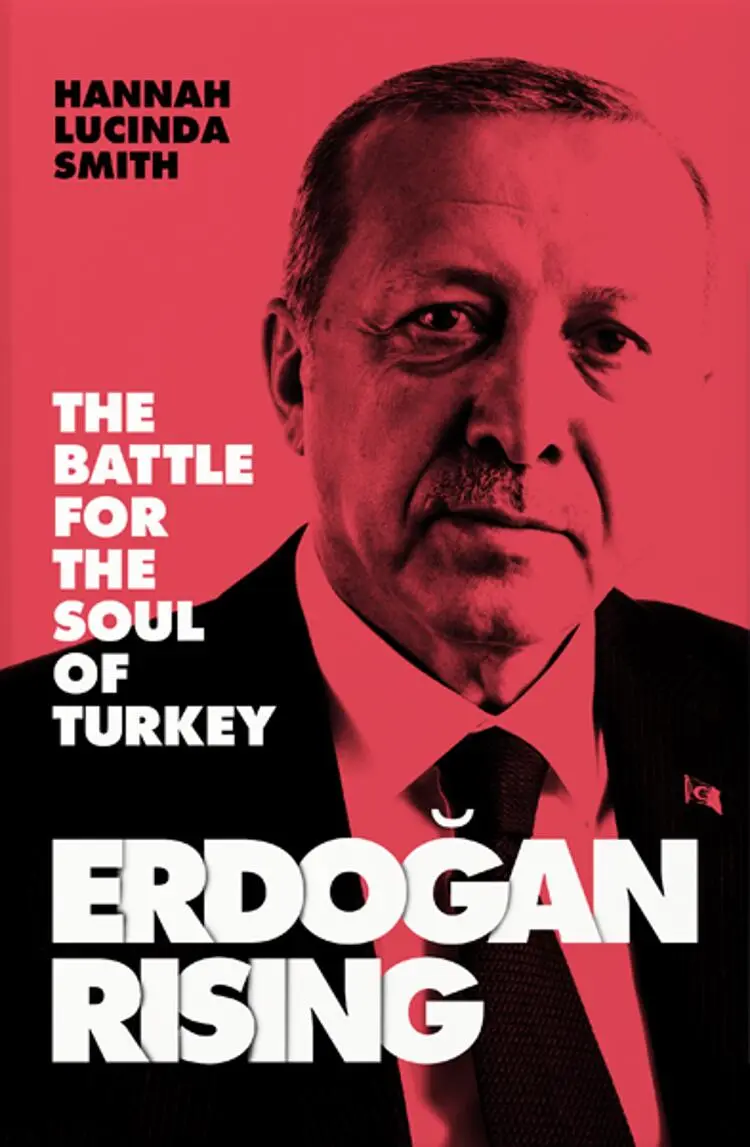
- Название:Erdogan Rising
- Автор:
- Жанр:
- Год:неизвестен
- ISBN:нет данных
- Рейтинг книги:4 / 5. Голосов: 1
-
Избранное:Добавить в избранное
- Отзывы:
-
Ваша оценка:
Erdogan Rising: краткое содержание, описание и аннотация
Предлагаем к чтению аннотацию, описание, краткое содержание или предисловие (зависит от того, что написал сам автор книги «Erdogan Rising»). Если вы не нашли необходимую информацию о книге — напишите в комментариях, мы постараемся отыскать её.
Erdogan Rising — читать онлайн ознакомительный отрывок
Ниже представлен текст книги, разбитый по страницам. Система сохранения места последней прочитанной страницы, позволяет с удобством читать онлайн бесплатно книгу «Erdogan Rising», без необходимости каждый раз заново искать на чём Вы остановились. Поставьте закладку, и сможете в любой момент перейти на страницу, на которой закончили чтение.
Интервал:
Закладка:
‘Our struggle was not so much about power, it was about a cause,’ Besli says, when I ask him what drove them to continue even when so much was stacked against them. ‘When you have a cause, you don’t give up just because you’re not in power. And when you’re a man of fate, you tell yourself that you have to struggle and the result will not be defined by you. You do what is necessary and leave the rest to Allah.’
We are twenty minutes into our conversation, yet it is the first time God has been mentioned. I can’t tell whether it is deliberate; however, when I later ask Besli what their biggest hurdle has been, he admits it was the fear and scepticism of Turkey’s secularist voters. He refers to them as the generation raised by the republic, brainwashed into rejecting their faith and their Eastern traditions in favour of a false affinity with the West. But he also says that a key part of his strategy with Erdoğan was to keep religion away from their image, so that they could broaden their appeal beyond the narrow, pious support base the MSP had commanded. When Erdoğan entered the mayor’s office, he signed a paper promising that no one would lose their jobs because of their political affiliations or be forced to adhere to Islamic rules. On the job, he won respect for his party’s technocratic efficiency.
Erdoğan’s early conciliations in the mayor’s office quickly gave way to a more combative tone. During a rally in the eastern town of Siirt in 1997 he read out a poem that blended nakedly Islamist metaphors with militaristic nationalism: ‘The mosques are our barracks, / The minarets our bayonets, / And the faithful our soldiers.’ The judicial system – dominated by Kemalists – seized the opportunity to take Erdoğan back down to where they believed he belonged. The mayor of Istanbul was sentenced to ten months in prison for inciting religious hatred. And he had already left the Refah Party, which was closed down anyway only eleven months later. But jail time proved the best image boost Erdoğan could have dreamed of.
Jail time
In 1999 the future Turkish president joined Johnny Cash and Tupac Shakur, and released an album from prison.
Bu şarkı burada bitmez (This Song Does Not End Here) – is a 35-minute compilation of Erdoğan reading poetry over a soundtrack of lilting Turkish melodies. Produced by Ulus Music, a label specialising in ‘introducing to the world the richness, colour and variety of Turkish music and same time making sure that the whole world can take advantage of our cultural preciousness’, the album remains widely available on CD and cassette on Turkish second-hand trading websites.
By the time the glamorous 43-year-old mayor of Istanbul broke with Refah and was sent to jail, he had already started an aggressive spin campaign to reinvent himself as Turkey’s number one Islamist. In the eleven months between his conviction and the start of his jail term, Erdoğan called his first major press conference. As mayor of Istanbul Erdoğan had almost always refused to speak with foreign journalists. Now, he needed the media to reboot his image for the world stage. So he invited a group of correspondents based in the city for a slap-up lunch at an upmarket restaurant serving hearty Ottoman-style food.
‘Why are you meeting with us now?’ asked one of the more cynical correspondents.
Erdoğan turned in surprise to his assistant, a pleasant young man who had always relayed his boss’s rejection of interview requests with an apologetic air. ‘Why didn’t you tell me these journalists have been wanting to meet with me?’ he berated the unfortunate bureaucrat.
It was, says one of the correspondents who was at the lunch, a transparent attempt to save face. ‘A charm offensive,’ was how another described it.
As the court case against Erdoğan dragged on, Istanbul city council turned its website into a protest page featuring messages of support and a link to the full text of his defence statement. By the time his appeal failed and he was finally sent to prison in March 1999, he had built a reputation as a free-speech crusader with a legion of loyal personal supporters. Before he was jailed he was allowed to attend Friday prayers at the Fatih Mosque in Istanbul for a final time. Huge crowds came to pray alongside him, and formed a convoy to escort him to Pınarhisar jail, north-west of Istanbul. When he was released in July 1999, having served only 119 days of his ten-month sentence, thousands turned out again to greet him.
The ad man
Erdoğan was not the only Islamist mayor to have been imprisoned in Turkey at that time. In 1996 şükrü Karatepe, the mayor of Kayseri in central Anatolia and also from the Refah Party, had told a rally that his ‘heart was bleeding’ because he had been obliged to attend a ceremony honouring Atatürk. Convicted of insulting the eternal leader in April 1998, a week after Erdoğan’s conviction for inciting religious hatred, he had a one-year sentence slapped on him and was sent straight to prison with no time for appeal. But Karatepe did not have a marketing genius behind him – and he was forgotten as soon as his cell door slammed shut.
Erdoğan, meanwhile, was working with the best in the business.
‘Even when Erdoğan was forbidden from engaging in politics we were engaged in communication campaigns. There was a political ban on him but we were trying to do as much as the law allowed,’ says Cevat Olçok, the bearded and sharp-suited director of Arter, Turkey’s first political marketing agency. I am sitting across from him at a huge desk in the agency’s minimalist-industrial-style Istanbul offices in April 2018. The clean lines of the shelves behind him are ruined by Ottoman-style knick-knacks, books and framed pictures of Erdoğan. Pride of place, though, goes to the photos of his brother, Erol, and nephew, Abdullah, both killed on the Bosphorus bridge by coup soldiers on 15 July.
Erol Olçok, who founded Arter with Cevat, first worked with Erdoğan as a spin doctor in the Istanbul mayoral election campaign of 1994. He was raised in a poor and religious family in the Anatolian town of Çorum and, like Erdoğan, had graduated from religious high school. But instead of entering the clergy like most of his peers he went to art college – the first from his village to take advantage of higher education.
‘I will never forget the day I first passed the Bosphorus,’ Erol later said of his first day in the city in 1982.
In 1986 he graduated with a degree in art history and started working in advertising. It was a relatively new and rapidly expanding sector; prime minister Turgut Özal, the first elected leader after the 1980 military coup, was opening up Turkey’s economy and Turks were becoming consumers in the Western style. After working with a number of commercial agencies Erol started Arter in 1993, and a year later was contracted by Erdoğan. Such was the bond that developed between them that, having won the Istanbul mayoral elections, Erdoğan appointed Erol Olçok his press adviser.
‘Erdoğan never stopped marketing himself,’ says Cevat Olçok. ‘We were making greetings cards from him for religious holidays and important dates for the country. When he had the political ban, his motto was “this song does not finish here”. We designed the poster for everybody in Turkey. There was a huge demand for it. It was in every city in Turkey.’
Arter’s iconic poster was the namesake of the later album of poetry: a picture of Erdoğan in profile, speaking from behind a podium with a Turkish flag in the background. At the top, his name. At the bottom, that slogan – a statement. And other than that, nothing else: no party logo, no symbol and no explanation. None was needed. Erdoğan had become a brand.
Читать дальшеИнтервал:
Закладка:
Похожие книги на «Erdogan Rising»
Представляем Вашему вниманию похожие книги на «Erdogan Rising» списком для выбора. Мы отобрали схожую по названию и смыслу литературу в надежде предоставить читателям больше вариантов отыскать новые, интересные, ещё непрочитанные произведения.






Обсуждение, отзывы о книге «Erdogan Rising» и просто собственные мнения читателей. Оставьте ваши комментарии, напишите, что Вы думаете о произведении, его смысле или главных героях. Укажите что конкретно понравилось, а что нет, и почему Вы так считаете.