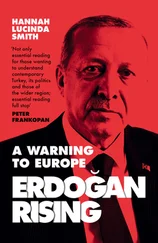
Hannah Smith - Erdogan Rising
Здесь есть возможность читать онлайн «Hannah Smith - Erdogan Rising» — ознакомительный отрывок электронной книги совершенно бесплатно, а после прочтения отрывка купить полную версию. В некоторых случаях можно слушать аудио, скачать через торрент в формате fb2 и присутствует краткое содержание. Жанр: unrecognised, на английском языке. Описание произведения, (предисловие) а так же отзывы посетителей доступны на портале библиотеки ЛибКат.
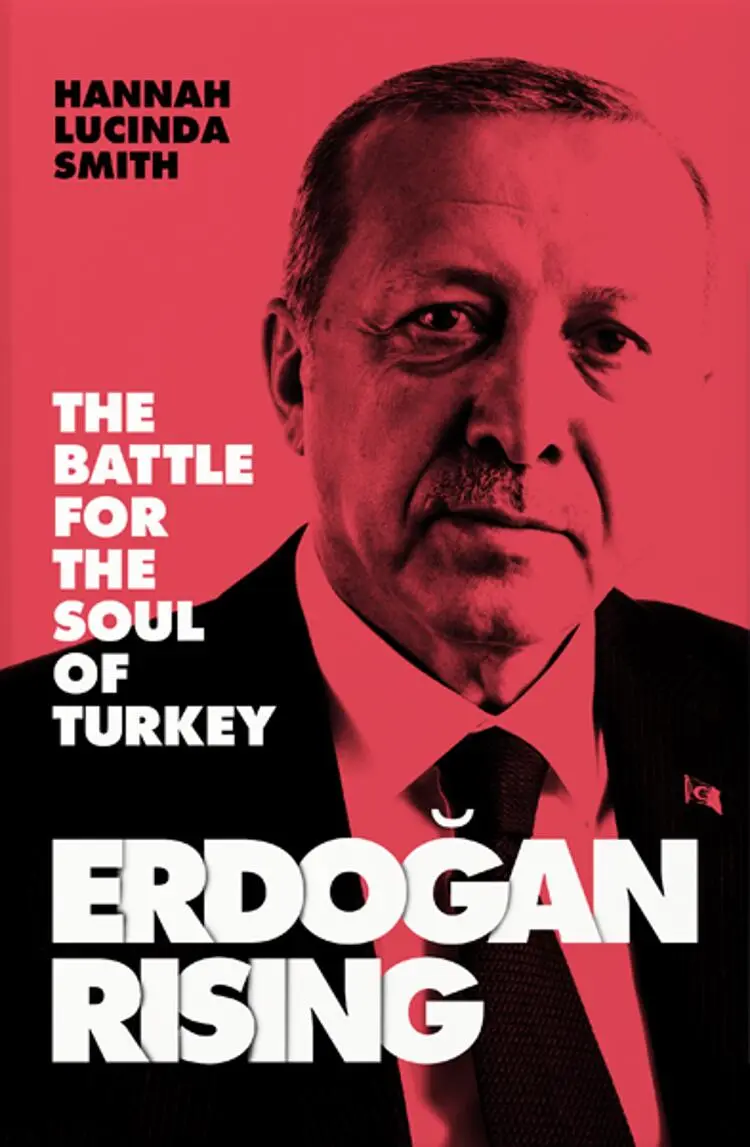
- Название:Erdogan Rising
- Автор:
- Жанр:
- Год:неизвестен
- ISBN:нет данных
- Рейтинг книги:4 / 5. Голосов: 1
-
Избранное:Добавить в избранное
- Отзывы:
-
Ваша оценка:
Erdogan Rising: краткое содержание, описание и аннотация
Предлагаем к чтению аннотацию, описание, краткое содержание или предисловие (зависит от того, что написал сам автор книги «Erdogan Rising»). Если вы не нашли необходимую информацию о книге — напишите в комментариях, мы постараемся отыскать её.
Erdogan Rising — читать онлайн ознакомительный отрывок
Ниже представлен текст книги, разбитый по страницам. Система сохранения места последней прочитанной страницы, позволяет с удобством читать онлайн бесплатно книгу «Erdogan Rising», без необходимости каждый раз заново искать на чём Вы остановились. Поставьте закладку, и сможете в любой момент перейти на страницу, на которой закончили чтение.
Интервал:
Закладка:
But the portraits in the public corridors of Aksaray, Erdoğan’s thousand-room palace, show the other side of the man at the top of the clique that rules Turkey. He is still in suits and dark glasses but now in the world’s misery spots rather than the halls of power, kissing the hands of old women in headscarves or surrounded by adoring African children.
The president’s loyal insiders – and often even his opponents – insist that such personal warmth is genuine. One lower-level bureaucrat working in the presidency tells me that in meetings, Erdoğan makes sure everyone has a glass of tea in front of them before he starts. An adviser insists that he berates Turks to have at least three children only because he cares about them as he would his own family. The head of the foreign investment board, who was personally appointed by Erdoğan, says people see the president as their father.
Turks who have met Erdoğan in person say time and again: he is funny. But his instinct to bring an iron fist down on those who oppose him politically is a bona fide part of his personality, too.
‘What I know from his life and his family is that he is not concerned on a macro level,’ a former aide told me. ‘He may cry and help a person but if you tell him that there are thousands of people gathered there, he sends somebody to bust them. A thousand people is something political. The other is something humane.’
Foreign diplomats paint a similar picture. For sure Erdoğan can be charming, and they agree his personal warmth is real. But they also say he can be obstructive and caustic, especially when he feels he is not getting his way or being treated with respect.
‘I don’t find him particularly funny, but he definitely has a presence,’ said one. ‘He was quite warm. He was always patting me on the back. To be this successful you must have something and he absolutely does. He has a very magnetic personality, which does not really come out. He always seems very angry and harsh in his public speaking. But he does not seem like that in private.’
Another, who had personally felt the force of the president’s fury several times during his posting, said there are two Erdoğans: ‘the diplomatic, polished guy who wants to make friends and is trying to act to his capabilities in order to influence others. This is the nice Erdoğan. Then there is the tough, awful Erdoğan. And you never know which one is going to show up.’
Outside the country, Erdoğan’s mercurial and often bullish personality wins him more detractors than fans. But inside Turkey – which is, at its heart, an Eastern country even if it often assumes the veneer of the West – it is seen as his biggest attribute.
‘One of his strongest points is that he is genuine in both doing right and wrong,’ a former adviser tells me. ‘He is very transparent, and that’s a good thing in Turkey. He does not conceal anything. He speaks his mind, and this is why he makes so many mistakes. He sometimes says absurd things. But he is not a European politician in that sense. He is more like a guide figure, like a politician of the Ottoman times.’
The speechwriter
The photo Hüseyin Besli has chosen for the wall of his Istanbul office is a classic of the genre. Erdoğan is smiling, shaded and waving, dressed in a black greatcoat and surrounded by his entourage. It is the new Tayyip in the new Turkey – a place where he is firmly in charge. But with his Marlboro reds, diamond-patterned sweater and tired and sagging grey face, Besli himself looks like a relic of the old – more like an ageing shopkeeper or a minor bureaucrat than the architect of a revolution. His shoulders hunch forward and his smile is resigned. The way he sucks his cigarettes through his own moustache – a little longer than Erdoğan’s and just as grey – suggests a deep sadness. Maybe he is just lost in his thoughts.
We meet in his writing room, a neat, wood-panelled attic in an old Balkan-style house, nestled in the heart of a bubbling district in Asian Istanbul. The streets of Çengelköy are narrow and cobbled, lined with family-run grocers. The district sits on the banks of the Bosphorus, at a point where the land juts out to gift it a panoramic view of the first of the three suspension bridges with the outlines of the mosques of Istanbul’s Ottoman centre in the hazy blue background. The din of a Monday evening rush hour leaks in through the huge window by Besli’s desk as I settle into one of his comfy leather chairs. Revving motorcycles and shouting shopkeepers blend with the wail of the sundown call to prayer. His floor-to-ceiling shelves are packed with books on religion and politics. There is a sticker of the Muslim Brotherhood’s Rabia hand, a four-fingered salute with the thumb tucked under, pasted onto the window, and that Erdoğan portrait is the first thing you’re confronted with as you walk in the door.
Besli chain smokes and occasionally apologises as he breaks off to answer his phone. He says he is sure that I won’t represent his words properly, because the foreign journalists never do.
‘Then why did you agree to speak with me?’ I ask.
‘Because I am polite,’ he laughs.
But I suspect he also craves some recognition for the years he spent moulding the image of the most powerful man in Turkey.
It was in 1974, when Besli was in his mid-twenties, that a tall and striking young man walked into one of his meetings. The National Salvation Party ( Milli Selâmet Partisi or MSP) was one of the few overtly Islamist organisations in Turkey at that time, and Besli was head of its youth branch. The country had just undergone its second military coup, and a mushrooming street war between leftist and nationalist youth gangs had sent the murder rate soaring. The rival factions were shooting and stabbing each other to death on the streets and in the university campuses. The MSP stayed outside the violence and the factionalism, meeting to pray, plan and organise. It was a tactic that bore fruit. Throughout the 1970s, the MSP won places in two coalition governments despite never winning more than 12 per cent of the vote, largely thanks to the hopeless fracturing of the non-Islamist parties.
In 1974 Erdoğan, aged twenty-one, was leader of the MSP’s local branch in Beyoğlu, his home borough in inner Istanbul. Besli, a couple of years older, remembers him as a charismatic guy who could already work a room. ‘I don’t remember where I first heard Erdoğan speak, but I remember that he was great, even back then,’ he says. ‘He could make himself heard. When he spoke, people felt sympathy with him.’
Within two years, Besli’s term in office had ended and Erdoğan was elected his successor. They were the young bloods in a party led by the middle-aged and nerdish professor Necmettin Erbakan, who was pursuing an agenda beloved of Islamists since the late Ottoman era. Erbakan insisted that Turkey’s ills could be blamed on foreign meddling and Western influence, and that the cure was to turn it back towards Islam and build relations with the Muslim world. The nefarious secular elites who ruled the republic had done her a disservice by taking her into NATO and cosying up to Europe; what was needed was a revival of strong Islamic morals, population growth and rapid industrialisation to bring Turkey’s living standards up to those of the West.
The establishment was rattled. The army stepped in, launching the third coup of the republic in 1980.
The MSP, like all the other parties, was shut down by the generals. But young Erdoğan’s rise continued. In 1985 he became Istanbul chair of the Welfare Party ( Refah Partisi , or RP – which replaced the MSP), and then stood unsuccessfully as their candidate for the mayorship of Beyoğlu in 1989. In 1991 he ran for parliament for the first time – and although he won, had to hand his seat to another parliamentary candidate due to the party’s preferential voting system. None of these setbacks discouraged him. That same year Besli began working as Erdoğan’s speechwriter, assembling the strategy that finally propelled him to the Istanbul mayor’s office in 1994. Erdoğan has never conceded victory at the ballot box since.
Читать дальшеИнтервал:
Закладка:
Похожие книги на «Erdogan Rising»
Представляем Вашему вниманию похожие книги на «Erdogan Rising» списком для выбора. Мы отобрали схожую по названию и смыслу литературу в надежде предоставить читателям больше вариантов отыскать новые, интересные, ещё непрочитанные произведения.






Обсуждение, отзывы о книге «Erdogan Rising» и просто собственные мнения читателей. Оставьте ваши комментарии, напишите, что Вы думаете о произведении, его смысле или главных героях. Укажите что конкретно понравилось, а что нет, и почему Вы так считаете.