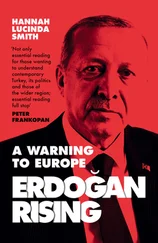
Hannah Smith - Erdogan Rising
Здесь есть возможность читать онлайн «Hannah Smith - Erdogan Rising» — ознакомительный отрывок электронной книги совершенно бесплатно, а после прочтения отрывка купить полную версию. В некоторых случаях можно слушать аудио, скачать через торрент в формате fb2 и присутствует краткое содержание. Жанр: unrecognised, на английском языке. Описание произведения, (предисловие) а так же отзывы посетителей доступны на портале библиотеки ЛибКат.
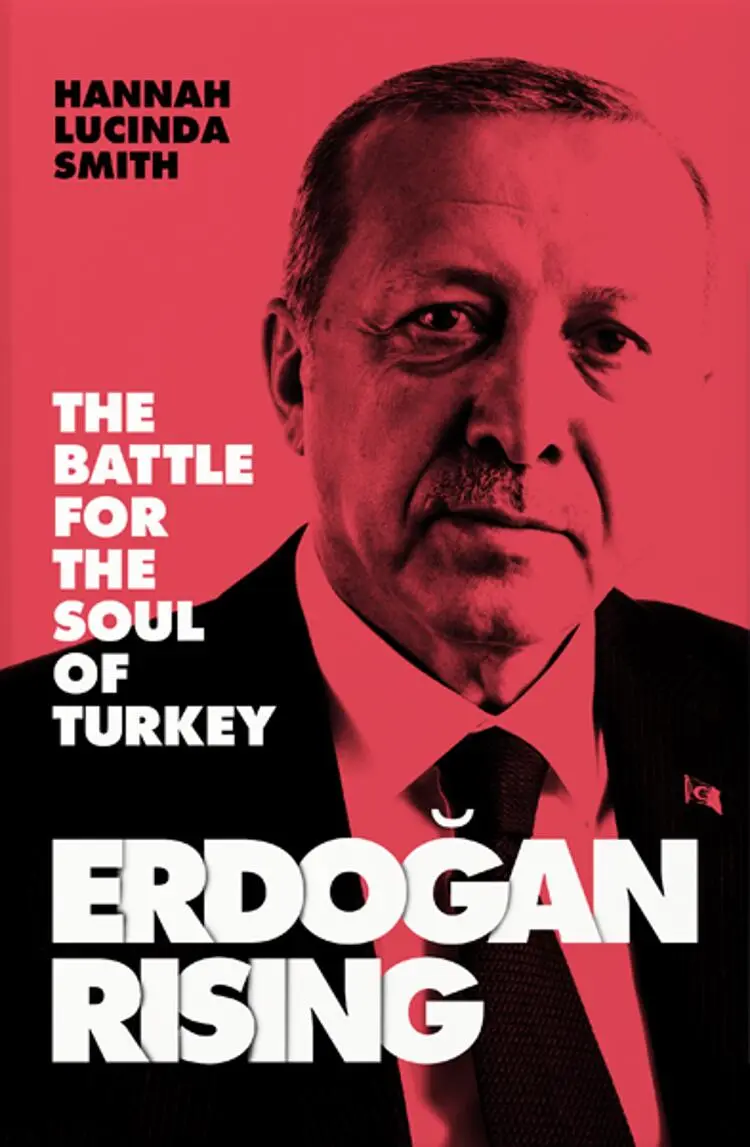
- Название:Erdogan Rising
- Автор:
- Жанр:
- Год:неизвестен
- ISBN:нет данных
- Рейтинг книги:4 / 5. Голосов: 1
-
Избранное:Добавить в избранное
- Отзывы:
-
Ваша оценка:
Erdogan Rising: краткое содержание, описание и аннотация
Предлагаем к чтению аннотацию, описание, краткое содержание или предисловие (зависит от того, что написал сам автор книги «Erdogan Rising»). Если вы не нашли необходимую информацию о книге — напишите в комментариях, мы постараемся отыскать её.
Erdogan Rising — читать онлайн ознакомительный отрывок
Ниже представлен текст книги, разбитый по страницам. Система сохранения места последней прочитанной страницы, позволяет с удобством читать онлайн бесплатно книгу «Erdogan Rising», без необходимости каждый раз заново искать на чём Вы остановились. Поставьте закладку, и сможете в любой момент перейти на страницу, на которой закончили чтение.
Интервал:
Закладка:
In February 1997, the Turkish army launched what became known as its postmodern coup. Tanks rolled through Ankara and Istanbul, setting off a series of events that would eventually force Fethullah Gülen into exile. The generals had been stirred into action after Necmettin Erbakan, leader of Erdoğan’s Refah Party, became prime minister in 1996 – Turkey’s first full-blooded Islamist premier. After the generals issued a memo from their boardroom, and Erbakan’s governing coalition partners rounded on him, he stepped down. For the next years political Islam was again forced into the shadows in Turkey; Refah was shut down, Erbakan’s political career was finished, and the AKP’s shoots started growing in the dark.
Gülen moved to the United States in 1999 and has remained there ever since, now living in a vast secluded ranch in Pennsylvania and rarely venturing out. But he has never stopped preaching. Gülen’s videos draw millions of views and both adulation and hilarity on YouTube (one has been superimposed with cartoon watermelons to make it look as though the imam is chopping them with his flailing hands as he rants).
Although he was little known outside Turkey, Gülen’s following had grown so huge by 2013 that he was propelled to the number one spot in Time magazine’s annual 100 Most Influential People in the World list. His devotees, loyal, worldly and highly organised, had voted en masse to get him there. The magazine’s blurb betrays the bemusement the editors must have felt at finding the votes flooding in for this unknown man. But there is also a prescient hint of what was to come:
Fethullah Gülen is among the world’s most intriguing religious leaders. From a secluded retreat in Pennsylvania, he preaches a message of tolerance that has won him admirers around the world. Schools founded by Gülen’s followers thrive in an estimated 140 countries. Doctors who respond to his wishes work without pay in disaster-afflicted countries.
Gülen, however, is also a man of mystery. His influence in his native Turkey is immense, exercised by graduates of his schools who have reached key posts in the government, judiciary and police. This makes him seem like a shadowy puppeteer, and he is scorned by almost as many Turks as love him.
The political rise and fall of the Gülenists is the murkiest and most controversial part of the Erdoğan story. But the first thing to say is that the core of Erdoğan’s allegations against the group are true – that as bizarre and conspiratorial as it sounds, Gülen’s followers really did become a shadowy cabal who spent decades inching their way up through the Turkish state.
Here is a taste of how the Gülenists operated. In September 2015, as the relationship between Erdoğan and Gülen was imploding, an email dropped into my inbox from Hawthorn Advisors, a London public relations and ‘reputation management’ agency, publicising a study written by a group of British barristers. It was titled A report on the rule of law and respect for human rights in Turkey since December 2013 , and had been commissioned by the Journalists’ and Writers’ Foundation – a well-known Gülenist front group. Established in 1994, the JWF operated from an office in Istanbul’s pious Üsküdar district and was, according to Joshua Hendrick, a US academic who immersed himself among the Gülenists in the 2000s, ‘the primary public face of the movement’.
‘They have a very strategic and long history, in Turkey and the world, of peddling favour from influential people, including elected officials, journalists and other leaders,’ Hendrick told me.
They had certainly picked the report’s authors well. Two of the four were serving British politicians, Sir Edward Garnier in the House of Commons and Lord Woolf in the House of Lords. Garnier’s Register of Interests entry for the work reveals that the JWF paid him £115,994 for his 100 hours spent on the project. Six months after the report was published, Garnier stood up in the Commons during a debate on the EU–Turkey migrant deal to raise the ‘serial and appalling human rights and rule of law abuses by the Turkish government’.
‘While these abuses continue,’ he said, ‘there should be no question of opening any chapters [on Turkey’s EU membership] at all, even though we need Turkey as a member of NATO and its agreement to help with the migration problem.’
Although he mentioned in his statement to the House that he had worked on the report, he did not reveal who had commissioned it. In his response to me in August 2016, when I reported the story in The Times , Garnier insisted that he and the other authors ‘are not supporters or adherents of [the Gülen movement] but wrote the report as independent English lawyers based on the evidence we had reviewed’.
There is no doubt that he knew who he was working for, though – the original press release sent to me by the Hawthorn PR agency had included a blurb about the Gülen movement at the end: ‘The Gülen movement is a civil society network of individuals and religious, humanitarian, and educational institutions that subscribe to Islamic scholar Fethullah Gülen’s advocacy of interfaith dialogue, community service, and universal education.’
It is easy to see how a British politician might be sucked in. Outside Turkey the Gülenists sell themselves as purveyors of modern, pluralist Islam, a pitch that is directly and deliberately tuned to Western ears. Using that narrative they have built up a large following within the Turkish émigré community and organised endless outreach programmes and round tables in the West. In the UK, where much Gülenist capital has fled since Erdoğan’s crackdown started, they still run a lobby group, The Dialogue Society, which has hosted Cherie Blair and former Liberty director Shami Chakrabati among its guest speakers, as well as an educational trust that offers free weekend tuition to pupils in the state school system. You have to dig fairly deep into their websites before you see that these organisations are linked to the Gülen movement.
Inside Turkey, the Gülenists were best known for running high-achieving private schools for the children of rich families and subsidised university dormitories for those of the poor. ‘Everyone was aware of Gülenists but they were not seen as particularly threatening,’ said one Western diplomat based in Turkey in the early AKP era. ‘They were seen as a kind of irrelevance, a rather eccentric secret society that raised money, did good things and ran schools in Turkey and other parts of the Islamic world. It felt like a normal part of the Turkish society. We did not, as diplomats, focus on things that we probably should have done more. It did have the civic elements, particularly in Anatolia. It felt almost like Germany or old UK, like the Rotary Clubs. It almost fell into that bracket rather than a serious political thing.’
Overseas the Gülenists ran Turkish language and cultural institutes. Their members, having come up through the elite Gülenist schools or been handpicked in the university dorms, were the brightest, the best educated and the most fluent foreign-language speakers – the perfect cultural ambassadors for Turkey abroad. While some members were directed by the higher ranks of the movement to take jobs in the Turkish state and security services (and often handed stolen test papers in advance to ensure they would get the plum positions), others went abroad and opened more schools overseas. Poorer, developing nations – particularly the Muslim parts of Africa, the Balkans and central Asia – were delighted to have such polished and pious people coming to provide education. An opaque group called ‘Citizens Against Special Interest Lobbying in Public Schools’ has released a document online titled ‘Every continent but Antarctica’, listing 101 countries where Gülenist schools were allegedly operating, from Afghanistan to Zambia.
Читать дальшеИнтервал:
Закладка:
Похожие книги на «Erdogan Rising»
Представляем Вашему вниманию похожие книги на «Erdogan Rising» списком для выбора. Мы отобрали схожую по названию и смыслу литературу в надежде предоставить читателям больше вариантов отыскать новые, интересные, ещё непрочитанные произведения.







Обсуждение, отзывы о книге «Erdogan Rising» и просто собственные мнения читателей. Оставьте ваши комментарии, напишите, что Вы думаете о произведении, его смысле или главных героях. Укажите что конкретно понравилось, а что нет, и почему Вы так считаете.