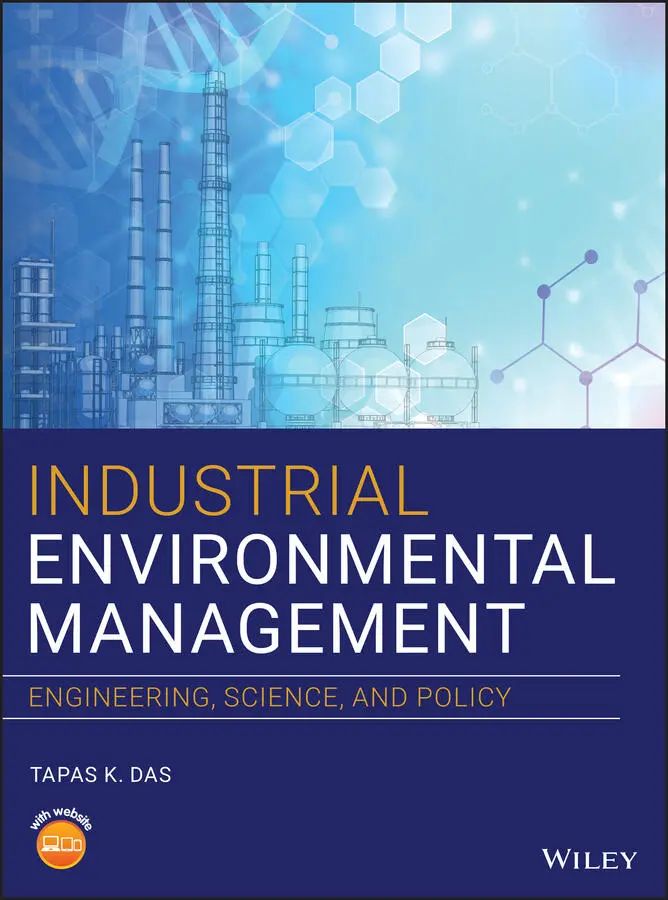
Tapas K. Das - Industrial Environmental Management
Здесь есть возможность читать онлайн «Tapas K. Das - Industrial Environmental Management» — ознакомительный отрывок электронной книги совершенно бесплатно, а после прочтения отрывка купить полную версию. В некоторых случаях можно слушать аудио, скачать через торрент в формате fb2 и присутствует краткое содержание. Жанр: unrecognised, на английском языке. Описание произведения, (предисловие) а так же отзывы посетителей доступны на портале библиотеки ЛибКат.
- Название:Industrial Environmental Management
- Автор:
- Жанр:
- Год:неизвестен
- ISBN:нет данных
- Рейтинг книги:5 / 5. Голосов: 1
-
Избранное:Добавить в избранное
- Отзывы:
-
Ваша оценка:
Industrial Environmental Management: краткое содержание, описание и аннотация
Предлагаем к чтению аннотацию, описание, краткое содержание или предисловие (зависит от того, что написал сам автор книги «Industrial Environmental Management»). Если вы не нашли необходимую информацию о книге — напишите в комментариях, мы постараемся отыскать её.
Industrial Environmental Management: Engineering, Science, and Policy Provides end-of-chapter questions along with a solutions manual for adopting professors Covers a wide range of interdisciplinary areas that makes it suitable for different branches of engineering such as wastewater management and treatment; pollutant sampling; health risk assessment; waste minimization; lean manufacturing; and regulatory information Shows how industrial environmental management is connected to areas like sustainable engineering, sustainable manufacturing, social policy, and more Contains theory, applications, and real-world problems along with their solutions Details waste recovery systems
is an ideal textbook for junior and senior level students in multidisciplinary engineering fields such as chemical, civil, environmental, and petroleum engineering. It will appeal to practicing engineers seeking information about sustainable design principles and methodology.
Industrial Environmental Management — читать онлайн ознакомительный отрывок
Ниже представлен текст книги, разбитый по страницам. Система сохранения места последней прочитанной страницы, позволяет с удобством читать онлайн бесплатно книгу «Industrial Environmental Management», без необходимости каждый раз заново искать на чём Вы остановились. Поставьте закладку, и сможете в любой момент перейти на страницу, на которой закончили чтение.
Интервал:
Закладка:
In order to protect the environment, the precautionary approach shall be widely applied by States according to their capabilities. Where there are threats of serious or irreversible damage, lack of full scientific certainty shall not be used as a reason for postponing cost‐effective measures to prevent environmental degradation.
The principle may play a role in any debate over the need for environmental regulation.
2.9.7 Prevention
The concept of prevention … can perhaps better be considered an overarching aim that gives rise to a multitude of legal mechanisms, including prior assessment of environmental harm, licensing or authorization that set out the conditions for operation and the consequences for violation of the conditions, as well as the adoption of strategies and policies. Emission limits and other product or process standards, the use of best available techniques and similar techniques can all be seen as applications of the concept of prevention.
2.10 Polluter Pays Principle
The polluter pays principle stands for the idea that “the environmental costs of economic activities, including the cost of preventing potential harm, should be internalized rather than imposed upon society at large.” All issues related to responsibility for cost for environmental remediation and compliance with pollution control regulations involve this principle.
2.11 Theory/Environmental Law Debate
Environmental law is a continuing source of controversy. Debates over the necessity, fairness, and cost of environmental regulation are ongoing, as well as regarding the appropriateness of regulations vs. market solutions to achieve even agreed‐upon ends.
Allegations of scientific uncertainty fuel the ongoing debate over greenhouse gas regulation and are a major factor in debates over whether to ban particular pesticides. In cases where the science is well‐settled, it is not unusual to find that corporations intentionally hide or distort the facts, or sow confusion (Oreskes and Conway 2010).
It is very common for regulated industry to argue against environmental regulation on the basis of cost (Pizer and Kopp 2003). Difficulties arise in performing cost‐benefit analysis of environmental issues. It is difficult to quantify the value of an environmental value such as a healthy ecosystem, clean air, or species diversity. Many environmentalists' response to pitting economy vs. ecology is summed up by former Senator and founder of Earth Day Gaylord Nelson: “The economy is a wholly owned subsidiary of the environment, not the other way around” (Nelson et al. 2002). Furthermore, environmental issues are seen by many as having an ethical or moral dimension, which would transcend financial cost. Even so, there are some efforts underway to systemically recognize environmental costs and assets, and account for them properly in economic terms.
While affected industries spark controversy in fighting regulation, there are also many environmentalists and public interest groups who believe that current regulations are inadequate, and advocate for stronger protection (Hiss 2014; Stein and Beckel 2004). Environmental law conferences – such as the annual Public Interest Environmental Law Conference in Eugene, Oregon – typically have this focus, also connecting environmental law with class, race, and other issues.
An additional debate is to what extent environmental laws are fair to all regulated parties. For instance, researchers Preston Teeter and Jorgen Sandberg highlight how smaller organizations can often incur disproportionately larger costs as a result of environmental regulations, which can ultimately create an additional barrier to entry for new firms, thus stifling competition and innovation (Teeter and Sandberg 2017).
2.11.1 Environmental Impact Statement and NEPA Process
An environmental impact statement (EIS), under US environmental law, is a document required by the National Environmental Policy Act (NEPA) for certain actions “significantly affecting the quality of the human environment” (NEPA 1969). An EIS is a tool for decision making. It describes the positive and negative environmental effects of a proposed action, and it usually also lists one or more alternative actions that may be chosen instead of the action described in the EIS. Several US state governments require that a document similar to an EIS be submitted to the state for certain actions.
2.11.2 Purpose of NEPA
The purpose of the NEPA is to promote informed decision making by federal agencies by making “detailed information concerning significant environmental impacts” available to both agency leaders and the public ( Robertson v. Methow Valley Citizens Council 1989). The NEPA was the first piece of legislation that created a comprehensive method to assess potential and existing environmental risks at once. It also encourages communication and cooperation between all the actors involved in environmental decisions, including government officials, private businesses, and citizens (Felleman 2013).
In particular, an EIS acts as an enforcement mechanism to ensure that the federal government adheres to the goals and policies outlined in the NEPA. An EIS should be created in a timely manner as soon as the agency is planning development or is presented with a proposal for development. The statement should use an interdisciplinary approach so that it accurately assesses both the physical and social impacts of the proposed development (EIS 2010). In many instances an action may be deemed subject to NEPA's EIS requirement even though the action is not specifically sponsored by a federal agency. These factors may include actions that receive federal funding, federal licensing, or authorization, or that are subject to federal control (Eccleston 2008).
An EIS typically has four sections (Eccleston 2014):
1 An introduction including a statement of the purpose and need of the proposed action.
2 A description of the affected environment.
3 A range of alternatives to the proposed action. Alternatives are considered the “heart” of the EIS.An analysis of the environmental impacts of each of the possible alternatives. This section covers topics such as the following:Impacts to threatened or endangered speciesAir and water quality impactsImpacts to historic and cultural sites, particularly sites of significant importance to indigenous peoples.Social and economic impacts to local communities, often including consideration of attributes such as impacts to available housing stock, economic impacts to businesses, property values, aesthetics, and noise within the affected area.Cost analysis for each alternative, including costs to mitigate expected impacts, to determine if the proposed action is a prudent use of taxpayer dollars.
2.12 International Law
It is well known that the United Nations Conference in Stockholm on the human environment is a landmark milestone at the international arena for the protection of the deteriorating environment. The conference laid emphasis on the need that man's capabilities to transform his surroundings must be wisely used. Wrong and unwise use can do incalculable harm to human beings and the human environment. It was suggested by the Conference that developing countries must direct their efforts toward balancing their priorities with the need to check increasing population. Moreover, the conference identified the areas and laid down the principles on which the nations should take up and enact laws for protecting environment. These principles have been incorporated in the Stockholm Declaration (British Institute of International and Comparative Environmental Law 1992; Caldwell 1996; Koivurova 2014; Muralikrishna and Manickam 2017). In this process, there are national and international dimensions of environmental law.
Читать дальшеИнтервал:
Закладка:
Похожие книги на «Industrial Environmental Management»
Представляем Вашему вниманию похожие книги на «Industrial Environmental Management» списком для выбора. Мы отобрали схожую по названию и смыслу литературу в надежде предоставить читателям больше вариантов отыскать новые, интересные, ещё непрочитанные произведения.






Обсуждение, отзывы о книге «Industrial Environmental Management» и просто собственные мнения читателей. Оставьте ваши комментарии, напишите, что Вы думаете о произведении, его смысле или главных героях. Укажите что конкретно понравилось, а что нет, и почему Вы так считаете.