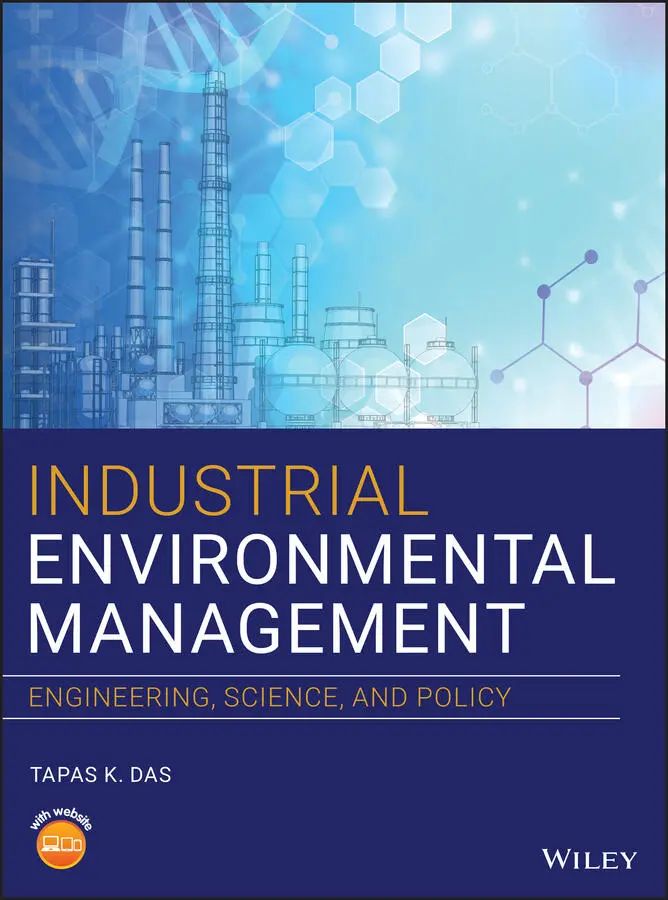
Tapas K. Das - Industrial Environmental Management
Здесь есть возможность читать онлайн «Tapas K. Das - Industrial Environmental Management» — ознакомительный отрывок электронной книги совершенно бесплатно, а после прочтения отрывка купить полную версию. В некоторых случаях можно слушать аудио, скачать через торрент в формате fb2 и присутствует краткое содержание. Жанр: unrecognised, на английском языке. Описание произведения, (предисловие) а так же отзывы посетителей доступны на портале библиотеки ЛибКат.
- Название:Industrial Environmental Management
- Автор:
- Жанр:
- Год:неизвестен
- ISBN:нет данных
- Рейтинг книги:5 / 5. Голосов: 1
-
Избранное:Добавить в избранное
- Отзывы:
-
Ваша оценка:
Industrial Environmental Management: краткое содержание, описание и аннотация
Предлагаем к чтению аннотацию, описание, краткое содержание или предисловие (зависит от того, что написал сам автор книги «Industrial Environmental Management»). Если вы не нашли необходимую информацию о книге — напишите в комментариях, мы постараемся отыскать её.
Industrial Environmental Management: Engineering, Science, and Policy Provides end-of-chapter questions along with a solutions manual for adopting professors Covers a wide range of interdisciplinary areas that makes it suitable for different branches of engineering such as wastewater management and treatment; pollutant sampling; health risk assessment; waste minimization; lean manufacturing; and regulatory information Shows how industrial environmental management is connected to areas like sustainable engineering, sustainable manufacturing, social policy, and more Contains theory, applications, and real-world problems along with their solutions Details waste recovery systems
is an ideal textbook for junior and senior level students in multidisciplinary engineering fields such as chemical, civil, environmental, and petroleum engineering. It will appeal to practicing engineers seeking information about sustainable design principles and methodology.
Industrial Environmental Management — читать онлайн ознакомительный отрывок
Ниже представлен текст книги, разбитый по страницам. Система сохранения места последней прочитанной страницы, позволяет с удобством читать онлайн бесплатно книгу «Industrial Environmental Management», без необходимости каждый раз заново искать на чём Вы остановились. Поставьте закладку, и сможете в любой момент перейти на страницу, на которой закончили чтение.
Интервал:
Закладка:
An irrigation ditch, operated in accordance with water resources law:
Water resources laws govern the ownership and use of water resources, including surface water and ground water. Regulatory areas may include water conservation, use restrictions, and ownership regimes.
2.8.7 Mineral Resources Law
Mineral resource laws cover several basic topics, including the ownership of the mineral resource and who can work them. Mining is also affected by various regulations regarding the health and safety of miners, as well as the environmental impact of mining.
2.8.8 Forest Resources Law
A timber operation, regulated by forestry law:
Forestry laws govern activities in designated forest lands, most commonly with respect to forest management and timber harvesting. Ancillary laws may regulate forest land acquisition and prescribed burn practices. Forest management laws generally adopt management policies, such as multiple use and sustained yield, by which public forest resources are to be managed. Governmental agencies are generally responsible for planning and implementing forestry laws on public forest lands and may be involved in forest inventory, planning, and conservation, and oversight of timber sales. Broader initiatives may seek to slow or reverse deforestation.
2.8.9 Wildlife and Plants Protection Laws
Wildlife laws govern the potential impact of human activity on wild animals, whether directly on individuals or populations, or indirectly via habitat degradation. Similar laws may operate to protect plant species. Such laws may be enacted entirely to protect biodiversity or as a means for protecting species deemed important for other reasons. Regulatory efforts may include the creation of special conservation statuses, prohibitions on killing, harming, or disturbing protected species, efforts to induce and support species recovery, establishment of wildlife refuges to support conservation, and prohibitions on trafficking in species or animal parts to combat poaching.
2.8.10 Fish and Game Laws
Fish and game laws regulate the right to pursue and take or kill certain kinds of fish and wild animal (game). Such laws may restrict the days to harvest fish or game, the number of animals caught per person, the species harvested, or the weapons or fishing gear used. Such laws may seek to balance dueling needs for preservation and harvest and to manage both environment and populations of fish and game. Game laws can provide a legal structure to collect license fees and other money which is used to fund conservation efforts as well as to obtain harvest information used in wildlife management practice.
2.8.11 Principles
Environmental law has developed in response to emerging awareness of and concern over issues impacting the entire world. While laws have developed piecemeal and for a variety of reasons, some effort has gone into identifying key concepts and guiding principles common to environmental law as a whole (UNEP 1992). The principles discussed below are not an exhaustive list and are not universally recognized or accepted. Nonetheless, they represent important principles for the understanding of environmental law around the world.
2.9 Resource Sustainability
2.9.1 Environmental Impact Assessment
Environmental impact assessment (EA) is the assessment of the environmental consequences both positive and negative of a plan, policy, program, or actual projects prior to the decision to move forward with the proposed action. In this context, the term “environmental impact assessment” is usually used when applied to actual projects by individuals or companies and the term “strategic environmental assessment” (SEA) applies to policies, plans, and programs most often proposed by organization of state (Eccleston 2017). Environmental assessments may be governed by rules of administrative procedure regarding public participation and documentation of decision making and may be subject to judicial review.
2.9.2 Sustainable Development
Defined by the United Nations Environment Program (UNEP 1986, 1992, 2001, 2006, 2013) as “development that meets the needs of the present without compromising the ability of future generations to meet their own needs,” sustainable development may be considered together with the concepts of “integration” (development cannot be considered in isolation from sustainability) and “interdependence” (social and economic development, and environmental protection, are interdependent). Laws mandating EPA and requiring or encouraging development to minimize environmental impacts may be assessed against this principle.
The modern concept of sustainable development was a topic of discussion at the 1972 United Nations Conference on the Human Environment (Stockholm Conference) and the driving force behind the 1983 World Commission on Environment and Development (WCED, or Bruntland Commission). In 1992, the first UN Earth Summit resulted in the Rio Declaration, Principle 3 of which reads: “The right to development must be fulfilled so as to equitably meet developmental and environmental needs of present and future generations.” Sustainable development has been a core concept of international environmental discussion ever since, including at the World Summit on Sustainable Development (Earth Summit 2002), and the United Nations Conference on Sustainable Development (Earth Summit 2012).
2.9.3 Equity
Further information: Intergenerational equity
Defined by UNEP to include intergenerational equity – “the right of future generations to enjoy a fair level of the common patrimony” – and intragenerational equity – “the right of all people within the current generation to fair access to the current generation's entitlement to the Earth's natural resources” – environmental equity considers the present generation under an obligation to account for long‐term impacts of activities, and to act to sustain the global environment and resource base for future generations. Pollution control and resource management laws may be assessed against this principle.
2.9.4 Transboundary Responsibility
Defined in the international law context as an obligation to protect one's own environment, and to prevent damage to neighboring environments, UNEP considers transboundary responsibility at the international level as a potential limitation on the rights of the sovereign state. Laws that act to limit externalities imposed upon human health and the environment may be assessed against this principle.
2.9.5 Public Participation and Transparency
Identified as essential conditions for “accountable governments ⋯ industrial concerns,” and organizations generally, public participation and transparency are presented by UNEP as requiring “effective protection of the human right to hold and express opinions and to seek, receive and impart ideas … a right of access to appropriate, comprehensible and timely information held by governments and industrial concerns on economic and social policies regarding the sustainable use of natural resources and the protection of the environment, without imposing undue financial burdens upon the applicants and with adequate protection of privacy and business confidentiality,” and “effective judicial and administrative proceedings.” These principles are present in EPA, laws requiring publication and access to relevant environmental data, and administrative procedure.
2.9.6 Precautionary principle
One of the most commonly encountered and controversial principles of environmental law, the Rio Declaration formulated the precautionary principle as follows:
Читать дальшеИнтервал:
Закладка:
Похожие книги на «Industrial Environmental Management»
Представляем Вашему вниманию похожие книги на «Industrial Environmental Management» списком для выбора. Мы отобрали схожую по названию и смыслу литературу в надежде предоставить читателям больше вариантов отыскать новые, интересные, ещё непрочитанные произведения.







Обсуждение, отзывы о книге «Industrial Environmental Management» и просто собственные мнения читателей. Оставьте ваши комментарии, напишите, что Вы думаете о произведении, его смысле или главных героях. Укажите что конкретно понравилось, а что нет, и почему Вы так считаете.