Tapas K. Das - Industrial Environmental Management
Здесь есть возможность читать онлайн «Tapas K. Das - Industrial Environmental Management» — ознакомительный отрывок электронной книги совершенно бесплатно, а после прочтения отрывка купить полную версию. В некоторых случаях можно слушать аудио, скачать через торрент в формате fb2 и присутствует краткое содержание. Жанр: unrecognised, на английском языке. Описание произведения, (предисловие) а так же отзывы посетителей доступны на портале библиотеки ЛибКат.
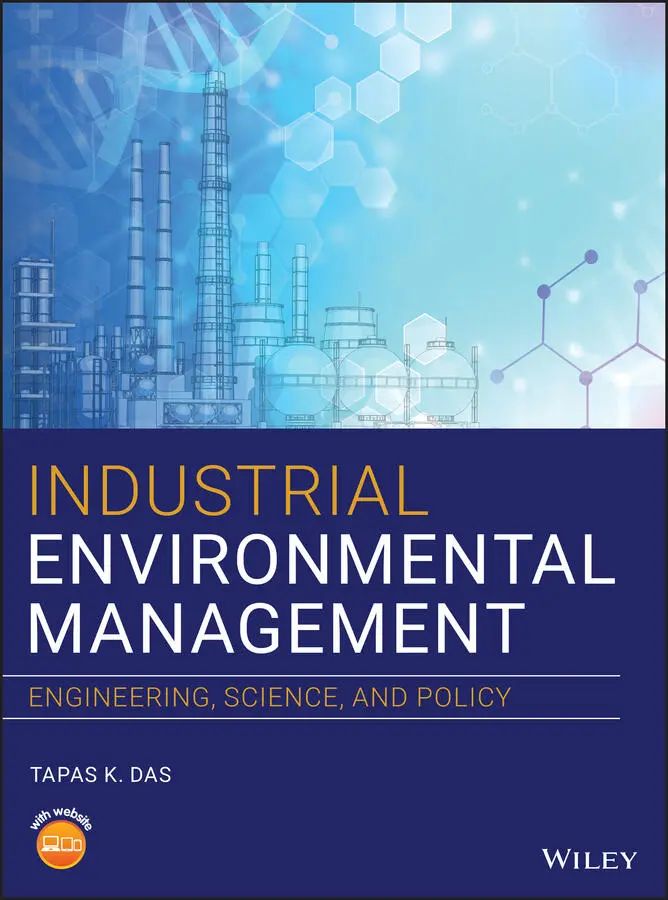
- Название:Industrial Environmental Management
- Автор:
- Жанр:
- Год:неизвестен
- ISBN:нет данных
- Рейтинг книги:5 / 5. Голосов: 1
-
Избранное:Добавить в избранное
- Отзывы:
-
Ваша оценка:
Industrial Environmental Management: краткое содержание, описание и аннотация
Предлагаем к чтению аннотацию, описание, краткое содержание или предисловие (зависит от того, что написал сам автор книги «Industrial Environmental Management»). Если вы не нашли необходимую информацию о книге — напишите в комментариях, мы постараемся отыскать её.
Industrial Environmental Management: Engineering, Science, and Policy Provides end-of-chapter questions along with a solutions manual for adopting professors Covers a wide range of interdisciplinary areas that makes it suitable for different branches of engineering such as wastewater management and treatment; pollutant sampling; health risk assessment; waste minimization; lean manufacturing; and regulatory information Shows how industrial environmental management is connected to areas like sustainable engineering, sustainable manufacturing, social policy, and more Contains theory, applications, and real-world problems along with their solutions Details waste recovery systems
is an ideal textbook for junior and senior level students in multidisciplinary engineering fields such as chemical, civil, environmental, and petroleum engineering. It will appeal to practicing engineers seeking information about sustainable design principles and methodology.
Industrial Environmental Management — читать онлайн ознакомительный отрывок
Ниже представлен текст книги, разбитый по страницам. Система сохранения места последней прочитанной страницы, позволяет с удобством читать онлайн бесплатно книгу «Industrial Environmental Management», без необходимости каждый раз заново искать на чём Вы остановились. Поставьте закладку, и сможете в любой момент перейти на страницу, на которой закончили чтение.
Интервал:
Закладка:
2.12.8 Canada
The Department of the Environment Act establishes the Department of the Environment in the Canadian government as well as the position Minister of the Environment. Their duties include “the preservation and enhancement of the quality of the natural environment, including water, air and soil quality; renewable resources, including migratory birds and other nondomestic flora and fauna; water; meteorology” (Department of the Environment Act 1985/2009). The Environmental Protection Act is the main piece of Canadian environmental legislation that was put into place on 31 March 2000. The Act focuses on “respecting pollution prevention and the protection of the environment and human health in order to contribute to sustainable development.” Other principle federal statutes include the Canadian Environmental Assessment Act and the Species at Risk Act. When provincial and federal legislation are in conflict, federal legislation takes precedence, that being said individual provinces can have their own legislation such as Ontario's Environmental Bill of Rights and Clean Water Act (1985).
2.12.9 China
According to the USEPA, “China has been working with great determination in recent years to develop, implement, and enforce a solid environmental law framework. Chinese officials face critical challenges in effectively implementing the laws, clarifying the roles of their national and provincial governments, and strengthening the operation of their legal system” (EPA Collaboration with China 2017). Explosive economic and industrial growth in China has led to significant environmental degradation, and China is currently in the process of developing more stringent legal controls (McElwee 2011). The harmonization of Chinese society and the natural environment is billed as a rising policy priority (NRDC 2014; Pettit 2014; Stern 2013; Wang 2013).
2.12.10 Ecuador
With the enactment of the 2008 Constitution, Ecuador became the first country in the world to codify the Rights of Nature. The Constitution, specifically Articles 10 and 71–74, recognizes the inalienable rights of ecosystems to exist and flourish, gives people the authority to petition on the behalf of ecosystems, and requires the government to remedy violations of these rights. The rights approach is a break away from traditional environmental regulatory systems, which regard nature as property and legalize and manage degradation of the environment rather than prevent it (CELDF 2017).
The Rights of Nature articles in Ecuador's constitution are part of a reaction to a combination of political, economic, and social phenomena. Ecuador's abusive past with the oil industry, most famously the class‐action litigation against Chevron, and the failure of an extraction‐based economy and neoliberal reforms to bring economic prosperity to the region has resulted in the election of a New Leftist regime, led by President Rafael Correa, and sparked a demand for new approaches to development. In conjunction with this need, the principle of “Buen Vivir,” or good living – focused on social, environmental, and spiritual wealth versus material wealth – gained popularity among citizens and was incorporated into the new constitution (Gudynas 2011).
The influence of indigenous groups, from whom the concept of “Buen Vivir” originates, in the forming of the constitutional ideals also facilitated the incorporation of the Rights of Nature as a basic tenet of their culture and conceptualization of “Buen Vivir” (Becker 2011).
2.12.11 Egypt
The Environmental Protection Law outlines the responsibilities of the Egyptian government to “preparation of draft legislation and decrees pertinent to environmental management, collection of data both nationally and internationally on the state of the environment, preparation of periodical reports and studies on the state of the environment, formulation of the national plan and its projects, preparation of environmental profiles for new and urban areas, and setting of standards to be used in planning for their development, and preparation of an annual report on the state of the environment to be prepared to the President” (Ministry of Environment Egyptian Environmental Affairs 2009).
2.12.12 Germany
Since 15 November 1994, environmental protection has been enshrined as an objective of the state in Article 20a of the German Basic Law. Constitutional status has thus been afforded to environmental protection and its objectives. All state bodies – in particular the legislature – are required to be “mindful also of [their] responsibility toward future generations” and to protect the environment (Seider 2010):
Law on Conservation and Environmental Care (Gesetz über Naturschutz und Landschaftspflege – Bundesnaturschutzgesetz – BNatSchG)
Law on Protection for Environmental Harms due to Air Pollution, Noise, etc. (Gesetz zum Schutz vor schädlichen Umwelteinwirkungen durch Luftverunreinigungen, Geräusche, Erschütterungen und ähnliche Vorgänge – Bundes‐Immissionsschutzgesetz – BImSchG)
Regulation on Drinking Water Quality (Trinkwasserverordnung – TrinkwV)
Regulation on Soil Protection (Bundesbodenschutzgesetz – BBSchG)
Regulation on Waste Management (Kreislaufwirtschaftsgesetz – KrwG)
Regulation on Water Usage (Wasserhaushaltsgesetz – WHG)
2.12.12.1 Environmental Rules for Doing Business in Germany: Legal Requirements
The environmental laws at the federal and state level are generally implemented by the Länder. The highest national authority for environmental matters is the Federal Ministry for the Environment, Nature Conservation and Nuclear Safety. The 16 Länder also have their own environment ministries.
The Federal Ministry for the Environment and Environment ministries of the Länder collates all acts and regulations within its area of competence. It is broken down into the following fields: General environmental protection; Waste management; Laws on chemicals; Renewable energy/climate protection; Water conservancy; Emission protection; Nuclear safety/radiological protection; Nature and landscape conservation; Chemicals Act (Act on protection against hazardous substances); Chemicals Prohibition Regulation; Hazardous Substances Regulation; and Chemicals Penalty Regulation.
2.12.13 India
In India, environmental law is governed by the Environment Protection Act (EPA, India), 1986 (The Environmental Act 1986; Upadhyay 2012). This act is enforced by the Central Pollution Control Board (CPCB) and the numerous State Pollution Control Boards (SPCBs). Apart from this, there are also individual legislations specifically enacted for the protection of water, air, wildlife, etc. Such legislations include the following:
The Water (Prevention and Control of Pollution) Act, 1974
The Water (Prevention and Control of Pollution) Cess Act, 1977
The Forest (Conservation) Act, 1980
The Air (Prevention and Control of Pollution) Act, 1981
Air (Prevention and Control of Pollution) (Union Territories) Rules, 1983
The Biological Diversity Act, 2002 and the Wild Life Protection Act, 1972
Batteries (Management and Handling) Rules, 2001
Recycled Plastics, Plastics Manufacture and Usage Rules, 1999
The National Green Tribunal established under the National Green Tribunal Act of 2010 has jurisdiction over all environmental cases dealing with a substantial environmental question and acts covered under the Water (Prevention and Control of Pollution) Act, 1974.
Water (Prevention and Control of Pollution) Cess Rules, 1978
Ganga Action Plan, 1986
The Forest (Conservation) Act, 1980
The Public Liability Insurance Act, 1991 and the Biological Diversity Act, 2002. The acts covered under Indian Wild Life Protection Act 1972 do not fall within the jurisdiction of the National Green Tribunal. Appeals can be filed in the Hon'ble Supreme Court of India (The Indian Wildlife Protection Act 1972)
Читать дальшеИнтервал:
Закладка:
Похожие книги на «Industrial Environmental Management»
Представляем Вашему вниманию похожие книги на «Industrial Environmental Management» списком для выбора. Мы отобрали схожую по названию и смыслу литературу в надежде предоставить читателям больше вариантов отыскать новые, интересные, ещё непрочитанные произведения.







Обсуждение, отзывы о книге «Industrial Environmental Management» и просто собственные мнения читателей. Оставьте ваши комментарии, напишите, что Вы думаете о произведении, его смысле или главных героях. Укажите что конкретно понравилось, а что нет, и почему Вы так считаете.