Tapas K. Das - Industrial Environmental Management
Здесь есть возможность читать онлайн «Tapas K. Das - Industrial Environmental Management» — ознакомительный отрывок электронной книги совершенно бесплатно, а после прочтения отрывка купить полную версию. В некоторых случаях можно слушать аудио, скачать через торрент в формате fb2 и присутствует краткое содержание. Жанр: unrecognised, на английском языке. Описание произведения, (предисловие) а так же отзывы посетителей доступны на портале библиотеки ЛибКат.
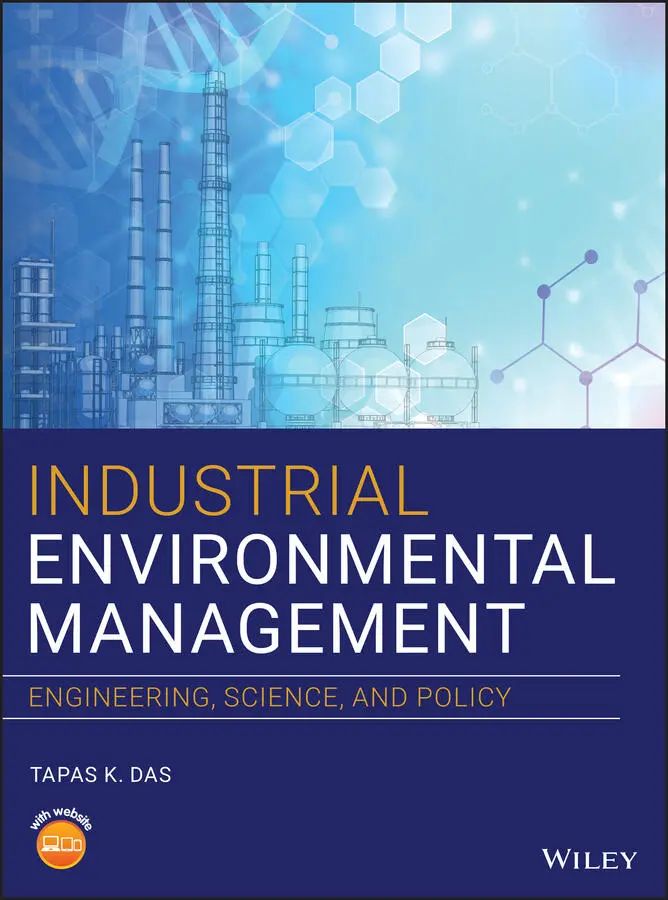
- Название:Industrial Environmental Management
- Автор:
- Жанр:
- Год:неизвестен
- ISBN:нет данных
- Рейтинг книги:5 / 5. Голосов: 1
-
Избранное:Добавить в избранное
- Отзывы:
-
Ваша оценка:
Industrial Environmental Management: краткое содержание, описание и аннотация
Предлагаем к чтению аннотацию, описание, краткое содержание или предисловие (зависит от того, что написал сам автор книги «Industrial Environmental Management»). Если вы не нашли необходимую информацию о книге — напишите в комментариях, мы постараемся отыскать её.
Industrial Environmental Management: Engineering, Science, and Policy Provides end-of-chapter questions along with a solutions manual for adopting professors Covers a wide range of interdisciplinary areas that makes it suitable for different branches of engineering such as wastewater management and treatment; pollutant sampling; health risk assessment; waste minimization; lean manufacturing; and regulatory information Shows how industrial environmental management is connected to areas like sustainable engineering, sustainable manufacturing, social policy, and more Contains theory, applications, and real-world problems along with their solutions Details waste recovery systems
is an ideal textbook for junior and senior level students in multidisciplinary engineering fields such as chemical, civil, environmental, and petroleum engineering. It will appeal to practicing engineers seeking information about sustainable design principles and methodology.
Industrial Environmental Management — читать онлайн ознакомительный отрывок
Ниже представлен текст книги, разбитый по страницам. Система сохранения места последней прочитанной страницы, позволяет с удобством читать онлайн бесплатно книгу «Industrial Environmental Management», без необходимости каждый раз заново искать на чём Вы остановились. Поставьте закладку, и сможете в любой момент перейти на страницу, на которой закончили чтение.
Интервал:
Закладка:
Global and regional environmental issues are increasingly the subject of international law. Debates over environmental concerns implicate core principles of international law and have been the subject of numerous international agreements and declarations (see Appendix B).
Customary international law is an important source of international environmental law. These are the norms and rules that countries follow as a matter of custom and they are so prevalent that they bind all states in the world. When a principle becomes customary law is not clear cut and many arguments are put forward by states not wishing to be bound. Examples of customary international law relevant to the environment include the duty to warn other states promptly about icons of an environmental nature and environmental damages to which another state or states may be exposed, and Principle 21 of the Stockholm Declaration.
Numerous legally binding international agreements encompass a wide variety of issue areas, from terrestrial, marine, and atmospheric pollution through to wildlife and biodiversity protection. International environmental agreements are generally multilateral (or sometimes bilateral) treaties (a.k.a. convention, agreement, protocol, etc.). Protocols are subsidiary agreements built from a primary treaty. They exist in many areas of international law but are especially useful in the environmental field, where they may be used to regularly incorporate recent scientific knowledge. They also permit countries to reach agreement on a framework that would be contentious if every detail were to be agreed upon in advance. The most widely known protocol in international environmental law is the Kyoto Protocol, which followed from the United Nations Framework Convention on Climate Change.
While the bodies that proposed, argued, agreed upon, and ultimately adopted existing international agreements vary according to each agreement, certain conferences, including 1972s United Nations Conference on the Human Environment, 1983s World Commission on Environment and Development, 1992s United Nations Conference on Environment and Development, and 2002s World Summit on Sustainable Development have been particularly important. Multilateral environmental agreements sometimes create an International Organization, Institution, or Body responsible for implementing the agreement. Major examples are the Convention on International Trade in Endangered Species of Wild Fauna and Flora (CITES) and the International Union for Conservation of Nature.
International environmental law also includes the opinions of international courts and tribunals. While there are few and they have limited authority, the decisions carry much weight with legal commentators and are quite influential on the development of international environmental law. One of the biggest challenges in international decisions is to determine an adequate compensation for environmental damages (Hardman Reis 2011). The courts include the International Court of Justice (ICJ), the international Tribunal for the Law of the Sea, the European Court of Justice, European Court of Human Rights, and other regional treaty tribunals.
2.12.1 Africa
According to the International Network for Environmental Compliance and Enforcement, the major environmental issues in Africa are “drought and flooding, air pollution, deforestation, loss of biodiversity, freshwater availability, degradation of soil and vegetation, and widespread poverty.” The USEPA is focused on the “growing urban and industrial pollution, water quality, electronic waste, and indoor air from cook stoves.” They hope to provide enough aid on concerns regarding pollution before their impacts contaminate the African environment as well as the global environment. By doing so, they intend to “protect human health, particularly vulnerable populations such as children and the poor” (EPA 2012). In order to accomplish these goals in Africa, EPA programs are focused on strengthening the ability to enforce environmental laws as well as public compliance to them. Other programs work on developing stronger environmental laws, regulations, and standards.
2.12.2 Asia
The Asian Environmental Compliance and Enforcement Network (AECEN) is an agreement between 16 Asian countries dedicated to improving cooperation with environmental laws in Asia. These countries include Cambodia, China, Indonesia, India, Maldives, Japan, Korea, Malaysia, Nepal, Philippines, Pakistan, Singapore, Sri Lanka, Thailand, Vietnam, and Lao PDR (AECEN 2018).
2.12.3 European Union
The European Union issues secondary legislation on environmental issues that are valid throughout the EU (so‐called regulations) and many directives that must be implemented into national legislation from the 28 member states (national states). Examples are the Regulation (EC) No. 338/97 on the implementation of CITES; or the Natura 2000 network the centerpiece for nature and biodiversity policy, encompassing the bird directive (79/409/EEC/ changed to 2009/147/EC) and the habitats directive (92/43/EEC), which are made up of multiple SACs (Special Areas of Conservation, linked to the habitats directive) and SPAs (Special Protected Areas, linked to the bird directive) throughout Europe.
EU legislation is ruled in Article 249 Treaty for the Functioning of the European Union. Topics for common EU legislation are as follows:
Climate change
Air pollution
Water protection and management
Waste management
Soil protection
Protection of nature, species, and biodiversity
Noise pollution
Cooperation for the environment with third countries (other than EU member states)
Civil protection
2.12.4 Middle East
The USEPA is working with countries in the Middle East to improve “environmental governance, water pollution and water security, clean fuels and vehicles, public participation, and pollution prevention.”
2.12.5 Oceania
The main concerns on environmental issues in the Oceanic Region are “illegal releases of air and water pollutants, illegal logging/timber trade, illegal shipment of hazardous wastes, including e‐waste and ships slated for destruction, and insufficient institutional structure/lack of enforcement capacity.” The Secretariat of the Pacific Regional Environmental Program (SPREP) is an international organization between Australia, the Cook Islands, Fiji, France, Kiribati, Marshall Islands, Nauru, New Zealand, Niue, Palau, Papua New Guinea, Samoa, Solomon Island, Tonga, Tuvalu, United States, and Vanuatu. The SPREP was established in order to provide assistance in improving and protecting the environment as well as to assure sustainable development for future generations (SPREP n.d.; Taylor et al. 2013).
2.12.6 Australia
The Environment Protection and Biodiversity Conservation Act 1999 is the centerpiece of environmental legislation in the Australian Government. It sets up the “legal framework to protect and manage nationally and internationally important flora, fauna, ecological communities and heritage places” (EPBC 1999). It also focuses on protecting world heritage properties, national heritage properties, wetlands of international importance, nationally threatened species and ecological communities, migratory species, Commonwealth marine areas, Great Barrier Reef Marine Park, and the environment surrounding nuclear activities (EPBC 1999). Commonwealth v. Tasmania (1983), also known as the “Tasmanian Dam Case,” is the most influential case for Australian environmental law ( Commonwealth v Tasmania 1983).
2.12.7 Brazil
The Brazilian government created the Ministry of Environment in 1992 in order to develop better strategies of protecting the environment, use natural resources sustainably, and enforce public environmental policies. The Ministry of Environment has authority over policies involving environment, water resources, preservation, and environmental programs involving the Amazon.
Читать дальшеИнтервал:
Закладка:
Похожие книги на «Industrial Environmental Management»
Представляем Вашему вниманию похожие книги на «Industrial Environmental Management» списком для выбора. Мы отобрали схожую по названию и смыслу литературу в надежде предоставить читателям больше вариантов отыскать новые, интересные, ещё непрочитанные произведения.









Обсуждение, отзывы о книге «Industrial Environmental Management» и просто собственные мнения читателей. Оставьте ваши комментарии, напишите, что Вы думаете о произведении, его смысле или главных героях. Укажите что конкретно понравилось, а что нет, и почему Вы так считаете.