Tapas K. Das - Industrial Environmental Management
Здесь есть возможность читать онлайн «Tapas K. Das - Industrial Environmental Management» — ознакомительный отрывок электронной книги совершенно бесплатно, а после прочтения отрывка купить полную версию. В некоторых случаях можно слушать аудио, скачать через торрент в формате fb2 и присутствует краткое содержание. Жанр: unrecognised, на английском языке. Описание произведения, (предисловие) а так же отзывы посетителей доступны на портале библиотеки ЛибКат.
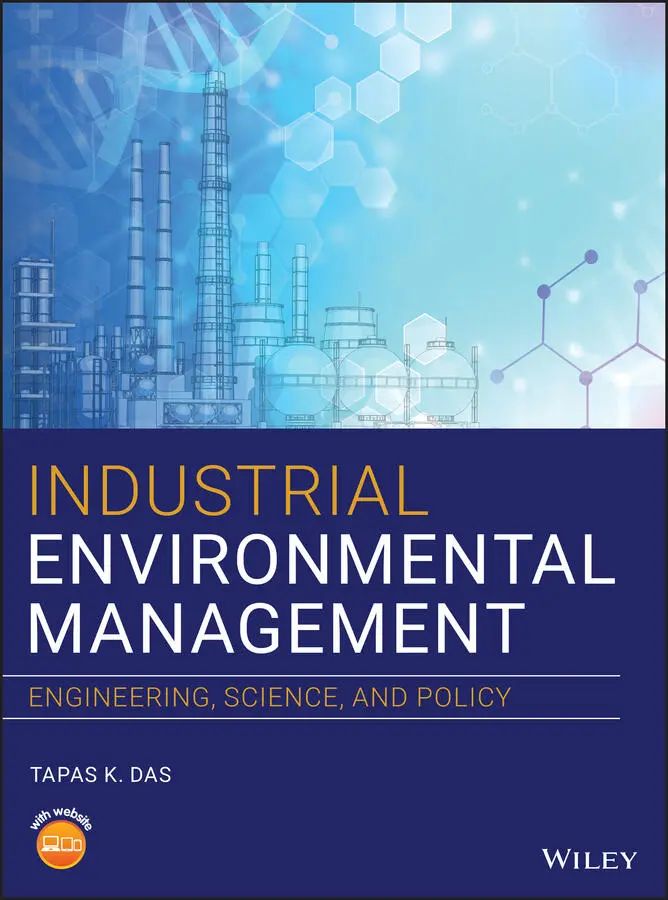
- Название:Industrial Environmental Management
- Автор:
- Жанр:
- Год:неизвестен
- ISBN:нет данных
- Рейтинг книги:5 / 5. Голосов: 1
-
Избранное:Добавить в избранное
- Отзывы:
-
Ваша оценка:
Industrial Environmental Management: краткое содержание, описание и аннотация
Предлагаем к чтению аннотацию, описание, краткое содержание или предисловие (зависит от того, что написал сам автор книги «Industrial Environmental Management»). Если вы не нашли необходимую информацию о книге — напишите в комментариях, мы постараемся отыскать её.
Industrial Environmental Management: Engineering, Science, and Policy Provides end-of-chapter questions along with a solutions manual for adopting professors Covers a wide range of interdisciplinary areas that makes it suitable for different branches of engineering such as wastewater management and treatment; pollutant sampling; health risk assessment; waste minimization; lean manufacturing; and regulatory information Shows how industrial environmental management is connected to areas like sustainable engineering, sustainable manufacturing, social policy, and more Contains theory, applications, and real-world problems along with their solutions Details waste recovery systems
is an ideal textbook for junior and senior level students in multidisciplinary engineering fields such as chemical, civil, environmental, and petroleum engineering. It will appeal to practicing engineers seeking information about sustainable design principles and methodology.
Industrial Environmental Management — читать онлайн ознакомительный отрывок
Ниже представлен текст книги, разбитый по страницам. Система сохранения места последней прочитанной страницы, позволяет с удобством читать онлайн бесплатно книгу «Industrial Environmental Management», без необходимости каждый раз заново искать на чём Вы остановились. Поставьте закладку, и сможете в любой момент перейти на страницу, на которой закончили чтение.
Интервал:
Закладка:
2.7 Environmental Law
Environmental law, also known as environmental and natural resources law, is a collective term describing the network of treaties, statutes, regulations, common, and customary laws addressing the effects of human activity on the natural environment. The core environmental law regimes address environmental pollution. A related but distinct set of regulatory regimes, now strongly influenced by environmental legal principles, focus on the management of specific natural resources, such as forests, minerals, or fisheries. Other areas, such as environmental impact assessment, may not fit neatly into either category but are nonetheless important components of environmental law.
In many parts of Eastern Europe, the former Soviet Union, and the developing countries, in Asia, Africa, and South America, pollution conditions persist today. Global and regional environmental issues are increasingly the subject of international law. The acronym ISO stands for International Organization for Standardization . It is a worldwide program that was founded in 1947 to promote the development of international manufacturing, trade, and communication standards. ISP membership includes over 100 countries.
2.7.1 History of Environmental Law
Early examples of legal enactments designed to consciously preserve the environment, for its own sake or human enjoyment, are found throughout history. In the common law, the primary protection was found in the law of nuisance, but this only allowed for private actions for damages or injunctions if there was harm to land. Thus, smells emanating from pig sties, ( Aldred's Case 1610), strict liability against dumping rubbish ( R v. Stephens 1866), or damage from exploding dams ( Rylands v. Fletcher , 1868). Private enforcement, however, was limited and found to be woefully inadequate to deal with major environmental threats, particularly threats to common resources. During the “Great Stink of 1858, the dumping of sewerage into the River Thames began to smell so ghastly in the summer heat that Parliament had to be evacuated. Ironically, the Metropolitan Commission of Sewers Act 1848 had allowed the Metropolitan Commission for Sewers to close cesspits around the city in an attempt to “clean up,” but this simply led people to pollute the river. In 19 days, Parliament passed a further Act to build the London sewerage system. London also suffered from terrible air pollution, and this culminated in the “Great Smog” of 1952, which in turn triggered its own legislative response: the Clean Air Act 1956. The basic regulatory structure was to set limits on emissions for households and business (particularly burning coal) while an inspectorate would enforce compliance.
Notwithstanding early analogs, the concept of “environmental law” as a separate and distinct body of law is a twentieth‐century development (Lazarus 2006). The recognition that the natural environment was fragile and in need of special legal protections, the translation of that recognition into legal structures, the development of those structures into a larger body of “environmental law,” and the strong influence of environmental law on natural resource laws did not occur until about the 1960s. At that time, numerous influences – including a growing awareness of the unity and fragility of the biosphere; increased public concern over the impact of industrial activity on natural resources and human health; the increasing strength of the regulatory state; and more broadly the advent and success of environmentalism as a political movement –coalesced to produce a huge new body of law in a relatively short period of time. While the modern history of environmental law is one of continuing controversy, by the end of the twentieth century environmental law had been established as a component of the legal landscape in all developed nations of the world, many developing ones, and the larger project of international law.
2.8 Pollution Control Laws
2.8.1 Air Quality Law
Industrial air pollution, now regulated by air quality law:
Air quality laws govern the emission of air pollutants into the atmosphere. A specialized subset of air quality laws regulate the quality of air inside buildings. Air quality laws are often designed specifically to protect human health by limiting or eliminating airborne pollutant concentrations. Other initiatives are designed to address broader ecological problems, such as limitations on chemicals that affect the ozone layer, and emissions trading programs to address acid rain or climate change. Regulatory efforts include identifying and categorizing air pollutants, setting limits on acceptable emissions levels, and dictating necessary or appropriate mitigation technologies.
2.8.2 Water Quality Law
A typical stormwater outfall, subject to water quality law:
Water quality laws govern the release of pollutants into water resources, including surface water, ground water, and stored drinking water. Some water quality laws, such as drinking water regulations, may be designed solely with reference to human health. Many others, including restrictions on the alteration of the chemical, physical, radiological, and biological characteristics of water resources, may also reflect efforts to protect aquatic ecosystems more broadly. Regulatory efforts may include identifying and categorizing water pollutants, dictating acceptable pollutant concentrations in water resources, and limiting pollutant discharges from effluent sources. Regulatory areas include sewage treatment and disposal, industrial and agricultural waste water management, and control of surface runoff from construction sites and urban environments.
2.8.3 Waste Management Law
A municipal landfill, operated pursuant to waste management law:
Waste management laws govern the transport, treatment, storage, and disposal of all manner of waste, including municipal solid waste, hazardous waste, and nuclear waste, among many other types. Waste laws are generally designed to minimize or eliminate the uncontrolled dispersal of waste materials into the environment in a manner that may cause ecological or biological harm and include laws designed to reduce the generation of waste and promote or mandate waste recycling. Regulatory efforts include identifying and categorizing waste types and mandating transport, treatment, storage, and disposal practices.
2.8.4 Contaminant Cleanup Law
Oil spill emergency response, governed by environmental cleanup law:
Environmental cleanup laws govern the removal of pollution or contaminants from environmental media, such as soil, sediment, surface water, or ground water. Unlike pollution control laws, cleanup laws are designed to respond after‐the‐fact to environmental contamination, and consequently must often define not only the necessary response actions but also the parties who may be responsible for undertaking (or paying for) such actions. Regulatory requirements may include rules for emergency response, liability allocation, site assessment, remedial investigation, feasibility studies, remedial action, post‐remedial monitoring, and site reuse.
2.8.5 Chemical Safety Laws
Chemical safety laws govern the use of chemicals in human activities, particularly man‐made chemicals in modern industrial applications. As contrasted with media‐oriented environmental laws (e.g. air or water quality laws), chemical control laws seek to manage the (potential) pollutants themselves. Regulatory efforts include banning specific chemical constituents in consumer products (e.g. Bisphenol A in plastic bottles) and regulating pesticides.
2.8.6 Water Resources Law
Интервал:
Закладка:
Похожие книги на «Industrial Environmental Management»
Представляем Вашему вниманию похожие книги на «Industrial Environmental Management» списком для выбора. Мы отобрали схожую по названию и смыслу литературу в надежде предоставить читателям больше вариантов отыскать новые, интересные, ещё непрочитанные произведения.






Обсуждение, отзывы о книге «Industrial Environmental Management» и просто собственные мнения читателей. Оставьте ваши комментарии, напишите, что Вы думаете о произведении, его смысле или главных героях. Укажите что конкретно понравилось, а что нет, и почему Вы так считаете.