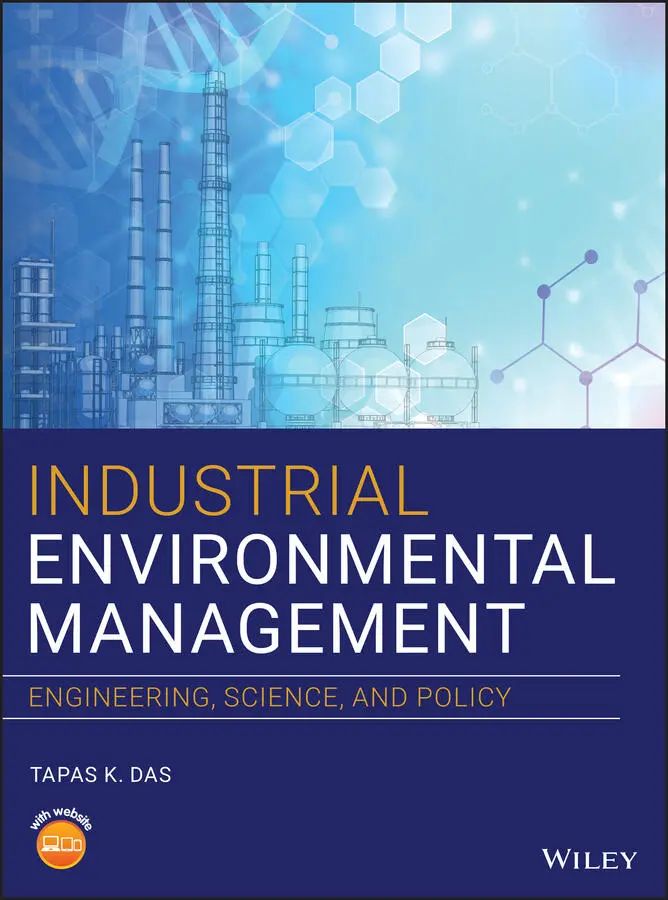
Tapas K. Das - Industrial Environmental Management
Здесь есть возможность читать онлайн «Tapas K. Das - Industrial Environmental Management» — ознакомительный отрывок электронной книги совершенно бесплатно, а после прочтения отрывка купить полную версию. В некоторых случаях можно слушать аудио, скачать через торрент в формате fb2 и присутствует краткое содержание. Жанр: unrecognised, на английском языке. Описание произведения, (предисловие) а так же отзывы посетителей доступны на портале библиотеки ЛибКат.
- Название:Industrial Environmental Management
- Автор:
- Жанр:
- Год:неизвестен
- ISBN:нет данных
- Рейтинг книги:5 / 5. Голосов: 1
-
Избранное:Добавить в избранное
- Отзывы:
-
Ваша оценка:
Industrial Environmental Management: краткое содержание, описание и аннотация
Предлагаем к чтению аннотацию, описание, краткое содержание или предисловие (зависит от того, что написал сам автор книги «Industrial Environmental Management»). Если вы не нашли необходимую информацию о книге — напишите в комментариях, мы постараемся отыскать её.
Industrial Environmental Management: Engineering, Science, and Policy Provides end-of-chapter questions along with a solutions manual for adopting professors Covers a wide range of interdisciplinary areas that makes it suitable for different branches of engineering such as wastewater management and treatment; pollutant sampling; health risk assessment; waste minimization; lean manufacturing; and regulatory information Shows how industrial environmental management is connected to areas like sustainable engineering, sustainable manufacturing, social policy, and more Contains theory, applications, and real-world problems along with their solutions Details waste recovery systems
is an ideal textbook for junior and senior level students in multidisciplinary engineering fields such as chemical, civil, environmental, and petroleum engineering. It will appeal to practicing engineers seeking information about sustainable design principles and methodology.
Industrial Environmental Management — читать онлайн ознакомительный отрывок
Ниже представлен текст книги, разбитый по страницам. Система сохранения места последней прочитанной страницы, позволяет с удобством читать онлайн бесплатно книгу «Industrial Environmental Management», без необходимости каждый раз заново искать на чём Вы остановились. Поставьте закладку, и сможете в любой момент перейти на страницу, на которой закончили чтение.
Интервал:
Закладка:
Industry is the axis to gear up the economy of a modern society – known as the indispensable motor of growth and development. On the other hand, it has been identified as a major source of environmental degradation and pollution. Therefore, development without destruction and environmental sustainability and sustainable development are the urgent needs of our time. The problem we are facing is how to strike a balance between the benefits of rising living standard and its cost in terms of deterioration of the physical environment and quality of life. In the past, the danger of polluting air, water, and land was not fully recognized, but now there is no doubt that it is a matter of great concern.
Famous Minamata Disease in Japan (1956), Flixborough (1974), Love Canal (1978), Three Mile Island incident (1979), Bhopal gas tragedy (1984), Chernobyl Atomic Reactor accident (1986), and Tennessee Valley Authority Kingston Coal Power Plant Toxic Ash Spill in Emory River (2008) have reminded us that industrialization has posed a serious threat not only to humans but also to animals, aquatic life, and vegetation cover. On one hand, industrialization has helped us to raise the standard and quality of life, but on the other it has deteriorated our environment. Thus, pollutants fate and transport in environment through human activities, e.g. acid rain, smog, global warming, ocean acidification, wild fires, cancer, are worst possible forms of pollution which is a direct result of industrialization.
Industries degrade the environment and pollute in the following ways:
1 Use of natural resources by industries, as it destroys nature and affects natural environment. Wheat, rice, barley, corn, cotton, trees, plywood, rubber, sugar cane, iron, coal, oil, natural gas, etc. are all natural resources for food processing, packing, paper, clothes, and other finished products. Thus, increasing needs of industries have resulted in over exploitation and stress on natural resources.
2 Residues and by‐products of industries are released in water, air, and land with or without any treatment which pollutes the water, air, and land, affecting the air quality, aquatic life, and ground water.
3 Fossil fuel used by industries like coal, kerosene, diesel, and nuclear energy pollutes the air in the form of smokes, soot, small particulate matter, smog, ozone, and radioactive wastes.
4 Noise is also a major by‐product of industries that cause noise pollution to human health.
5 Industrial wastes, particularly hazardous wastes and radioactive wastes, have become a major environmental pollution problem.
2.6 Industrial Disasters
2.6.1 Bhopal: The World's Worst Industrial Tragedy
Thirty three years ago, on the night of 2 December 1984, an accident at the Union Carbide pesticide plant in Bhopal, India, released at least 30 T of a highly toxic gas called methyl isocyanate (MIC), as well as a number of other poisonous gases. The pesticide plant was surrounded by shanty towns, leading to more than 600 000 people being exposed to the deadly gas cloud that night. The gases stayed low to the ground, causing victims' throats and eyes to burn, inducing nausea, and many deaths. Estimates of the death toll vary from as few as 3 800 to as many as 16 000, but government figures now refer to an estimate of 15 000 killed over the years. Toxic material remains, and 30 years later, many of those who were exposed to the gas have given birth to physically and mentally disabled children. For decades, survivors have been fighting to have the site cleaned up, but they say the efforts were slowed when Michigan‐based Dow Chemical took over Union Carbide in 2001. Human rights groups say that thousands of tons of hazardous waste remain buried underground, and the government has conceded the area is contaminated. There has, however, been no long‐term epidemiological research which conclusively proves that birth defects are directly related to the drinking of the contaminated water.
2.6.1.1 What Happened that Evening!
Due to lack of environmental regulations, enforcement and compliance, maintenance and operation safety, the plant in Bhopal where the disaster happened started to produce “Carbaryl” in 1977. Carbaryl is mainly used as an insecticide. At first, the production was 2500 T/Y. This was no problem, as the plant had been designed for an output of 5000 T. At the beginning of the 1980s, Carbaryl did not sell very well. For this reason, the owners of the plant started to cut costs. This included employing fewer people, doing maintenance less frequently, and using parts that were made of lower‐grade steel. Closing the plant was being considered as well. When the disaster happened, there was no production at the plant because there was a surplus on the market.
The disaster happened because water entered a tank containing MIC . This caused a chemical reaction which resulted in the buildup of much carbon dioxide, among other things. The resulting reaction increased the temperature inside the tank to reach over 200 °C (392 °F). The pressure was more than the tank was built to withstand. The tank had valves to control the pressure. These were triggered in an emergency, which reduced the pressure. As a result, large amounts of toxic gases were released into the environment. The pipes were rusty. The rust in the iron pipes made the reaction faster. All the contents of the tank were released within a period of about two hours. The water had entered the tank because of a sequence of events. The tank had been maintained badly. When cleaning work was done, water could enter the tank. The leakage of MIC gas from Union Carbide Corporation, Bhopal, gave impetus to the development of environmental law and principles of quantum of compensation ( Union Carbide v. Union of India 1989).
2.6.1.2 Taj Mahal Acid Rain Attack
Yellowing of a historical monument, the Taj Mahal at Agra, was attacked by acid gases due to emissions of oxides of sulfur (SO x) from foundries, coal‐fired power plants, chemical and hazardous industries, and oil refinery. The sulfur dioxide emitted from these industries, combined with atmospheric oxygen in presence of moisture and sun, formed sulfuric acid called “acid rain” affecting the marble of the Taj Mahal (Mehta 1987).
2.6.1.3 River Ganges and River Yamuna
The industries which made the water of the holy River Ganges and a river of the south Chennai toxic were found to be tanneries (Mehta 1988; Vellore Citizen 1996). In the Ganges pollution case, tanneries discharged untreated effluents in the river, and near Kanpur the water of Ganges was found to be highly toxic. In the other case, the Pallar River of the state of Tamil Nadu became highly polluted because tanneries discharged chemicals used in treating leather, which resulted in nonavailability of potable water. Recently, the Supreme Court of India ordered the closure of industries or to shift them from the territory of the State of Delhi as their untreated effluent and sludge was polluting the holy River Yamuna (Hindustan Times 2000; Times of India 2000).
2.6.1.4 Flixborough
On Saturday, 1 June 1974, the Nypro (UK) site at Flixborough was severely damaged by a large explosion. Twenty‐eight workers were killed and a further 36 suffered injuries. It is recognized that the number of casualties would have been more if the incident had occurred on a weekday, as the main office block was not occupied. Offsite consequences resulted in 53 reported injuries. Property in the surrounding area was damaged to a varying degree.
The chemical plant was designed to produce 70 000 T/Y of caprolactam, a raw material for the production of nylon. The process used cyclohexane as a feed and oxidized it to cyclohexanol in the presence of air within a series of six catalytic reactors. Under process conditions, cyclohexane vaporizes immediately upon mixed depressurization, forming a cloud of flammable cyclohexane vapor mixed with air. Reactor 5 was found to have a small crack in the stainless steel structure in the series using a 20 in. pipe, even though the reactors are normally connected using 28 in. pipe. The temporary section of piping was not properly supported and it ruptured upon pressurization, releasing an estimated 30 T of cyclohexane in a large cloud. An unknown ignition source caused the cloud to explode, leveling the entire plant facility. The resulting fire in the plant burned for over 10 days. The accident could have been prevented by following proper safety design and operating procedures, including reducing the inventory of flammable liquids onsite (CCPS 1993; Crowl and Louver 1990).
Читать дальшеИнтервал:
Закладка:
Похожие книги на «Industrial Environmental Management»
Представляем Вашему вниманию похожие книги на «Industrial Environmental Management» списком для выбора. Мы отобрали схожую по названию и смыслу литературу в надежде предоставить читателям больше вариантов отыскать новые, интересные, ещё непрочитанные произведения.







Обсуждение, отзывы о книге «Industrial Environmental Management» и просто собственные мнения читателей. Оставьте ваши комментарии, напишите, что Вы думаете о произведении, его смысле или главных героях. Укажите что конкретно понравилось, а что нет, и почему Вы так считаете.