Tapas K. Das - Industrial Environmental Management
Здесь есть возможность читать онлайн «Tapas K. Das - Industrial Environmental Management» — ознакомительный отрывок электронной книги совершенно бесплатно, а после прочтения отрывка купить полную версию. В некоторых случаях можно слушать аудио, скачать через торрент в формате fb2 и присутствует краткое содержание. Жанр: unrecognised, на английском языке. Описание произведения, (предисловие) а так же отзывы посетителей доступны на портале библиотеки ЛибКат.
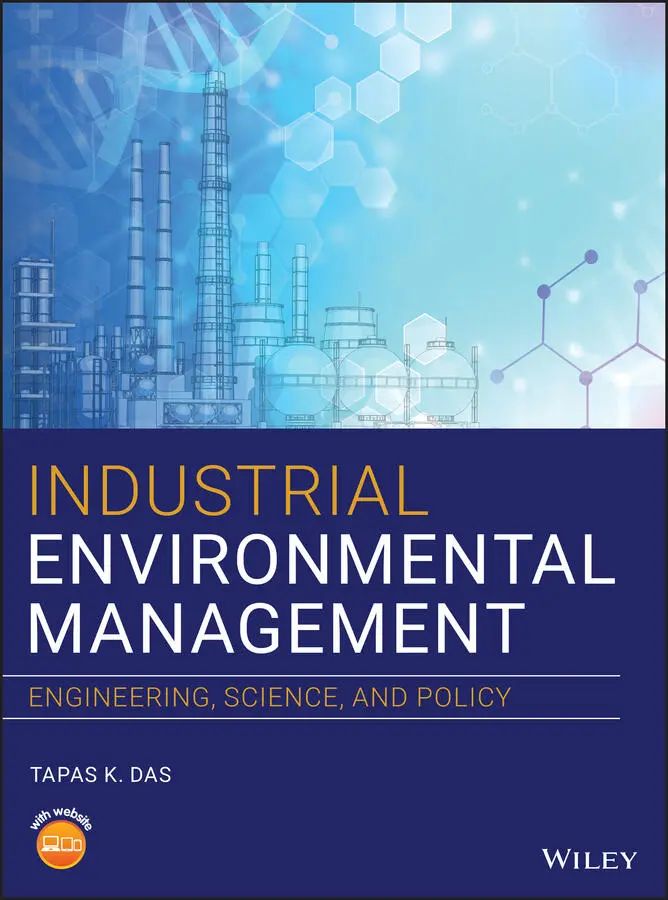
- Название:Industrial Environmental Management
- Автор:
- Жанр:
- Год:неизвестен
- ISBN:нет данных
- Рейтинг книги:5 / 5. Голосов: 1
-
Избранное:Добавить в избранное
- Отзывы:
-
Ваша оценка:
Industrial Environmental Management: краткое содержание, описание и аннотация
Предлагаем к чтению аннотацию, описание, краткое содержание или предисловие (зависит от того, что написал сам автор книги «Industrial Environmental Management»). Если вы не нашли необходимую информацию о книге — напишите в комментариях, мы постараемся отыскать её.
Industrial Environmental Management: Engineering, Science, and Policy Provides end-of-chapter questions along with a solutions manual for adopting professors Covers a wide range of interdisciplinary areas that makes it suitable for different branches of engineering such as wastewater management and treatment; pollutant sampling; health risk assessment; waste minimization; lean manufacturing; and regulatory information Shows how industrial environmental management is connected to areas like sustainable engineering, sustainable manufacturing, social policy, and more Contains theory, applications, and real-world problems along with their solutions Details waste recovery systems
is an ideal textbook for junior and senior level students in multidisciplinary engineering fields such as chemical, civil, environmental, and petroleum engineering. It will appeal to practicing engineers seeking information about sustainable design principles and methodology.
Industrial Environmental Management — читать онлайн ознакомительный отрывок
Ниже представлен текст книги, разбитый по страницам. Система сохранения места последней прочитанной страницы, позволяет с удобством читать онлайн бесплатно книгу «Industrial Environmental Management», без необходимости каждый раз заново искать на чём Вы остановились. Поставьте закладку, и сможете в любой момент перейти на страницу, на которой закончили чтение.
Интервал:
Закладка:
Cities grew when industries grew during this era. Since people had to live near where they worked (and few people lived in skyscrapers), many builders built out into undeveloped areas. If a city had annexed much of the land around it previous to these economic expansions (like Detroit), those areas became parts of a larger city. If they hadn't, much of this growth occurred in new suburbs (like Philadelphia). Chicago was so confident of further growth during this period that it built streetcar lines into vacant fields. To meet rising demand for housing, homebuilders applied industrial principles to building – using standardized parts that were themselves the result of mass production techniques. By the 1920s, buying precut mail order houses became big business.
2.4.5 The Origins of Mass Production
After 1880, mechanization made factories even more productive thanks to technological improvements. This can be traced back to Thomas Edison's labs in New Jersey, where he practiced systematic invention to exploit the great commercial opportunities that modern life created. The electrical and chemical industries formed the vanguard for the blending of science and the useful arts during this era. By the 1920s, engineers had been formally integrated into the management hierarchies of countless American industries.
Reorganization of production merged with technological improvement had made mass production possible long before Ford developed the assembly line. James Bonsack's cigarette rolling machine, for example, patented in 1881, could produce 70 000 cigarettes in a single 10‐hour day. By the end of that decade, it could produce 120 000 cigarettes in a day (Chandler 1977). When James “Buck” Duke bought exclusive rights to this machine in 1885, it became the basis of his American Tobacco Company, which quickly controlled most of the industry.
By the 1920s, mass production had arrived in industries that produced goods that were much more expensive than cigarettes. Ford's principles of mass production spread quickly throughout the manufacturing sector, to products of all kinds, because Henry Ford was so open about the way he designed his factories. Among the other manufacturers that used Ford's principles during the 1920s were the makers of home appliances, like refrigerators and radios. General Electric, for example, built an $18 million assembly line for its Monitor Top refrigerator and sold 1 million refrigerators just 4 years after its introduction in 1927 (Cowan 1985).
Even craft‐dominated industries like furniture making came to depend upon mass production to make their products more available to the masses. People who moved from farms to cities desperately needed furniture for their new urban residences, but in industrial towns like Grand Rapids, Michigan, they could not afford pieces made by craftsman. New mass‐produced models made with minimal carving and overlays, based on stylish patterns, found a market all over the country. It helped that companies like Bassett, founded in Virginia in 1902, discouraged their workers from forming unions, just like Ford did. An unorganized workforce made it easier for industrialists to impose changes in the production process without resistance from employees.
The changeover from the Model T to the Model A, in 1927, demonstrated the limits of industrialized mass production. The Model A was incredibly expensive, and Ford had to shut his main plant for months to retool the production line for his new models. While the new car sold well initially, sales dropped precipitously as the Depression deepened. “Mass production is not simply large‐scale production,” wrote the department store magnate Edward Filene, in 1932. “It is large‐scale production based upon a clear understanding that increased production demands increased buying” (Hounshell 1984). Mass buying became difficult when people had little money with which to buy the products of industrialization. Urban building slowed precipitously during the Depression too. Since cities were the focal points of industrialization, urban citizens suffered disproportionately when production waned. Of course, when the United States sank into the economic downturn of the Great Depression, both urban and industrial growth decreased sharply.
2.5 Important Technological Developments
The commencement of the Industrial Revolution is closely linked to a small number of innovations, beginning in the second half of the eighteenth century (Bond et al. 2003). By the 1830s the following gains had been made in important technologies:
Textiles – Mechanized cotton spinning powered by steam or water increased the output of a worker by a factor of 500. The power loom increased the output of a worker by a factor of over 40 (Ayres 1989). The cotton gin increased productivity of removing seed from cotton by a factor of 50 (Wickham 1916). Large gains in productivity also occurred in spinning and weaving of wool and linen, but they were not as great as in cotton (Beckert 2014; Landes 1969).
Steam power – The efficiency of steam engines increased so that they used between one‐fifth and one‐tenth as much fuel. The adaptation of stationary steam engines to rotary motion made them suitable for industrial uses (Landes 1969). The high‐pressure engine had a high power to weight ratio, making it suitable for transportation. Steam power underwent a rapid expansion after 1800.
Iron making – The substitution of coke for charcoal greatly lowered the fuel cost for pig iron and wrought iron production (Landes 1969). Using coke also allowed larger blast furnaces, resulting in economies of scale (Landes 1969; Rosen 2012). The cast iron blowing cylinder was first used in 1760. It was later improved by making it double acting, which allowed higher blast furnace temperatures. The puddling process produced a structural grade iron at a lower cost than the finery forge (Landes 1969). The rolling mill was 15 times faster than hammering wrought iron. Hot blast greatly increased fuel efficiency in iron production in the following decades.
Invention of machine tools – The first machine tools were invented. These included the screw cutting lathe, cylinder boring machine, and the milling machine (Hounshell 1984).
As the nineteenth century was drawing to a close, three very special individuals made their entrance on the US national stage. Gifford Pinchot, John Muir, and Theodore Roosevelt were to write the first pages of modern environmental history in the United States, which in turn led to the birth of the modern environmental movement early in the twentieth century. However, pollution and environmental degradation was a fact of life across most of America during the first half of the twentieth century, and phrases such as “the smell of money,” “good, clean soot,” “God bless it,” “it's our life‐blood,” and “an index to local activity and enterprise” were used to describe air pollution.
At this point of time, muscle and animal power were replaced with electricity, internal‐combustion engines, and nuclear reactors. At the same time, industry was consuming natural resources at an incredible rate. All of these events began to escalate at a dangerous rate after World War II. Soon after, in the late summer of 1962, a marine biologist named Rachael Carson, author of Silent Spring , the best‐selling book about ocean life, opened the eyes of the world to the dangers of attacking the environment (Carson 1962). It was perhaps at this point that America began calling in earnest for reform of the destruction of nature and constraints on environment laws that addressed these issues. It all began in 1970 with the birth of the EPA. For additional literature regarding Early History of the American Environmental Movement and American technology, the interested readers are referred to the book by Philip Shabecoff, titled A Fierce Green Fire (1993). This outstanding book, as well as Ponting's A Green History of the World (1991), and Ruth Cowan's book, titled A Social History of American Technology (1985), is a “must” for anyone who works in or has interests in the environment.
Читать дальшеИнтервал:
Закладка:
Похожие книги на «Industrial Environmental Management»
Представляем Вашему вниманию похожие книги на «Industrial Environmental Management» списком для выбора. Мы отобрали схожую по названию и смыслу литературу в надежде предоставить читателям больше вариантов отыскать новые, интересные, ещё непрочитанные произведения.











Обсуждение, отзывы о книге «Industrial Environmental Management» и просто собственные мнения читателей. Оставьте ваши комментарии, напишите, что Вы думаете о произведении, его смысле или главных героях. Укажите что конкретно понравилось, а что нет, и почему Вы так считаете.