Robert Bartoszynski - Probability and Statistical Inference
Здесь есть возможность читать онлайн «Robert Bartoszynski - Probability and Statistical Inference» — ознакомительный отрывок электронной книги совершенно бесплатно, а после прочтения отрывка купить полную версию. В некоторых случаях можно слушать аудио, скачать через торрент в формате fb2 и присутствует краткое содержание. Жанр: unrecognised, на английском языке. Описание произведения, (предисловие) а так же отзывы посетителей доступны на портале библиотеки ЛибКат.
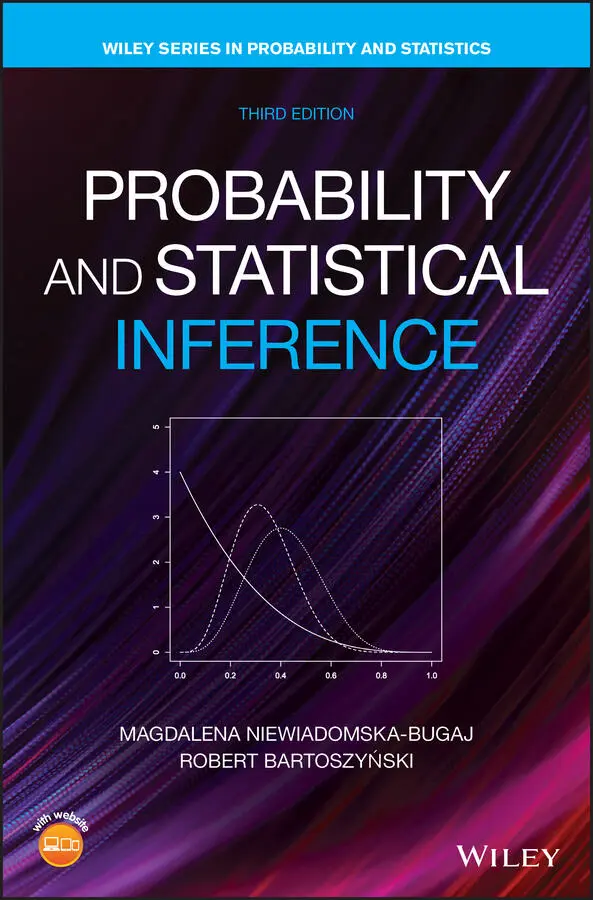
- Название:Probability and Statistical Inference
- Автор:
- Жанр:
- Год:неизвестен
- ISBN:нет данных
- Рейтинг книги:4 / 5. Голосов: 1
-
Избранное:Добавить в избранное
- Отзывы:
-
Ваша оценка:
Probability and Statistical Inference: краткое содержание, описание и аннотация
Предлагаем к чтению аннотацию, описание, краткое содержание или предисловие (зависит от того, что написал сам автор книги «Probability and Statistical Inference»). Если вы не нашли необходимую информацию о книге — напишите в комментариях, мы постараемся отыскать её.
Probability and Statistical Inference, Third Edition
Probability and Statistical Inference
Probability and Statistical Inference — читать онлайн ознакомительный отрывок
Ниже представлен текст книги, разбитый по страницам. Система сохранения места последней прочитанной страницы, позволяет с удобством читать онлайн бесплатно книгу «Probability and Statistical Inference», без необходимости каждый раз заново искать на чём Вы остановились. Поставьте закладку, и сможете в любой момент перейти на страницу, на которой закончили чтение.
Интервал:
Закладка:
Note that if  and
and  contain the class
  , then the intersection
  also contains
  . The property extends to any intersection of fields containing
  (not only the intersections of two such fields).
Now, let  be the intersection of all fields containing
  . We claim that
  is the minimal unique field containing
  . We have to show that (1)
  exists, (2)
  is a field containing
  , (3)
, (3)  is unique, and (4)
  is minimal.
For property (1) it is enough to show that there exists at least one field containing  . We may take here the class of all subsets of
  : it is a field (as well as a
  ‐field and monotone class), and it contains all sets in
  . Property (2) follows from the fact that the intersection of fields containing
  is a field containing
  . Property (3) (i.e., uniqueness of
  ) follows from the fact that the result of the operation of intersection is unique.
Finally, suppose that there exists a field  containing
  such that
  . Then
  must appear as one of the factors in the intersection defining
  so that
  . Consequently,
  . This completes the proof for the case of fields. The proofs for
  ‐fields and monotone classes are exactly the same, since an intersection of
  ‐fields (or monotone classes) containing
  is again a
  ‐field (monotone class) containing
  .
.
One may find it disturbing that Theorem 1.4.3asserts the existence and uniqueness of some objects without giving a clue as to how to practically find them. In fact, the nonconstructive character of the theorem, combined with its generality, is instead a great help. As we will see in Chapter 2, the natural objects of our interest (the domains of definition of probability) will be  ‐fields of events. Beyond the trivial situations of finite or countably infinite sample spaces
  , where one can always consider the maximal
  ‐field consisting of all subsets of
  , one is forced to restrict consideration to classes of events that form
  ‐fields generated by some “simple” events. The events in these
  ‐fields are typically of a very rich structure, and one seldom has useful criteria for distinguishing events (elements of the
  ‐field in question) from “nonevents,” that is, subsets of
  to which probabilities are not assigned. However, as shown by the two examples below, the smallest
  ‐field generated by some class is richer than the smallest field generated by the same class.
Интервал:
Закладка:
Похожие книги на «Probability and Statistical Inference»
Представляем Вашему вниманию похожие книги на «Probability and Statistical Inference» списком для выбора. Мы отобрали схожую по названию и смыслу литературу в надежде предоставить читателям больше вариантов отыскать новые, интересные, ещё непрочитанные произведения.









Обсуждение, отзывы о книге «Probability and Statistical Inference» и просто собственные мнения читателей. Оставьте ваши комментарии, напишите, что Вы думаете о произведении, его смысле или главных героях. Укажите что конкретно понравилось, а что нет, и почему Вы так считаете.