Michael H. Veatch - Linear and Convex Optimization
Здесь есть возможность читать онлайн «Michael H. Veatch - Linear and Convex Optimization» — ознакомительный отрывок электронной книги совершенно бесплатно, а после прочтения отрывка купить полную версию. В некоторых случаях можно слушать аудио, скачать через торрент в формате fb2 и присутствует краткое содержание. Жанр: unrecognised, на английском языке. Описание произведения, (предисловие) а так же отзывы посетителей доступны на портале библиотеки ЛибКат.
- Название:Linear and Convex Optimization
- Автор:
- Жанр:
- Год:неизвестен
- ISBN:нет данных
- Рейтинг книги:3 / 5. Голосов: 1
-
Избранное:Добавить в избранное
- Отзывы:
-
Ваша оценка:
Linear and Convex Optimization: краткое содержание, описание и аннотация
Предлагаем к чтению аннотацию, описание, краткое содержание или предисловие (зависит от того, что написал сам автор книги «Linear and Convex Optimization»). Если вы не нашли необходимую информацию о книге — напишите в комментариях, мы постараемся отыскать её.
The book offers a breadth of recent applications to demonstrate the many areas in which optimization is successfully and frequently used, while the process of formulating optimization problems is addressed throughout.
Linear and Convex Optimization Coverage of current methods in optimization in a style and level that remains appealing and accessible for mathematically trained undergraduates Enhanced insights into a few algorithms, instead of presenting many algorithms in cursory fashion An emphasis on the formulation of large, data-driven optimization problems Inclusion of linear, integer, and convex optimization, covering many practically solvable problems using algorithms that share many of the same concepts Presentation of a broad range of applications to fields like online marketing, disaster response, humanitarian development, public sector planning, health delivery, manufacturing, and supply chain management Ideal for upper level undergraduate mathematics majors with an interest in practical applications of mathematics, this book will also appeal to business, economics, computer science, and operations research majors with at least two years of mathematics training.
Linear and Convex Optimization — читать онлайн ознакомительный отрывок
Ниже представлен текст книги, разбитый по страницам. Система сохранения места последней прочитанной страницы, позволяет с удобством читать онлайн бесплатно книгу «Linear and Convex Optimization», без необходимости каждый раз заново искать на чём Вы остановились. Поставьте закладку, и сможете в любой момент перейти на страницу, на которой закончили чтение.
Интервал:
Закладка:
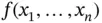
In Section 1.2we introduced the concept of a linear program. This section introduces algebraic and matrix notation for linear programs. It then defines the three main classes of mathematical programs: linear programs, integer programs, and nonlinear programs. Each of these will be studied in later chapters, though for nonlinear programs we will focus on the more tractable subclass of convex programs. A mathematical program with variables  and objective function
  can be stated abstractly in terms of a feasible region
  as
as
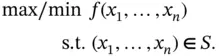
However, we will always describe the feasible region using constraint equations or inequalities. The notation for the constraints is introduced in the following text.
1.4.1 Linear Programs
We have already seen two examples of linear programs.
General Form of a Linear Program
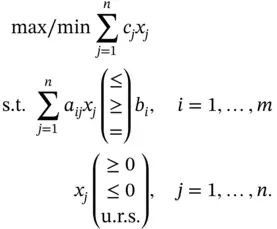
There are  decision variables,
  and
and  functional constraints. The constraints can use a mixture of “
  ”, “
”, “  ”, and “
  ”. Each variable may have the bound
  ,
,  , or no bound, which we call unrestricted in sign (u.r.s.). The distinguishing characteristics of a linear program are (i) the objective function and all constraints are linear functions and (ii) the variables are continuous, i.e. fractional values are allowed. They are often useful as approximate models even when these assumptions do not fully hold.
We will use matrix notation for linear programs whenever possible. Let  ,
,  ,
,  , and
, and
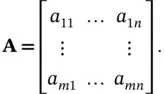
Here  ,
,  , and
, and  are column vectors. If all the constraints are equalities, they can be written
  . Similarly, “
  ” constraints can be written
  .
.
Example 1.2Consider the linear program
(1.4) 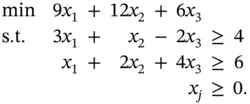
Converting the objective function and constraints to matrix form, we have
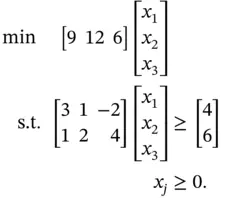
If we let

then this linear program can be written
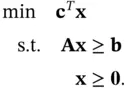
It is important to distinguish between the structure of an optimization problem and the data that provides a specific numerical example. The structure of ( 1.4) is a minimization linear program with “  ” constraints and nonnegative variables; the data are the values in
  ,
,  , and
, and  .
.
To write a mixture of “  ” and “
  ” constraints, it is convenient to use submatrices
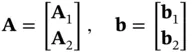
and write, e.g.

1.4.2 Integer Programs
Many practical optimization problems involve making discrete quantitative choices, such as how many fire trucks of each type a fire department should purchase, or logical choices, such as whether or not each drug being developed by a pharmaceutical company should be chosen for a clinical trial. Both types of situations can be modeled by integer variables.
Читать дальшеИнтервал:
Закладка:
Похожие книги на «Linear and Convex Optimization»
Представляем Вашему вниманию похожие книги на «Linear and Convex Optimization» списком для выбора. Мы отобрали схожую по названию и смыслу литературу в надежде предоставить читателям больше вариантов отыскать новые, интересные, ещё непрочитанные произведения.











Обсуждение, отзывы о книге «Linear and Convex Optimization» и просто собственные мнения читателей. Оставьте ваши комментарии, напишите, что Вы думаете о произведении, его смысле или главных героях. Укажите что конкретно понравилось, а что нет, и почему Вы так считаете.