Aiden A. Bruen - Cryptography, Information Theory, and Error-Correction
Здесь есть возможность читать онлайн «Aiden A. Bruen - Cryptography, Information Theory, and Error-Correction» — ознакомительный отрывок электронной книги совершенно бесплатно, а после прочтения отрывка купить полную версию. В некоторых случаях можно слушать аудио, скачать через торрент в формате fb2 и присутствует краткое содержание. Жанр: unrecognised, на английском языке. Описание произведения, (предисловие) а так же отзывы посетителей доступны на портале библиотеки ЛибКат.
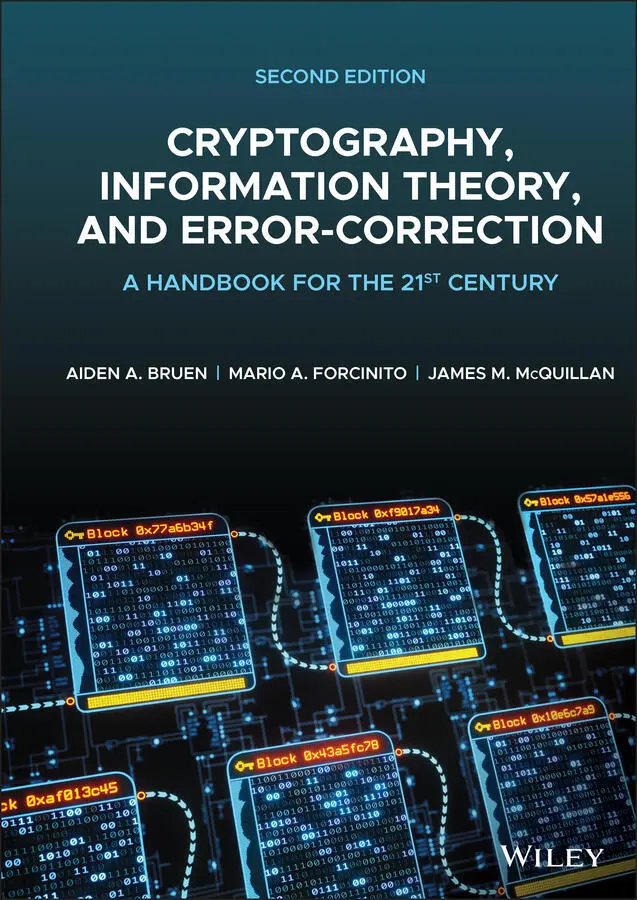
- Название:Cryptography, Information Theory, and Error-Correction
- Автор:
- Жанр:
- Год:неизвестен
- ISBN:нет данных
- Рейтинг книги:5 / 5. Голосов: 1
-
Избранное:Добавить в избранное
- Отзывы:
-
Ваша оценка:
Cryptography, Information Theory, and Error-Correction: краткое содержание, описание и аннотация
Предлагаем к чтению аннотацию, описание, краткое содержание или предисловие (зависит от того, что написал сам автор книги «Cryptography, Information Theory, and Error-Correction»). Если вы не нашли необходимую информацию о книге — напишите в комментариях, мы постараемся отыскать её.
A rich examination of the technologies supporting secure digital information transfers from respected leaders in the field Cryptography, Information Theory, and Error-Correction: A Handbook for the 21ST Century
Cryptography, Information Theory, and Error-Correction
Cryptography, Information Theory, and Error-Correction — читать онлайн ознакомительный отрывок
Ниже представлен текст книги, разбитый по страницам. Система сохранения места последней прочитанной страницы, позволяет с удобством читать онлайн бесплатно книгу «Cryptography, Information Theory, and Error-Correction», без необходимости каждый раз заново искать на чём Вы остановились. Поставьте закладку, и сможете в любой момент перейти на страницу, на которой закончили чтение.
Интервал:
Закладка:
Several remarks are in order.
Remark 3.1
1 The fact that B deciphers to recover the message by simply using the deciphering algorithm explained above is proved in Chapter 19.
2 Having found a decryption index by the official (hard) way, let us find an easier method. All we need is the unique integer, let us call it , between 1 and 20, such that gives a remainder of 1 when divided by 20. Why 20? Well, instead of using , we can use any positive integer divisible by both and . With and , we choose the number 20, and get . Then it is easy to check that the remainder of upon division by 55 is 6. It is much easier to use the decryption index 3 instead of the decryption index 23.
3 The security of RSA rests on the mathematically unproven assumption that, even given , , , an individual (other than B) cannot recover in a reasonable amount of time if and are large.
In technical language, the problem of recovering  is said to be computationally infeasible (= infeasible ) or intractable . The enciphering function transforming
  is conjectured to be a one‐way function , i.e. it is easy to calculate
  given
given  , but it is impossible to undo this calculation.
Given  and the two factors
  of
of  it is easy to calculate
  and thus to obtain
  from
from  (see Chapter 19). Thus, if one can solve the problem of factoring
  quickly one can calculate
  quickly and thus
  , given
  . On the other hand, if we can find
  , then we can get
  (but also
  and
and  ).
).
It is now time to give a formal description of the RSA algorithm, as follows.
3.3 The General RSA Algorithm
A(=Alice) wants to send a secret message  to B(=Bob). Bob has already chosen two large unequal prime 1 numbers
  and
and  . Bob multiplies
  and
and  together to get
  . Bob also chooses some integer
  bigger than 1. The integer
  (
(  for enciphering) must have no factors in common with
  and no factors in common with
  . In other words, the greatest common divisor of
  and
and  is 1 (and similarly for
  and
and  ). In symbols, we write
  and
and  . Thus, the only number dividing both
  and
and  is 1, and the only number dividing both
  and
and  is 1. We say also that
  is relatively prime to
  and to
  . It follows that
  .
.
Интервал:
Закладка:
Похожие книги на «Cryptography, Information Theory, and Error-Correction»
Представляем Вашему вниманию похожие книги на «Cryptography, Information Theory, and Error-Correction» списком для выбора. Мы отобрали схожую по названию и смыслу литературу в надежде предоставить читателям больше вариантов отыскать новые, интересные, ещё непрочитанные произведения.










Обсуждение, отзывы о книге «Cryptography, Information Theory, and Error-Correction» и просто собственные мнения читателей. Оставьте ваши комментарии, напишите, что Вы думаете о произведении, его смысле или главных героях. Укажите что конкретно понравилось, а что нет, и почему Вы так считаете.