Aiden A. Bruen - Cryptography, Information Theory, and Error-Correction
Здесь есть возможность читать онлайн «Aiden A. Bruen - Cryptography, Information Theory, and Error-Correction» — ознакомительный отрывок электронной книги совершенно бесплатно, а после прочтения отрывка купить полную версию. В некоторых случаях можно слушать аудио, скачать через торрент в формате fb2 и присутствует краткое содержание. Жанр: unrecognised, на английском языке. Описание произведения, (предисловие) а так же отзывы посетителей доступны на портале библиотеки ЛибКат.
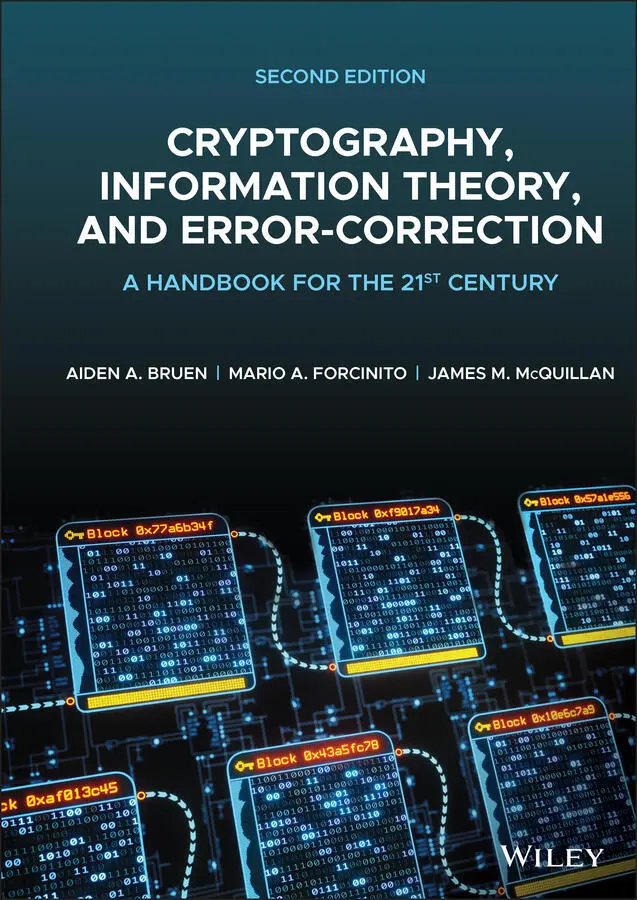
- Название:Cryptography, Information Theory, and Error-Correction
- Автор:
- Жанр:
- Год:неизвестен
- ISBN:нет данных
- Рейтинг книги:5 / 5. Голосов: 1
-
Избранное:Добавить в избранное
- Отзывы:
-
Ваша оценка:
Cryptography, Information Theory, and Error-Correction: краткое содержание, описание и аннотация
Предлагаем к чтению аннотацию, описание, краткое содержание или предисловие (зависит от того, что написал сам автор книги «Cryptography, Information Theory, and Error-Correction»). Если вы не нашли необходимую информацию о книге — напишите в комментариях, мы постараемся отыскать её.
A rich examination of the technologies supporting secure digital information transfers from respected leaders in the field Cryptography, Information Theory, and Error-Correction: A Handbook for the 21ST Century
Cryptography, Information Theory, and Error-Correction
Cryptography, Information Theory, and Error-Correction — читать онлайн ознакомительный отрывок
Ниже представлен текст книги, разбитый по страницам. Система сохранения места последней прочитанной страницы, позволяет с удобством читать онлайн бесплатно книгу «Cryptography, Information Theory, and Error-Correction», без необходимости каждый раз заново искать на чём Вы остановились. Поставьте закладку, и сможете в любой момент перейти на страницу, на которой закончили чтение.
Интервал:
Закладка:
Let us formalize the procedure.
The RSA Algorithm.
1 Bob chooses in secret two large primes with and sets .
2 Bob chooses bigger than 1 with relatively prime to and to , and with .
3 Bob calculates the decryption index , where is such that the remainder of on division by is 1. More generally, Bob calculates a decryption index , where is such that the remainder of on division by is 1. Here, is any number divisible by both and .
4 Bob announces his public key and keeps his private key secret.
5 Alice wishes to send a secret message and represents as a number between 0 and . Alice then encrypts the message as the remainder of upon division by and transmits to Bob.
6 Bob decrypts by calculating the remainder of upon division by : this gives the original secret message .
Remark 3.2
If  are odd, then
  are even, and so each is divisible by 2. So by choosing
  to be the least common multiple of
  and
and  , we get that
  .
.
Remark 3.3
It is beneficial for Bob to also store  and
and  rather than just
  . The reason is that some decryption algorithms work faster if he makes use of
  and
and  rather than just
  . Thus, the private key is sometimes defined as the triple
  .
.
Another example of the RSA algorithm
In the example below, we also briefly indicate how more sophisticated number theory can shorten the calculations.
Suppose Bob chooses the primes  and
and  . So
. So  , and
, and  . A valid choice for
  is 7, as
  . Using the Euclidean Algorithm, Bob can also calculate
  (see Chapter 19). Bob announces his public key
  and finds
  . Bob keeps
  secret. When Alice wants to send
  to Bob, she computes
  using the repeated squaring method to find that
  . Alice then transmits
  in public, and when Bob receives it, he can either compute
  directly using the repeated squaring technique, or take a more efficient approach, as follows: Bob calculates
  and
and  , then uses the Chinese Remainder Theorem (of Chapter 19) to combine them to find
  . Since
  , Bob knows that
  , and by a theorem due to Fermat 2 this is equal to
  . Similarly,
  . Bob then combines
  and
and  to find
  .
.
Интервал:
Закладка:
Похожие книги на «Cryptography, Information Theory, and Error-Correction»
Представляем Вашему вниманию похожие книги на «Cryptography, Information Theory, and Error-Correction» списком для выбора. Мы отобрали схожую по названию и смыслу литературу в надежде предоставить читателям больше вариантов отыскать новые, интересные, ещё непрочитанные произведения.







Обсуждение, отзывы о книге «Cryptography, Information Theory, and Error-Correction» и просто собственные мнения читателей. Оставьте ваши комментарии, напишите, что Вы думаете о произведении, его смысле или главных героях. Укажите что конкретно понравилось, а что нет, и почему Вы так считаете.