Michael Veitch - Hell Ship
Здесь есть возможность читать онлайн «Michael Veitch - Hell Ship» весь текст электронной книги совершенно бесплатно (целиком полную версию без сокращений). В некоторых случаях можно слушать аудио, скачать через торрент в формате fb2 и присутствует краткое содержание. Город: Sydney, Год выпуска: 2018, ISBN: 2018, Издательство: Allen & Unwin, Жанр: История, на английском языке. Описание произведения, (предисловие) а так же отзывы посетителей доступны на портале библиотеки ЛибКат.
- Название:Hell Ship
- Автор:
- Издательство:Allen & Unwin
- Жанр:
- Год:2018
- Город:Sydney
- ISBN:978-1-76063-084-3
- Рейтинг книги:4 / 5. Голосов: 1
-
Избранное:Добавить в избранное
- Отзывы:
-
Ваша оценка:
Hell Ship: краткое содержание, описание и аннотация
Предлагаем к чтению аннотацию, описание, краткое содержание или предисловие (зависит от того, что написал сам автор книги «Hell Ship»). Если вы не нашли необходимую информацию о книге — напишите в комментариях, мы постараемся отыскать её.
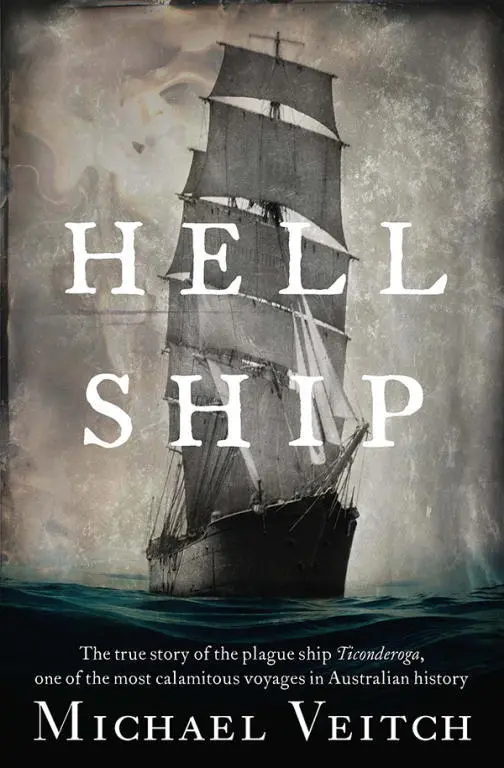
that left England for Victoria with 800 doomed emigrants on board. For more than a century and a half, a grim tale has passed down through Michael Veitch’s family: the story of the
, a clipper ship that sailed from Liverpool in August 1852, crammed with poor but hopeful emigrants—mostly Scottish victims of the Clearances and the potato famine. A better life, they believed, awaited them in Australia.
Three months later, a ghost ship crept into Port Phillip Bay flying the dreaded yellow flag of contagion. On her horrific three-month voyage, deadly typhus had erupted, killing a quarter of
’s passengers and leaving many more desperately ill. Sharks, it was said, had followed her passage as the victims were buried at sea.
Panic struck Melbourne. Forbidden to dock at the gold-boom town, the ship was directed to a lonely beach on the far tip of the Mornington Peninsula, a place now called Ticonderoga Bay.
James William Henry Veitch was the ship’s assistant surgeon, on his first appointment at sea. Among the volunteers who helped him tend to the sick and dying was a young woman from the island of Mull, Annie Morrison. What happened between them on that terrible voyage is a testament to human resilience, and to love.
Michael Veitch is their great-great-grandson, and
is his brilliantly researched narrative of one of the biggest stories of its day, now all but forgotten. Broader than his own family’s story, it brings to life the hardships and horrors endured by those who came by sea to seek a new life in Australia.
Hell Ship — читать онлайн бесплатно полную книгу (весь текст) целиком
Ниже представлен текст книги, разбитый по страницам. Система сохранения места последней прочитанной страницы, позволяет с удобством читать онлайн бесплатно книгу «Hell Ship», без необходимости каждый раз заново искать на чём Вы остановились. Поставьте закладку, и сможете в любой момент перейти на страницу, на которой закончили чтение.
Интервал:
Закладка:
Patrick Sullivan, William Cannon and a small group of local lime-burners and fishermen were more than alarmed to see a group of seamen storming ashore towards their homes like a small invading army. Confronting them, they demanded to know what exactly was going on. The crew of the Ticonderoga had no time for niceties, however, and relating what they had been through these last weeks—for the first time to outsiders—while they worked on the shelters, the little crowd, as well as those family members whose curiosity had overcome their fear to emerge from their dwellings, gathered around their uninvited guests in deepening silence while the story of the ship of death unfolded.
As they listened, Sullivan and Cannon, who had watched the vessel’s ominous approach from the other side of the bay the day before, realised that their worst fears were unfolding. None of it came as a complete surprise. It had now been months since the small surveying party led by the important doctor from Melbourne, Thomas Hunt, first arrived to inspect their beach and its environs. From that moment, the brothers-in-law realised that the clock was ticking on the day the government would take it back from them. For Sullivan, whose parents had already suffered exile back in Ireland when people of power decided they would leave their land, it seemed that history was repeating itself.
With some rudimentary shelters established, Veitch made an assessment of the little hospital ward taking shape on the beach and was pleased by what he saw. Delivering his patients to shore, however, would be a far more difficult matter. Except for the very worst cases, though, the risk must be taken to remove them from the ship, where he knew only too well there was no hope for them whatever. Again, the crew of the Ticonderoga would carry out the task, being instructed to extract people as delicately as possible from their berths or from the ship’s hospital and carry them, literally on their backs, to the deck then down the long gangway to the waterline, where rowboats would take them to shore. Some of the sick could walk, but not many.
Reporting back to Sanger, Veitch was told to delay not a moment further. It was a long, miserable and enervating process for all concerned, but by the end of the first day at the cove, 40 of the Ticonderoga ’s most feverish and delirious passengers had been taken off and laid down on dry land for the first time in three months. Some, however, were simply too sick to move and were compelled to remain on the ship. For those who came ashore, it was all they could do to crawl into the shady nooks and shelters that had been provided for them by the sailors. Passenger James Dundas recalled years later that ‘there was very little canvas for tents, so they had to make bush mia-mias for us to camp in them… like black fellows’. [1] Carroll, 1970, (page not visible)
Here, at the very least, they could look up at a clear sky, released finally from the dreadful smell, the deathly, suffocating atmosphere and incessant rocking of the ship.
The ship’s doctors, by contrast, could indulge in no such relief, faced as they were with an entirely new set of problems. Veitch estimated to Sanger that upwards of 250 people still required treatment and that not enough of anything was available to help them. To start with, there was hardly any bedding left on board that was not putrid, that of the dead having been thrown overboard after them, and much of the spare sailcloth had gone as well. And how were they expected to feed this burgeoning beach hospital? Time would be needed to remove stoves and other facilities from the ship and relocate them on to land. Nor were there any medical comforts remaining, with both Veitch and Sanger having now exhausted their own stocks as well as the ship’s. Then there was the question of who was to bury the dead, mounting up perilously on the deck in the warm spring sun. For it was now, upon arriving at her destination, that the Ticonderoga ’s death toll reached its terrible zenith.
In the first few days of November, within clear sight of land, no less than fourteen people died on board the Ticonderoga . Alexander Mercer, 32, from Edinburgh followed his infant son, who had been one of the ship’s earliest victims back in August, leaving only his wife and six-year-old boy. The infant Elizabeth Wilkie perished—mercifully the only member of her family of five to do so—but the very opposite was the case for the Appleby family, which saw the death on 2 November of John Appleby, three, following his younger sister Emma and his mother Sarah to the grave, leaving Silas Appleby, 28, alone in a new and unfamiliar world.
The list continued: Euphemia Reid, 36; John Spinwright, 30; Janet Stevenson; and Mary Bunton, 31. Little James Isbister would be the first—but not the last—to die from his very large family of twelve, who had possibly travelled the furthest of anyone on board the Ticonderoga , having left their home in the remote Orkney Islands off Scotland’s north-east coast.
The worst day of the voyage was 4 November, when seven people died. One of those was Elizabeth Harcus, twenty, who the very next day would be joined by her sixteen-year-old sister, Mary, as the disease tore through the single women’s quarters. By the end of the voyage, her father, George, would have lost all the women in his family as well as a son. There would be more deaths the next day, and the day after that until the warm spring sunshine and healing rest would gradually begin their work. Meanwhile, the ship continued to be awash with misery, but the focus of Drs Veitch and Sanger had to be on the living. Without the continued assistance of their volunteer nurses, Mr and Mrs Fanning and the steady Highland lass Annie Morrison, the doctors could not possibly have coped.
When dusk came, a good number of the sickest passengers had been placed ashore in their hastily constructed quarters. It being too risky to continue transferring patients after dark, Captain Boyle called a halt to the proceedings as the sun started to set. As he did, he was approached by one of the more senior passengers on board, 49-year-old Malcolm McRae, who had travelled with his wife, Helen, 39, and their seven children ranging from seventeen-year-old Christopher to Malcolm, two, who was currently sick. As McRae would later recall in his letter in The Argus , he politely explained to the captain in his soft Highland accent that his only daughter, Janet, ten, had died that afternoon and he would like permission to go ashore and bury her. To Boyle, he looked as utterly worn out as a man could be, but he was at pains to maintain his dignity as well as his manners. The captain had no doubt a refusal would be met simply with a nod, a ‘Thank-you, Captain’, and a quiet departure. Despite the last of the rowboats having returned for the night, some light still remained on the western horizon. Boyle looked around for one of his crew. ‘You would need to be quick, Sir,’ he said to McRae. ‘I cannot have you returning in the dark.’ McRae shook his hand. ‘I thank you, Captain,’ he said, with just a hint of a failing voice.
With the help of her eldest brother, Christopher, the girl was retrieved from below and her father carried her out, under a cloth, her small body appearing to weigh little more than the cold, damp clothes that clung to her. He was led down the side gangway and waited there while the sailor retrieved the small rowboat. Doyle watched them as they set off for the nearby shore, the rich red rays of a dazzling sunset lighting his expressionless face.
A short time later, at the very edge of the dusk, they returned to the ship, where yet more grief awaited Malcolm McRae. His son, Malcolm, had also now died. Once more, he politely requested permission to bury him, but this time Boyle had to refuse. ‘Thank you, Captain,’ was the man’s only reply, as he nodded and turned quietly away, having lost two children in a single day. His son would be buried beside his sister the next morning, in a dry plot behind the dunes that the first mate had pegged out that afternoon. The boy would not be the last member of his family that McRae would have to bury before the ordeal was finally over.
Читать дальшеИнтервал:
Закладка:
Похожие книги на «Hell Ship»
Представляем Вашему вниманию похожие книги на «Hell Ship» списком для выбора. Мы отобрали схожую по названию и смыслу литературу в надежде предоставить читателям больше вариантов отыскать новые, интересные, ещё непрочитанные произведения.










Обсуждение, отзывы о книге «Hell Ship» и просто собственные мнения читателей. Оставьте ваши комментарии, напишите, что Вы думаете о произведении, его смысле или главных героях. Укажите что конкретно понравилось, а что нет, и почему Вы так считаете.