Michael Veitch - Hell Ship
Здесь есть возможность читать онлайн «Michael Veitch - Hell Ship» весь текст электронной книги совершенно бесплатно (целиком полную версию без сокращений). В некоторых случаях можно слушать аудио, скачать через торрент в формате fb2 и присутствует краткое содержание. Город: Sydney, Год выпуска: 2018, ISBN: 2018, Издательство: Allen & Unwin, Жанр: История, на английском языке. Описание произведения, (предисловие) а так же отзывы посетителей доступны на портале библиотеки ЛибКат.
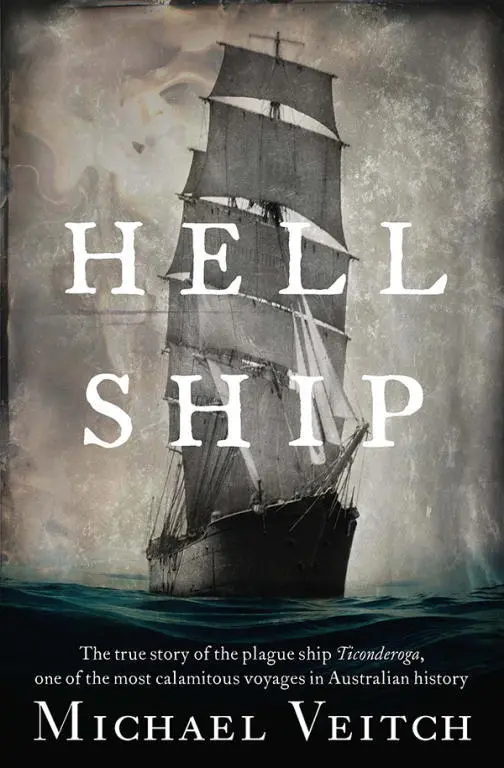
- Название:Hell Ship
- Автор:
- Издательство:Allen & Unwin
- Жанр:
- Год:2018
- Город:Sydney
- ISBN:978-1-76063-084-3
- Рейтинг книги:4 / 5. Голосов: 1
-
Избранное:Добавить в избранное
- Отзывы:
-
Ваша оценка:
Hell Ship: краткое содержание, описание и аннотация
Предлагаем к чтению аннотацию, описание, краткое содержание или предисловие (зависит от того, что написал сам автор книги «Hell Ship»). Если вы не нашли необходимую информацию о книге — напишите в комментариях, мы постараемся отыскать её.
that left England for Victoria with 800 doomed emigrants on board. For more than a century and a half, a grim tale has passed down through Michael Veitch’s family: the story of the
, a clipper ship that sailed from Liverpool in August 1852, crammed with poor but hopeful emigrants—mostly Scottish victims of the Clearances and the potato famine. A better life, they believed, awaited them in Australia.
Three months later, a ghost ship crept into Port Phillip Bay flying the dreaded yellow flag of contagion. On her horrific three-month voyage, deadly typhus had erupted, killing a quarter of
’s passengers and leaving many more desperately ill. Sharks, it was said, had followed her passage as the victims were buried at sea.
Panic struck Melbourne. Forbidden to dock at the gold-boom town, the ship was directed to a lonely beach on the far tip of the Mornington Peninsula, a place now called Ticonderoga Bay.
James William Henry Veitch was the ship’s assistant surgeon, on his first appointment at sea. Among the volunteers who helped him tend to the sick and dying was a young woman from the island of Mull, Annie Morrison. What happened between them on that terrible voyage is a testament to human resilience, and to love.
Michael Veitch is their great-great-grandson, and
is his brilliantly researched narrative of one of the biggest stories of its day, now all but forgotten. Broader than his own family’s story, it brings to life the hardships and horrors endured by those who came by sea to seek a new life in Australia.
Hell Ship — читать онлайн бесплатно полную книгу (весь текст) целиком
Ниже представлен текст книги, разбитый по страницам. Система сохранения места последней прочитанной страницы, позволяет с удобством читать онлайн бесплатно книгу «Hell Ship», без необходимости каждый раз заново искать на чём Вы остановились. Поставьте закладку, и сможете в любой момент перейти на страницу, на которой закончили чтение.
Интервал:
Закладка:
Ferguson planned to sail the Empire as soon as possible to Point Nepean to deal with this new emergency and to take along with him one of the most important medical men in the colony, his colleague and Port Health Officer, Dr Thomas Hunt, whose new quarantine station, Ferguson had told him, might be happening considerably sooner than planned. In the meantime, he arranged for the ship to be packed with as many fresh stores as she could carry: eleven live sheep, 276 pounds of fresh beef, 53 loaves of freshly baked bread, 24 bags of fresh potatoes, four cases of porter, one case of wine, 9 pounds of arrowroot, and six iron pots. The list was a long one, but whatever had to be done to see it filled, Ferguson saw that it was done.
The rest of that day, orders and requisitions raced out of the Harbour Master’s office to suppliers across Williamstown and Melbourne. Their response came swiftly in the form of wagons arriving at the dock heavily laden with provisions. The most important acquisition of the day was the full medical chest to replenish the exhausted supplies of Drs Sanger and Veitch, but what Ferguson desperately needed was another doctor to travel with it. This same person would be then required to relieve the ailing and exhausted ship’s surgeons, distribute supplies, then stay on to organise the quarantine station, which at this moment existed only on paper. Such a person would not be easy to come by—particularly at short notice—but these were desperate times. Hurrying down the corridor to Thomas Hunt’s nearby office, the two men struggled to think of a suitable candidate.
Ferguson then fetched the list of ships currently in port and, running his finger down the column, stopped at the Ottillia, another large emigrant vessel that had recently arrived from Liverpool, currently undergoing repairs for lightning damage, and whose surgeon was listed as a Dr Joseph Taylor. The two men looked at each other. Perfect, they agreed, before hurrying out the door. A short time later, they stood beside the handsome Ottillia as she was tied up at the wharf, inquiring of her officers whether the surgeon superintendent might be available for a brief word. As it happened, Dr Taylor was in his cabin, and more than a little surprised to have his presence requested by no lesser figures than the Chief Harbour Master and Port Health Officer, who greeted him in the warmest of terms despite neither having met him before in their lives.
After extolling his well-known reputation as an exemplary practitioner of medicine, Ferguson and Hunt came quickly to the point. A brand new government quarantine station was being set up a little way from Melbourne and Dr Taylor was just the man to run it. A handsome salary of not less than £300 was on offer, as well as accommodation and excellent rations for himself and his family. Did he by chance, Dr Hunt inquired, happen to have any experience with fever? Absolutely, replied Dr Taylor, a veteran of several long voyages who in fact had treated many such cases. ‘Excellent!’ exclaimed Ferguson. Lieutenant-Governor La Trobe, he added quietly, is most pleased that you might consider the position favourably. When Taylor’s head had stopped spinning, he wondered whether he might be allowed a little time to consider the Lieutenant-Governor’s most generous offer. Unfortunately, insisted the two gentlemen, time was such that the Lieutenant-Governor was most anxious to see the position filled without delay, and so an answer was required, well, immediately. As soon as a stunned Taylor nodded his assent, he felt his hand pumped vigorously and was told to pack his bags to be ready to sail to Point Nepean in precisely… at this point Ferguson checked his fob watch… two hours’ time. Oh, Dr Hunt added, you would be advised to bring with you all the medicine and drugs you might have in your possession, as well as all those you can get your hands on at short notice. Then, thanking him profusely and wishing him a good day, Ferguson and Hunt were gone.
Sitting in the wooden cottage he had had dismantled in England and brought out in pieces to be re-erected on his estate in Melbourne, which—in a touch of nostalgia for his French heritage—he had named Jolimont , news of the Ticonderoga hit Lieutenant-Governor Charles La Trobe like a lightning bolt. Immediately, he knew himself to be facing the most serious crisis in his role of running this new colony. Not only could such a disaster have serious ramifications for the flow of able-bodied people willing to come to Victoria, but if the disease itself was allowed to gain a foothold in Melbourne itself… it was a picture that did not bear thinking about.
The Empire, he knew, would soon be on its way to Point Nepean along with Hunt and Ferguson, but with nearly 700 desperately ill people stranded on a beach, whatever relief she could bring would, he knew, not last long. He urgently inquired about what other provisions were available to be sent to the Ticonderoga. He then learned that, by remarkable fortune, the old Lysander had once more become available, on account of the initial diagnosis of smallpox among the men of the 40th Regiment of Foot now being declared a false alarm. Advanced syphilis, it transpired, was the disease in question. While undoubtedly ghastly for the sufferer involved, this was nonetheless a far cry from smallpox. The relieved men of the 40th had been allowed to disembark the Lysander , and the ship was given pratique —permission to enter port—a day or so later. Even better, 50 new beds had just been installed in her holds, and her stores of fresh water and other provisions had yet to be returned to the warehouses. She would therefore immediately be dispatched to Point Nepean, where she would distribute her goods, offer what help she could and remain as a hospital ship until the quarantine station could erect more permanent facilities. This would have been welcome news indeed for the people on board the Ticonderoga , as down at the little cove, help could not come fast enough.
Unlike just about everybody else on board the Ticonderoga , Dr Sanger was showing some signs of recovery. Having been acting as his plenipotentiary these past few days, Dr Veitch conveyed his superior’s instructions when he was well enough to actually issue them, doing his best to reassure the passengers that a period of quarantine was a blessing in disguise—it was not only essential to stop the spread of the disease, but the enforced rest it entailed, not to mention the fresh food and medicine that would soon arrive, would provide the greatest incentive to a cure that could be asked for. In truth though, Veitch had shared his passengers’ shock at realising that they were headed not for port, but rather for a lonely beach, and for an indefinite period of time.
The pilot, Henry Draper, had not said much beyond delivering them to the sanitary station , but when Boyle searched the shoreline for evidence of such a station, all he could see in front of him was sand and scrub. Draper may at this point have quietly qualified his earlier remark with the words ‘future sanitary station’ . He assured Boyle that help would be arriving, and that they must wait here until it did.
Boyle informed Veitch of the situation, adding that as far as anchorages went, this secure and sheltered little cove was not too bad. Wherever they found themselves, however, both agreed that the passengers—starting with the very sick—must be evacuated off the ship as soon as possible. Without waiting for instructions, Boyle directed those able-bodied of his crew to go ashore and begin to construct whatever shelter they could from the ship’s spare spars and sailcloth, which were hauled out from deep in her holds. In the bright sunshine, the working parties rowed ashore and toiled in front of the lime-burners’ cottages and further back among the dunes, using the hardy ti-tree branches as supports for makeshift tents.
Читать дальшеИнтервал:
Закладка:
Похожие книги на «Hell Ship»
Представляем Вашему вниманию похожие книги на «Hell Ship» списком для выбора. Мы отобрали схожую по названию и смыслу литературу в надежде предоставить читателям больше вариантов отыскать новые, интересные, ещё непрочитанные произведения.










Обсуждение, отзывы о книге «Hell Ship» и просто собственные мнения читателей. Оставьте ваши комментарии, напишите, что Вы думаете о произведении, его смысле или главных героях. Укажите что конкретно понравилось, а что нет, и почему Вы так считаете.