Michael Veitch - Hell Ship
Здесь есть возможность читать онлайн «Michael Veitch - Hell Ship» весь текст электронной книги совершенно бесплатно (целиком полную версию без сокращений). В некоторых случаях можно слушать аудио, скачать через торрент в формате fb2 и присутствует краткое содержание. Город: Sydney, Год выпуска: 2018, ISBN: 2018, Издательство: Allen & Unwin, Жанр: История, на английском языке. Описание произведения, (предисловие) а так же отзывы посетителей доступны на портале библиотеки ЛибКат.
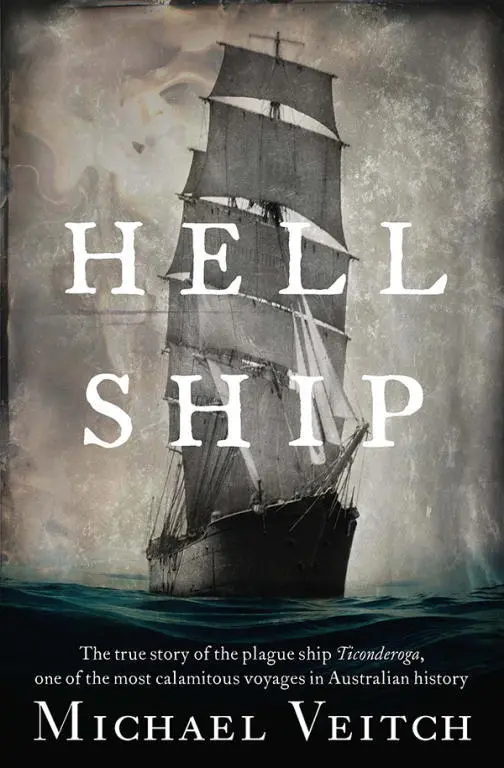
- Название:Hell Ship
- Автор:
- Издательство:Allen & Unwin
- Жанр:
- Год:2018
- Город:Sydney
- ISBN:978-1-76063-084-3
- Рейтинг книги:4 / 5. Голосов: 1
-
Избранное:Добавить в избранное
- Отзывы:
-
Ваша оценка:
Hell Ship: краткое содержание, описание и аннотация
Предлагаем к чтению аннотацию, описание, краткое содержание или предисловие (зависит от того, что написал сам автор книги «Hell Ship»). Если вы не нашли необходимую информацию о книге — напишите в комментариях, мы постараемся отыскать её.
that left England for Victoria with 800 doomed emigrants on board. For more than a century and a half, a grim tale has passed down through Michael Veitch’s family: the story of the
, a clipper ship that sailed from Liverpool in August 1852, crammed with poor but hopeful emigrants—mostly Scottish victims of the Clearances and the potato famine. A better life, they believed, awaited them in Australia.
Three months later, a ghost ship crept into Port Phillip Bay flying the dreaded yellow flag of contagion. On her horrific three-month voyage, deadly typhus had erupted, killing a quarter of
’s passengers and leaving many more desperately ill. Sharks, it was said, had followed her passage as the victims were buried at sea.
Panic struck Melbourne. Forbidden to dock at the gold-boom town, the ship was directed to a lonely beach on the far tip of the Mornington Peninsula, a place now called Ticonderoga Bay.
James William Henry Veitch was the ship’s assistant surgeon, on his first appointment at sea. Among the volunteers who helped him tend to the sick and dying was a young woman from the island of Mull, Annie Morrison. What happened between them on that terrible voyage is a testament to human resilience, and to love.
Michael Veitch is their great-great-grandson, and
is his brilliantly researched narrative of one of the biggest stories of its day, now all but forgotten. Broader than his own family’s story, it brings to life the hardships and horrors endured by those who came by sea to seek a new life in Australia.
Hell Ship — читать онлайн бесплатно полную книгу (весь текст) целиком
Ниже представлен текст книги, разбитый по страницам. Система сохранения места последней прочитанной страницы, позволяет с удобством читать онлайн бесплатно книгу «Hell Ship», без необходимости каждый раз заново искать на чём Вы остановились. Поставьте закладку, и сможете в любой момент перейти на страницу, на которой закончили чтение.
Интервал:
Закладка:
The more of the area Ferguson explored, the more he believed Hunt’s initial recommendation for the site to have been a sound one. As well as bush, he reported a large area of
dry open country, a large portion of which is capable of immediate cultivation, with abundance of timber, and from the statements of the Pilots, and those who have resided there for many years, plenty of fresh water can be got at all seasons by sinking wells at a moderate depth. The anchorage is quite secure, any vessel can lay in safety within a quarter of a mile of the beach. [6] Welch, 1969, p. 24
There was also an area of several acres under cultivation with oats and potatoes, which would be of good use.
Red marker lines were laid out to delineate various other necessary aspects of the station, and by making all who were there again walk over the boundaries with him, Ferguson made sure everyone understood exactly the new parameters of their changing world. Failing to respect those parameters, he added, would lead to severe consequences. Then, satisfied with the rudimentary layout, Ferguson ordered two 30-foot timbers to be taken from the ship’s carpentry stores and brought ashore. Two holes were dug several yards apart, and the timbers were erected as flagpoles, marking out in the boldest terms the entrance of the station—directly off the beach, facing the water, so that any who approached would be in no doubt that this was no longer simply a quiet piece of beach.
The next morning, to Ferguson’s considerable relief, the great hulk of the Lysander hove into view. Three vessels of size—a small but impressive fleet—had now dropped anchor inside the previously quiet cove of Abraham’s Bosom. More stores were offloaded, then Ferguson requested that Captain Boyle assemble all his able-bodied passengers. In terms that invited neither question nor equivocation, Ferguson informed them that all joiners, carpenters, stonemasons—in fact, every man skilled in a useful trade—were as of now employed by the government at a rate of 5 shillings a day. A quarantine station needed to be built right here, he told them, and they were going to build it. Those who had not travelled with their own tools would be provided with them from the Ticonderoga ’s stores, or those of the Lysander . The men, slightly dumbfounded, looked around at each other briefly, then nodded in assent. The stonemasons went ashore first, and were told to begin work on a couple of simple storehouses utilising the abundance of limestone that surrounded them. Aside from the pay, which was at a rate greater than they could expect doing similar work at home, most were happy to finally be of some use after the ghastly voyage when all they could do was wait for death to stalk yet another victim.
Apart from the practical advantage of an instant labour force, Ferguson, who had worked with men all his life at sea, on no account wanted idle and potentially disgruntled hands lying about with nothing to do but brood on their ill fortune. In his report, he dared to
respectfully suggest that the Colonial Architect send down at once a plain plan or sketch of a large airy barracks or depot, as there is an abundance of materials on the spot for its construction, which would furnish immediate work for the healthy Emigrants, who ought on no account to wander about the station in idleness. [7] Welch, 1969, p. 25
Realising that sick people could endure only so much sleeping on a beach, and that an alternative quickly needed to be found, Ferguson drew Sanger and Veitch to the rail, and indicated the Lysander. This, he told them, was to be their new hospital. Fifty new beds plus new blankets and bedding had been provided, and he suggested they begin transferring the most serious patients over to it as soon as possible. The Ticonderoga, he added, was no longer viable as a place for the sick.
Sanger thanked him, but pointed out that medical staff of any description were needed desperately. Ferguson did his best to recruit more from the able-bodied passengers, but even his powers of persuasion were barely adequate. He even flexed his authority to intercept one John Chambers and his wife Janet, who were simply catching a ride on board the Lysander to take up a position as assistant lighthouse keeper at Shortland’s Bluff. Now, they were told, they were to be re-employed—at a rate of six shillings a day—as hospital attendants on board the Lysander , which was now a floating hospital. [8] Kruithof, 2002, p. 82
This is in itself a testament to the depths of the emergency. Ferguson knew well that lighthouse keepers in the colony were regarded far more highly than nurses, and the step down the social ladder for the young couple—albeit a temporary one—would have been significant indeed. It is reported, however, that both served admirably on board the Lysander , without complaint, for the entire period of its quarantine.
Next, Ferguson turned his attention to the Ticonderoga herself. Dr Taylor had made his preliminary examination of the ship, and was visibly shaken by what he had seen. The lower decks were appalling, he said—virtually indescribable. People were so ill as to be crawling on hands and knees. How anyone could have endured a day down there, let alone three months, was utterly unfathomable. Believing—as virtually everyone at the time did—that diseases such as typhus were borne through the air by ‘foul miasma’, his immediate assessment was that it was poor ventilation that had been the root cause of the catastrophe. As Ferguson later stated, ‘Doctor Taylor will report fully as soon as he has made himself acquainted with matters on board. Want of ventilation and cleanliness appear to me to have much to do with it…’ [9] Welch, 1969, p. 29
Fresh provisions would be needed, and quickly. Ferguson had already arranged to draw upon his contacts in the upper echelons of Victorian colonial society, and fortunately Mr John Barker, Clerk of the Victorian Legislative Assembly and prominent landholder in the Westernport area, agreed to supply beef from his Boneo and Cape Shanck properties for five pence a pound. The lime-burner families, too, would be engaged to regularly supply eggs and fresh milk.
Turning to Boyle, Ferguson enquired how often his ship needed pumping. Mustering a little pride, Boyle stated that the Ticonderoga was tight as a drum, one of the finest ships he had sailed, and that her pumps rarely required anything beyond normal use. After some thought, Ferguson surprised the captain by instructing him to fill the holds of his ship with seawater, then have the pumps manned continually, day and night until the water, as well as the foul air, was drawn out. However, he added in his report, ‘it was evident that to check the further spread of this disease, the people should all be landed out of the ship’. [10] Welch, 1969, p. 24
Everyone, declared Ferguson—the sick as well as the healthy—as well as their belongings, were getting off the ship as soon as possible. Boyle announced that he had a number of large tents on board each capable of housing ten men. Ferguson bought the lot. He reported:
As it was evident that to check the further spread of this disease, the people should all be landed out of the ship, I urged the immediate erection of large tents on shore, and Captain Boyle having twelve for sale, each capable of holding ten men, I purchased them on account of the Government for Seven pounds each, and ordered them to be at once erected and occupied. [11] Welch, 1969, p. 32
Then, he continued, the Ticonderoga would be thoroughly cleaned from top to bottom. Every bench, every locker, every inch of floor and deck would be swept, washed and disinfected with chloride of lime, then several coats of whitewash. Every remaining piece of bedding, every sheet or cloth, as well as the beds, benches and tables where the Ticonderoga ’s passengers slept, ate, lived and died, would then be ripped from her insides and burned on a great and cathartic pyre or else thrown into the sea. In the end, no trace would remain of the Ticonderoga ’s passengers, or the terrible disease that had literally decimated their numbers.
Читать дальшеИнтервал:
Закладка:
Похожие книги на «Hell Ship»
Представляем Вашему вниманию похожие книги на «Hell Ship» списком для выбора. Мы отобрали схожую по названию и смыслу литературу в надежде предоставить читателям больше вариантов отыскать новые, интересные, ещё непрочитанные произведения.










Обсуждение, отзывы о книге «Hell Ship» и просто собственные мнения читателей. Оставьте ваши комментарии, напишите, что Вы думаете о произведении, его смысле или главных героях. Укажите что конкретно понравилось, а что нет, и почему Вы так считаете.