Michael Veitch - Hell Ship
Здесь есть возможность читать онлайн «Michael Veitch - Hell Ship» весь текст электронной книги совершенно бесплатно (целиком полную версию без сокращений). В некоторых случаях можно слушать аудио, скачать через торрент в формате fb2 и присутствует краткое содержание. Город: Sydney, Год выпуска: 2018, ISBN: 2018, Издательство: Allen & Unwin, Жанр: История, на английском языке. Описание произведения, (предисловие) а так же отзывы посетителей доступны на портале библиотеки ЛибКат.
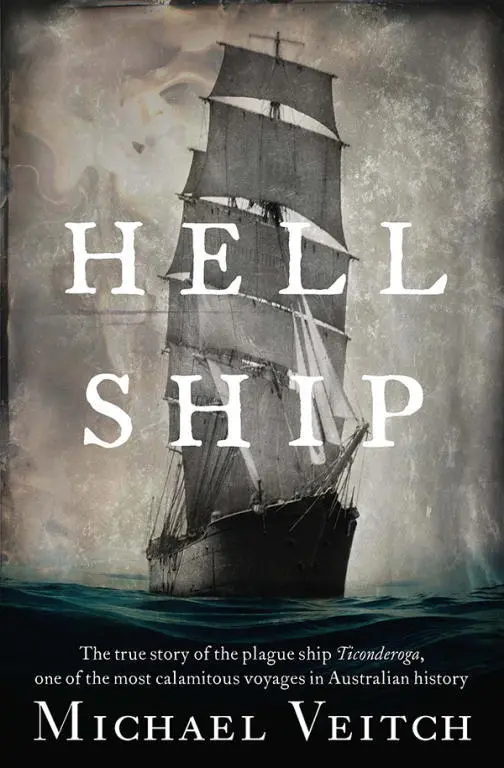
- Название:Hell Ship
- Автор:
- Издательство:Allen & Unwin
- Жанр:
- Год:2018
- Город:Sydney
- ISBN:978-1-76063-084-3
- Рейтинг книги:4 / 5. Голосов: 1
-
Избранное:Добавить в избранное
- Отзывы:
-
Ваша оценка:
Hell Ship: краткое содержание, описание и аннотация
Предлагаем к чтению аннотацию, описание, краткое содержание или предисловие (зависит от того, что написал сам автор книги «Hell Ship»). Если вы не нашли необходимую информацию о книге — напишите в комментариях, мы постараемся отыскать её.
that left England for Victoria with 800 doomed emigrants on board. For more than a century and a half, a grim tale has passed down through Michael Veitch’s family: the story of the
, a clipper ship that sailed from Liverpool in August 1852, crammed with poor but hopeful emigrants—mostly Scottish victims of the Clearances and the potato famine. A better life, they believed, awaited them in Australia.
Three months later, a ghost ship crept into Port Phillip Bay flying the dreaded yellow flag of contagion. On her horrific three-month voyage, deadly typhus had erupted, killing a quarter of
’s passengers and leaving many more desperately ill. Sharks, it was said, had followed her passage as the victims were buried at sea.
Panic struck Melbourne. Forbidden to dock at the gold-boom town, the ship was directed to a lonely beach on the far tip of the Mornington Peninsula, a place now called Ticonderoga Bay.
James William Henry Veitch was the ship’s assistant surgeon, on his first appointment at sea. Among the volunteers who helped him tend to the sick and dying was a young woman from the island of Mull, Annie Morrison. What happened between them on that terrible voyage is a testament to human resilience, and to love.
Michael Veitch is their great-great-grandson, and
is his brilliantly researched narrative of one of the biggest stories of its day, now all but forgotten. Broader than his own family’s story, it brings to life the hardships and horrors endured by those who came by sea to seek a new life in Australia.
Hell Ship — читать онлайн бесплатно полную книгу (весь текст) целиком
Ниже представлен текст книги, разбитый по страницам. Система сохранения места последней прочитанной страницы, позволяет с удобством читать онлайн бесплатно книгу «Hell Ship», без необходимости каждый раз заново искать на чём Вы остановились. Поставьте закладку, и сможете в любой момент перейти на страницу, на которой закончили чтение.
Интервал:
Закладка:
The disembarkation happened agonisingly slowly, but soon the little cove began to resemble a camp city. Boxes and trunks soon littered the sand and foreshore as people re-established themselves at the cove. People in their dozens, in various stages of illness from near death to experiencing the first symptoms, were deposited wherever there was something to lie on. However, some had already circumvented Ferguson’s intentions to purge the ship and had taken their blankets and bedding from the ship, lice-ridden as they probably were, further risking the spread of the disease.
The first to come off the Ticonderoga were the dead—two at a time, in the rowboats—but even from among the fit passengers, few could be found to bury them, terrified as they were of themselves becoming victims of the contagion. A burial area had been set aside a little way from the shore, but with no coffins, and hardly anything left that could be used as even a shroud, the dead were buried, usually by their own family members, fully clothed along with their few meagre possessions. Even sadder perhaps, is that these humble burial plots were not to last, as the ground had been sited too close to the water’s edge. In just a few years, therefore, the Ticonderoga ’s victims, as well as their resting places, would be lost forever to erosion and the sea.
Nor, it transpired, was Point Nepean’s sandy soil, with its meagre 10-foot water table, suitable for the digging of graves in any case. This too proposed a problem for the disposing of animal offal and carcasses, as well as the hastily dug toilets, all of which were liable to spreading more filth and illness with one decent rain.
The several hundred healthy passengers who had travelled on board the Ticonderoga likewise came to regard themselves as victims of the disease—albeit by default—being equally subject to the restrictions imposed by Dr Hunt and harbourmaster Ferguson. It was not long before some began to resent the confinement of this desolate place. Many who had lost loved ones wanted to pick up the pieces of their broken lives and start again in this new country; others wanted to put it all behind them and move on. For the time being, however, none would be allowed to do so. In front of them was a bay, behind them an ocean and standing in between them and the town of Melbourne was roughly 100 kilometres of scrub and bush, making it as unreachable as the moon.
Ferguson was aware of the potential for trouble rising out of a large number of discontented passengers. In his report to La Trobe, he added:
As there is such a large body of people landed, I beg to recommend that a Sergeant and a small body of police be sent down overland and stationed at the Eastern boundary of the quarantine ground to maintain order, and check the insubordination which was beginning to show itself amongst the seamen and Emigrants before I left.
Soon, a contingent of around half a dozen sergeants accompanied by six mounted constables was beating its way overland on horseback through bush to set up camp, ostensibly to protect the borders of the quarantine station, but also to prevent those who might attempt to leave it, and be ready to react to any unrest.
On Sunday, 6 November, Ferguson returned from Point Nepean to Melbourne on board the Empire , feeling that he had aged an entire year in the few days he had spent there. He reported to an anxious Lieutenant-Governor La Trobe that the final 150 sick and 250 fit passengers had all been removed from the Ticonderoga , with some being accommodated in the requisitioned lime-burners’ cottages, while others were living in primitive and makeshift conditions on the shore. The worst cases had been transferred to the hospital ship Lysander . The epidemic was far from over, though. People were still dying daily, although the numbers were gradually starting to decline. Dr Taylor was in charge, but Ferguson privately doubted whether he was up to the task. The Ticonderoga ’s principal surgeon, Joseph Sanger, was recovering and now able to resume some work, and was once again being assisted on board the Lysander by Dr Veitch, although Ferguson described both of them as being ‘in an extremely debilitated state’. [12] Welch, 1969, p. 35 13 Welch, 1969, p. 23 (?)
He meanwhile approached another physician, a William Farman, surgeon superintendent of the Mobile, to quietly take over some of Taylor’s duties . Taylor, he decided, would now oversee the camp on shore, while Farman would undertake the cleaning of the Ticonderoga and work with Sanger and Veitch on board the Lysander. Supplies would still be needed—particularly tent material, blankets, bedding and mattresses, as well as the usual demands for wine and porter.
La Trobe and Ferguson realised, however, that the tragedy unfolding at Point Nepean could not be kept quiet for long, and both men readied themselves for the storm both had seen coming long before the arrival of the Ticonderoga.
25
Quarantine and outrage
To the people on the streets of Melbourne who gathered in huddles on that November Friday morning to hear the grizzly details of the Ticonderoga laid out by The Argus ’s reporter under the memorable headline, ‘Terrible State of Affairs on board an Emigrant Ship at the Port Phillip Heads’, the notion of an overcrowded vessel struck down with disease was nothing new. During the latter half of 1852, the Colonial Land and Emigration Commission’s four big double-deck ships had each arrived with varying amounts of sickness on board. The first of these had been the very large German ship, Borneuf, which had arrived in March with 83 of her passengers having died at sea, almost all of those being children and infants. This, though regrettable, was not seen as the catastrophe such an event would be deemed in later times. Children died frequently in the nineteenth century, particularly at sea, and in the case of the Borneuf , much of the blame was laid at the feet of the parents. In a report into the voyage, the Board concluded that ‘the high mortality rate was largely attributed to the insurmountable objection of Irish and Scots parents to seeking medical attention for their children’. [1] Kruithof, 2002, p. 99
The drinking water also failed on board this ship, with the inadequate storage facilities turning it putrid, green and undrinkable. Even so, only a handful of adults perished on board the Borneuf —a figure quite within acceptable limits—and the voyage was regarded as a success.
The Wanata was next. She was a ship of just over 1100 tons, arriving soon after the Borneuf . A total of 39 of her passengers had not survived the journey, but once again all but ten of those were children. Scarlatina, measles and ‘fever’ were cited as the chief complaints, and the Wanata was sent to the Red Bluff sanitary station for a period of quarantine.
Then, on 20 September, it was the turn of the mighty Marco Polo to make its grand arrival into Port Phillip, under the command of a man who was already a global celebrity of the high seas, ‘Bully’ Forbes. At first the newspapers were so enraptured by the time he had set—a record 68 days from Liverpool to Melbourne—that their triumphant headlines ignored the fact that 51 children and two adults had died under his care.
Slowly, however, people both in England and in the Australian colonies began to question the wisdom of crowding so many people into these Goliaths of the sea, simply to alleviate the logistical problems in which the Colonial Land and Emigration Commission had found itself. Letters to the Editor of prominent newspapers in both England and Australia began to reflect public concern, one of the earliest being from an anonymous writer in The Argus on 24 September:
Читать дальшеИнтервал:
Закладка:
Похожие книги на «Hell Ship»
Представляем Вашему вниманию похожие книги на «Hell Ship» списком для выбора. Мы отобрали схожую по названию и смыслу литературу в надежде предоставить читателям больше вариантов отыскать новые, интересные, ещё непрочитанные произведения.









Обсуждение, отзывы о книге «Hell Ship» и просто собственные мнения читателей. Оставьте ваши комментарии, напишите, что Вы думаете о произведении, его смысле или главных героях. Укажите что конкретно понравилось, а что нет, и почему Вы так считаете.