Michael Veitch - Hell Ship
Здесь есть возможность читать онлайн «Michael Veitch - Hell Ship» весь текст электронной книги совершенно бесплатно (целиком полную версию без сокращений). В некоторых случаях можно слушать аудио, скачать через торрент в формате fb2 и присутствует краткое содержание. Город: Sydney, Год выпуска: 2018, ISBN: 2018, Издательство: Allen & Unwin, Жанр: История, на английском языке. Описание произведения, (предисловие) а так же отзывы посетителей доступны на портале библиотеки ЛибКат.
- Название:Hell Ship
- Автор:
- Издательство:Allen & Unwin
- Жанр:
- Год:2018
- Город:Sydney
- ISBN:978-1-76063-084-3
- Рейтинг книги:4 / 5. Голосов: 1
-
Избранное:Добавить в избранное
- Отзывы:
-
Ваша оценка:
Hell Ship: краткое содержание, описание и аннотация
Предлагаем к чтению аннотацию, описание, краткое содержание или предисловие (зависит от того, что написал сам автор книги «Hell Ship»). Если вы не нашли необходимую информацию о книге — напишите в комментариях, мы постараемся отыскать её.
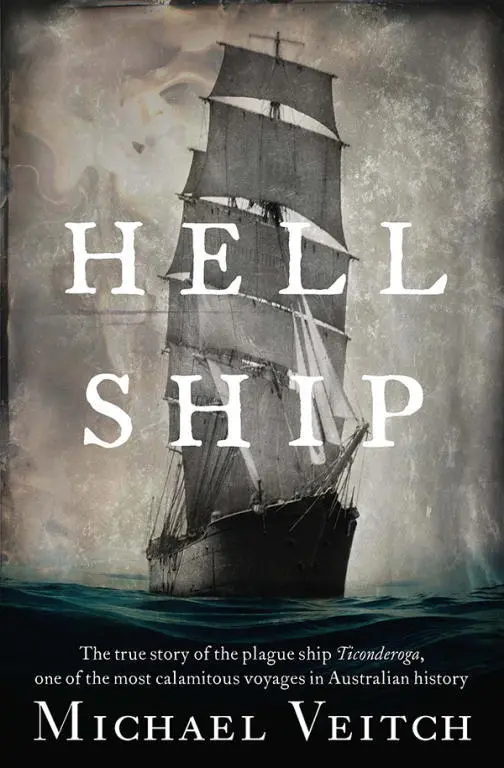
that left England for Victoria with 800 doomed emigrants on board. For more than a century and a half, a grim tale has passed down through Michael Veitch’s family: the story of the
, a clipper ship that sailed from Liverpool in August 1852, crammed with poor but hopeful emigrants—mostly Scottish victims of the Clearances and the potato famine. A better life, they believed, awaited them in Australia.
Three months later, a ghost ship crept into Port Phillip Bay flying the dreaded yellow flag of contagion. On her horrific three-month voyage, deadly typhus had erupted, killing a quarter of
’s passengers and leaving many more desperately ill. Sharks, it was said, had followed her passage as the victims were buried at sea.
Panic struck Melbourne. Forbidden to dock at the gold-boom town, the ship was directed to a lonely beach on the far tip of the Mornington Peninsula, a place now called Ticonderoga Bay.
James William Henry Veitch was the ship’s assistant surgeon, on his first appointment at sea. Among the volunteers who helped him tend to the sick and dying was a young woman from the island of Mull, Annie Morrison. What happened between them on that terrible voyage is a testament to human resilience, and to love.
Michael Veitch is their great-great-grandson, and
is his brilliantly researched narrative of one of the biggest stories of its day, now all but forgotten. Broader than his own family’s story, it brings to life the hardships and horrors endured by those who came by sea to seek a new life in Australia.
Hell Ship — читать онлайн бесплатно полную книгу (весь текст) целиком
Ниже представлен текст книги, разбитый по страницам. Система сохранения места последней прочитанной страницы, позволяет с удобством читать онлайн бесплатно книгу «Hell Ship», без необходимости каждый раз заново искать на чём Вы остановились. Поставьте закладку, и сможете в любой момент перейти на страницу, на которой закончили чтение.
Интервал:
Закладка:
A new quarantine station was obviously needed, and Charles La Trobe, recently elevated to the position of Victoria’s first Lieutenant-Governor upon the colony becoming independent the year before, demanded that another location be found, accessible by sea but preferably a long way from the city. In early 1852, he sent his Port Health Officer, Dr Thomas Hunt, on a surveying mission.
Two possible sites were decided upon, one at Swan Island on the west side of the Port Phillip Bay, the other on a section of the long sandy peninsula which made up one arm of the bay’s eastern entrance. Hunt eventually concluded that Swan Island was too marshy, too hard to land at and generally too depressing, but the bright little cove over on the eastern shore around from Point Nepean had potential. In a report to La Trobe, he described this area as
admirably adapted for the purposes required; its position isolated, its anchorage good and easy of access both from inside the Heads when a vessel takes a pilot there and from Shortlands Bluff. The soil is sandy and at all times dry, the air pure. Water is procured by sinking wells to the depth of 12 to 15 feet, in abundance and sufficient purity, although somewhat aluminous and impregnated with lime. A root resembling sarsaparilla, wild parsley, and a root known here as pennyroyal, grow wild and cure scurvy in a short time. [3] Welch, 1969, p. 21
The site in fact already had its own short history of White settlement. Edward Hobson, a sailor turned grazier (and cousin of Captain William Hobson, a recent Governor of New Zealand and in whose honour Hobson’s Bay had been named), was probably the first European to establish himself in the area, arriving overland from Parramatta in 1837. Seeing the potential of the area as cattle country, he used his connections to secure permission to graze across two large runs he established around the southern part of the large spit of land stretching south-east from Melbourne known as the Mornington Peninsula. He gave his runs two Aboriginal words, Kangerong and Tootgarook, the latter being the local Aboriginal Bunurong word to describe the croaking frogs in the many nearby swamps.
Over the next decade or so, a handful of other hardy families arrived and set themselves up along the peninsula’s southern and western ends—including Point Nepean—taking out pastoral, fishing and lime-burning leases or squatting. Patrick Sullivan, who with his brother-in-law William Cannon had observed the Ticonderoga ’s arrival from across the other side of the bay, was part of a large family of ten who had been evicted from their ancestral land in County Kerry, Ireland, by their English landlord (who at least agreed to pay their passage to Sydney, where they arrived, as free emigrants, in 1839). Before long, the Sullivans had ventured south to the Port Phillip District, where they liked what they saw, taking out several leases, constructing modest dwellings and generally living completely removed from interference by government—or, for that matter, anyone else. Other families arrived and likewise established themselves into a tight-knit and inter-marrying community. As Crown Land leaseholders, however, their tenure to the land they had come to regard as their own was uncertain, and in faraway Melbourne, those in power were preparing to bring that tenure to an abrupt end.
Throughout 1852, with Little Red Bluff’s time as a quarantine station coming to an end, a stately procession of paperwork passed between the desks of Lieutenant-Governor La Trobe, his Port Health Officer Dr Hunt and the Victorian Surveyor-General Robert Hoddle. In October, La Trobe requested that due diligence be applied in establishing exactly what rights the lessees at Point Nepean may have:
what are their expected tenures, and what power the Government possesses of removal, now or at the expiration of lease, whenever that may be. [4] Welch, 1969, p. 22
On 27 October, Surveyor-General Hoddle replied that with one month’s notice, and a balance on the remaining leases—roughly £12—being refunded to each individual leaseholder, such lands as His Excellency might require may indeed be secured without too much fuss. He suggested that the Harbour Master, Charles Ferguson, might be granted sufficient legal and administrative powers to execute such an arrangement. La Trobe thought it an excellent idea. In this fashion, the bureaucratic wheels slowly revolved, and the plan for a new quarantine station to protect the people of Melbourne began to take shape—at least on paper.
A few days later, on the morning of 3 November, Ferguson sat in his office in Williamstown when the wild-eyed figure of Captain Wylie burst in. The two men knew one another, but Ferguson had never seen his old friend like this. He had sailed at haste all through the night, he said, and was wrung out and exhausted. He stammered:
A… ship has come. A large one. From Liverpool. A hundred… yes, a hundred!… dead on board, many more sick. You must inform the Governor… and send help. [5] Carroll, 1970, p. 26
The leisurely progress of the planned, but entirely prospective quarantine station had been overtaken by a very real emergency.
Meanwhile, the passengers on board the Ticonderoga were close to despair. Three days earlier, believing their arrival into Melbourne would lead to better care, or at the very least the chance to get off this wretched ship, the passengers had felt that the worst was over. Those well enough and not numb with grief could finally allow themselves the luxury of contemplating some kind of future. When instead they dropped anchor off a lonely bluff with little signs of habitation, bar a couple of cottages, some tents and a signal station, then the pilot ordered them to remain there for an entire day, then another, followed by a third, they once again began to lose hope. Finally, though, the pilot boarded once more and as the sound of the anchor being raised reverberated through the ship, hopes rose again. But these too would be dashed when, instead of heading north to Melbourne, the pilot took them just a short way across the bay to an even more desolate-looking location, and left them there.
At this small and seemingly deserted little cove, where all that could be seen was scrub, sand dunes and empty beaches, rumours began to fly that they were to remain here for the foreseeable future, in quarantine. [6] Kruithof, 2002, p. 64
When this was confirmed by the sight of the pilot once more departing, many began to curse their decision to leave their beloved homeland to travel on this death ship to the far side of the Earth, only to be left alone and forgotten by the rest of the world. Nothing, however, could have been further from the truth.
23
A colonial crisis
After hearing Captain Wylie’s account of the Ticonderoga , and relaying what the pilot, Henry Draper, had seen of her horrific state, Harbour Master Captain Charles Ferguson started a chain of events that would electrify the upper echelons of Victoria’s young colonial government. An urgent note was dispatched immediately to Governor La Trobe, but Ferguson had no intention of waiting for his answer before deciding to act.
A short distance from Ferguson’s office in the small port of Williamstown, just a few miles from Melbourne , HMS Empire sat tied up and ready. This fast little ship served as an emergency vessel of sorts, scooting around the coast of Victoria and beyond, pulling stranded ships off reefs, rescuing survivors from shipwrecks and intercepting incoming emigrant ships to ensure that their captains were in compliance with the Passengers Act (one such master would later be fined almost £500 for supplying inadequate provisions to his passengers).
Читать дальшеИнтервал:
Закладка:
Похожие книги на «Hell Ship»
Представляем Вашему вниманию похожие книги на «Hell Ship» списком для выбора. Мы отобрали схожую по названию и смыслу литературу в надежде предоставить читателям больше вариантов отыскать новые, интересные, ещё непрочитанные произведения.







Обсуждение, отзывы о книге «Hell Ship» и просто собственные мнения читателей. Оставьте ваши комментарии, напишите, что Вы думаете о произведении, его смысле или главных героях. Укажите что конкретно понравилось, а что нет, и почему Вы так считаете.