Michael Veitch - Hell Ship
Здесь есть возможность читать онлайн «Michael Veitch - Hell Ship» весь текст электронной книги совершенно бесплатно (целиком полную версию без сокращений). В некоторых случаях можно слушать аудио, скачать через торрент в формате fb2 и присутствует краткое содержание. Город: Sydney, Год выпуска: 2018, ISBN: 2018, Издательство: Allen & Unwin, Жанр: История, на английском языке. Описание произведения, (предисловие) а так же отзывы посетителей доступны на портале библиотеки ЛибКат.
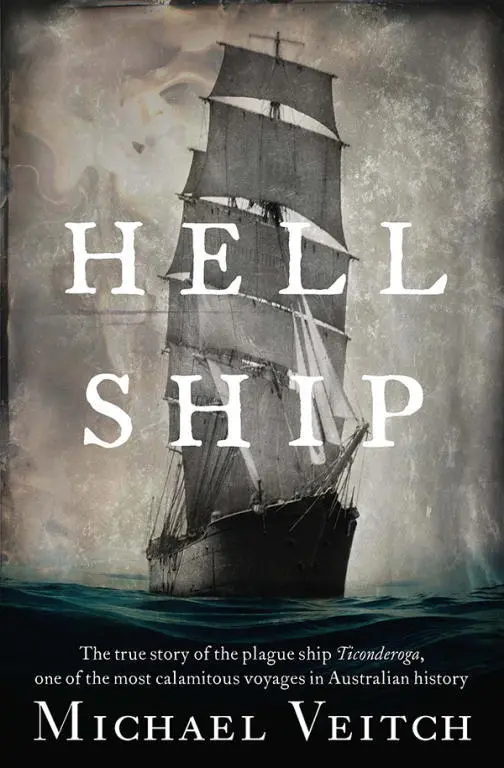
- Название:Hell Ship
- Автор:
- Издательство:Allen & Unwin
- Жанр:
- Год:2018
- Город:Sydney
- ISBN:978-1-76063-084-3
- Рейтинг книги:4 / 5. Голосов: 1
-
Избранное:Добавить в избранное
- Отзывы:
-
Ваша оценка:
Hell Ship: краткое содержание, описание и аннотация
Предлагаем к чтению аннотацию, описание, краткое содержание или предисловие (зависит от того, что написал сам автор книги «Hell Ship»). Если вы не нашли необходимую информацию о книге — напишите в комментариях, мы постараемся отыскать её.
that left England for Victoria with 800 doomed emigrants on board. For more than a century and a half, a grim tale has passed down through Michael Veitch’s family: the story of the
, a clipper ship that sailed from Liverpool in August 1852, crammed with poor but hopeful emigrants—mostly Scottish victims of the Clearances and the potato famine. A better life, they believed, awaited them in Australia.
Three months later, a ghost ship crept into Port Phillip Bay flying the dreaded yellow flag of contagion. On her horrific three-month voyage, deadly typhus had erupted, killing a quarter of
’s passengers and leaving many more desperately ill. Sharks, it was said, had followed her passage as the victims were buried at sea.
Panic struck Melbourne. Forbidden to dock at the gold-boom town, the ship was directed to a lonely beach on the far tip of the Mornington Peninsula, a place now called Ticonderoga Bay.
James William Henry Veitch was the ship’s assistant surgeon, on his first appointment at sea. Among the volunteers who helped him tend to the sick and dying was a young woman from the island of Mull, Annie Morrison. What happened between them on that terrible voyage is a testament to human resilience, and to love.
Michael Veitch is their great-great-grandson, and
is his brilliantly researched narrative of one of the biggest stories of its day, now all but forgotten. Broader than his own family’s story, it brings to life the hardships and horrors endured by those who came by sea to seek a new life in Australia.
Hell Ship — читать онлайн бесплатно полную книгу (весь текст) целиком
Ниже представлен текст книги, разбитый по страницам. Система сохранения места последней прочитанной страницы, позволяет с удобством читать онлайн бесплатно книгу «Hell Ship», без необходимости каждый раз заново искать на чём Вы остановились. Поставьте закладку, и сможете в любой момент перейти на страницу, на которой закончили чтение.
Интервал:
Закладка:
In a decision the Governor of Victoria, Charles La Trobe, would later praise, Henry Draper took it upon himself to direct the Ticonderoga to an area of land that he understood to have only recently been set aside as a future quarantine station. There were as yet, he knew, few resources to be found there: only the two limestone cottages built by the lime-burners themselves, and one or two other small structures, but fresh water wells had been sunk, and a secure anchorage was to be had not far off the beach. From here, the sick could be evacuated and help could be delivered relatively easily. Getting those people off that ghastly ship, he had decided before approaching the Ticonderoga that morning, had to be the first priority. As he later recalled—indeed, with some pride—in his memoir:
I piloted her to the Quarantine Station at Point Nepean, let go the anchor, gave her 60 fathoms of chain, came down the rigging, and slipped back into my boat… by taking the precaution of going into the mizzen-top I could state to the Health Officer that I had not had any communication with the ill-fated people. Getting up into the mizzen-top was considered quite a masterpiece of ingenuity and forethought. [4] H. Draper, in The Log , 2002, p. 6
Closer to the shore they may have been, but if the poor passengers on board the Ticonderoga had thought that their ordeal was nearing its end, they were sadly mistaken.
22
Protecting the colony
Despite the ever-increasing confidence of nineteenth-century medicine, despite the delivery of intelligent and highly trained graduates from ancient universities such as Oxford and St Bartholomew’s into British hospitals and surgeries, despite the volumes written about new advances in medical treatment of all kinds, most of the virulent and destructive diseases of the day remained essentially mysterious and completely incurable. With typhus, for example, despite the millions it killed there is no evidence to suggest that anyone, anywhere—prior to its pathogen being finally described by Henrique da Rocha Lima and Stanislaus von Prowazek in the early 1900s—had so much as suggested the possibility of its cause being linked to human body lice.
In the 1850s, therefore, doctors such as Sanger and Veitch, despite their best intentions and tireless concern for their patients, could barely even scratch at the symptoms with the knowledge and medicines at their disposal. Prior to the modern comprehension of infection, a disease having taken hold was simply left to run its terrible course. The only bulwark against its spreading was avoidance, in the form of isolation or quarantine.
With the advent of the gold rush, the colonial backwater of Melbourne, founded only seventeen years previously by John Batman (a syphilitic conman and slaughterer of Tasmanian Aboriginals, described by artist John Glover as ‘a rogue, thief, cheat and liar, a murderer of blacks and the vilest man I have ever known’, [1] National Australian Museum, 2013, Batmania: Who’s Who , available from: https://web.archive.org/web/20140303233422/http://www.nma.gov.au/engage-learn/schools/classroom-resources/multimedia/interactives/batmania_html_version/whos_who
) suddenly began to burst its established boundaries, even up to the threshold of its hitherto isolated quarantine station at Little Red Bluff. This had been established by the government in 1840, its hand forced by the arrival of one of the unluckiest vessels ever to set sail, the Glen Huntly. This purpose-built 450-ton barque departed Greenock on her maiden voyage from Scotland under the command of a Captain Buchanan in December 1839, laden with 157 mainly Scottish emigrant passengers bound for Victoria. On her very first night at sea, she collided with a coastal vessel, then in the English Channel as fog set in, she missed a marker and struck a submerged rock, which damaged her timbers even further. A few days later, despite being in the open waters of the North Atlantic, the hapless Buchanan managed to plough into yet another vessel, this time an American packet ship, which tore away the Glen Huntly ’s masthead and lower spars. Then, while crossing the equator, typhus broke out, resulting in her arrival into Melbourne with 50 cases of ‘fever’ and ten passengers fewer than had embarked.
When the unfortunate ship limped into Hobson’s Bay with the yellow flag at her topmast, the people of Melbourne, already spooked by a recent outbreak of typhus that devastated Hobart and reports of the disease in Sydney, went into such a panic that the then Superintendent of the Port Phillip District, Charles La Trobe, was later reported by The Age of 1931 as becoming ‘considerably perturbed and anxious to avoid the introduction of what might prove to be a serious menace to the well-being of the small but flourishing community’. He ordered the Glen Huntly to depart forthwith to a small sandstone promontory known as Little Red Bluff, 4 miles south-east of the city. It was a lonely, windy place, isolated in the bush but bordered by a swamp on one side, which had been a former meeting place for the now dispersed Bunurong Aboriginal people.
To accommodate both the Glen Huntly ’s sick and healthy passengers, a hospital of sorts was set up in tents along the foreshore, which evolved by default into Melbourne’s first quarantine or ‘sanitary’ station, as it was dubbed initially to dampen public fears. In any case, it was a facility for which the burgeoning city was long overdue. Accepting its sudden establishment as a fait accompli , La Trobe appointed Dr Barry Cotter, Colonial Surgeon and the man described on a family biographical website as ‘Melbourne’s first doctor’, to oversee its proper development. Cotter decided that the sick would remain on board their anchored ships to either recover or die, while those still healthy would be housed in canvas tents along the shore and up on the bluff. These twin camps were named, appropriately enough, ‘Sick’ and ‘Healthy’, and the arrangement apparently worked, as only three more deaths eventuated from the Glen Huntly . To bolster the station’s position of isolation, La Trobe also provided a contingent of soldiers to prevent any contact between the patients and the outside world, as well as a water patrol in rowboats to deter any notions those confined to their ships may have had about swimming ashore. Cotter’s diary of April 1840 captured some of the scene:
The remainder of the emigrants were landed yesterday from the Glen Huntly, with an addition of six fresh cases for the sick camp. There are at present in the healthy camp one hundred and eight, including children; many of them appear much emaciated from long and continued illness but I have every reason to hope that the change of quarters and diet will soon restore them. [2] Extract from the diary of Dr Barry Cotter, April 1840, available from: https://drbarrycotter.com/chapter-6/
Despite Cotter’s efforts, and the considerable interest shown by La Trobe, who became a regular visitor, Little Red Bluff was, by all accounts, a miserable place. Cold and windswept by the southerlies slicing up the bay in winter, baking hot in summer, it remained for more than a decade no more than a flimsy canvas city filled with miserable people who desperately wanted to get out of there. Hemmed in by the sea on one side and a swamp on the other, and under permanent armed guard, its inmates would have felt little better than convicts. Nor was the gloomy atmosphere alleviated by one part of the camp evolving eventually into one of the city’s first burial grounds.
However, as Melbourne’s southern seaside residences expanded further southwards, the camp became untenable—particularly when gold was discovered, at which point even the guards proved unable to prevent the escape of those determined to head inland and try their luck in Bendigo and other places. In September 1852, the Wanata —one of the twin-deck clippers that preceded the Ticonderoga —likewise having had a terrible journey with many cases of typhus, arrived; she was followed two days later by HMSS Vulcan , a Royal Navy frigate recently converted into a steam-powered troopship. She carried several hundred Somersetshire soldiers of the 40th Regiment of Foot, arriving for their second tour of duty in Australia, who were destined to see a good deal of action fighting off bushrangers on Cobb and Co. stagecoaches as well as storming the Eureka Stockade in 1854. First, though, they had to make it off the boat, and as one of their ranks seemed to be presenting signs of the dreaded smallpox, they were all ordered into quarantine at Little Red Bluff, which was now struggling to cope. The entire regiment was placed on board the hulk Lysander , an ageing veteran of several runs from England, currently sitting idle and empty in Hobson’s Bay. The Lysander was quickly fitted with 50 beds and a generous amount of stores, and the men of the 40th were told to settle in for a long wait.
Читать дальшеИнтервал:
Закладка:
Похожие книги на «Hell Ship»
Представляем Вашему вниманию похожие книги на «Hell Ship» списком для выбора. Мы отобрали схожую по названию и смыслу литературу в надежде предоставить читателям больше вариантов отыскать новые, интересные, ещё непрочитанные произведения.









Обсуждение, отзывы о книге «Hell Ship» и просто собственные мнения читателей. Оставьте ваши комментарии, напишите, что Вы думаете о произведении, его смысле или главных героях. Укажите что конкретно понравилось, а что нет, и почему Вы так считаете.