Michael Veitch - Hell Ship
Здесь есть возможность читать онлайн «Michael Veitch - Hell Ship» весь текст электронной книги совершенно бесплатно (целиком полную версию без сокращений). В некоторых случаях можно слушать аудио, скачать через торрент в формате fb2 и присутствует краткое содержание. Город: Sydney, Год выпуска: 2018, ISBN: 2018, Издательство: Allen & Unwin, Жанр: История, на английском языке. Описание произведения, (предисловие) а так же отзывы посетителей доступны на портале библиотеки ЛибКат.
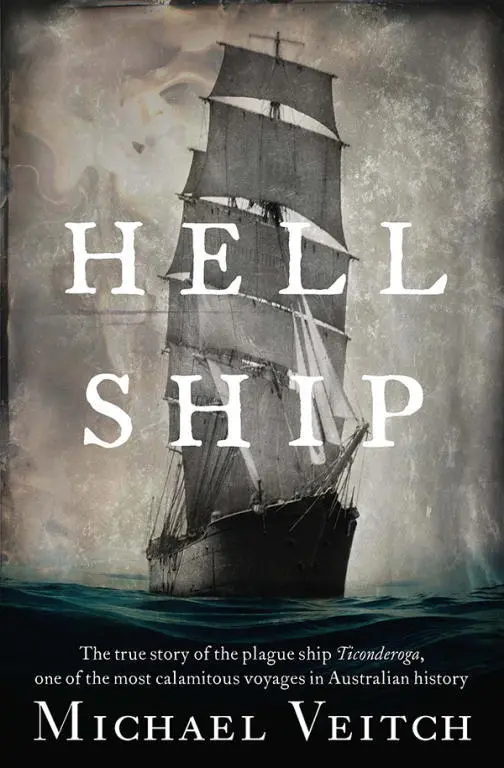
- Название:Hell Ship
- Автор:
- Издательство:Allen & Unwin
- Жанр:
- Год:2018
- Город:Sydney
- ISBN:978-1-76063-084-3
- Рейтинг книги:4 / 5. Голосов: 1
-
Избранное:Добавить в избранное
- Отзывы:
-
Ваша оценка:
Hell Ship: краткое содержание, описание и аннотация
Предлагаем к чтению аннотацию, описание, краткое содержание или предисловие (зависит от того, что написал сам автор книги «Hell Ship»). Если вы не нашли необходимую информацию о книге — напишите в комментариях, мы постараемся отыскать её.
that left England for Victoria with 800 doomed emigrants on board. For more than a century and a half, a grim tale has passed down through Michael Veitch’s family: the story of the
, a clipper ship that sailed from Liverpool in August 1852, crammed with poor but hopeful emigrants—mostly Scottish victims of the Clearances and the potato famine. A better life, they believed, awaited them in Australia.
Three months later, a ghost ship crept into Port Phillip Bay flying the dreaded yellow flag of contagion. On her horrific three-month voyage, deadly typhus had erupted, killing a quarter of
’s passengers and leaving many more desperately ill. Sharks, it was said, had followed her passage as the victims were buried at sea.
Panic struck Melbourne. Forbidden to dock at the gold-boom town, the ship was directed to a lonely beach on the far tip of the Mornington Peninsula, a place now called Ticonderoga Bay.
James William Henry Veitch was the ship’s assistant surgeon, on his first appointment at sea. Among the volunteers who helped him tend to the sick and dying was a young woman from the island of Mull, Annie Morrison. What happened between them on that terrible voyage is a testament to human resilience, and to love.
Michael Veitch is their great-great-grandson, and
is his brilliantly researched narrative of one of the biggest stories of its day, now all but forgotten. Broader than his own family’s story, it brings to life the hardships and horrors endured by those who came by sea to seek a new life in Australia.
Hell Ship — читать онлайн бесплатно полную книгу (весь текст) целиком
Ниже представлен текст книги, разбитый по страницам. Система сохранения места последней прочитанной страницы, позволяет с удобством читать онлайн бесплатно книгу «Hell Ship», без необходимости каждый раз заново искать на чём Вы остановились. Поставьте закладку, и сможете в любой момент перейти на страницу, на которой закончили чтение.
Интервал:
Закладка:
The tragedy that befell the Robertson family from Inverness unfolded on 26 October, when both Daniel, 40, and his wife Isabella, also 40, died within hours of each other. A few days later, their now orphaned baby daughter, Ann, would also pass away, leaving their eldest, eighteen-year-old Mary, to care for her three younger siblings, one of whom would also die a few weeks later in quarantine. Having left Birkenhead a family of seven, the Robertsons would finally disembark in Melbourne just three strong. In the last few days of October, the death toll on board rose to a terrible crescendo with around 25 passengers perishing within a few days. On 28 October, 32-year-old Sarah Bell from Somerset died, leaving a husband and three children, although she had begun the journey with four. The next day, James McKean, 24, also passed away, making a widow of his 22-year-old wife Margaret. On the last day of the month, Margaret Rutherford, 28, died. Exactly a month later, she would be followed by her husband. That night, as the ship pitched in a stiff breeze towards the north, yet another funeral for two of the infants who had died over the past two days took place. It was a pathetic affair, with barely a word spoken above a mumble of the few lines of the prescribed service and the endless wash of the sea. There were simply no words left to say.
Then a triumphant voice sang out somewhere high in the rigging: ‘Light! Port bow!’ Forgetting everything—even the melancholy reason they were on the deck—the funeral party rushed to the side of the ship and peered into the darkness. There, in the distance, a pale yellow beam stoked the blackened sky to the north.
Instantly, feet were heard from everywhere rushing onto the deck. Captain Boyle appeared, his first mate clutching a heavy ledger, hurriedly opening it to a particular page under the dim light of a hurricane lamp. ‘Yes, First Mate, yes?’ Boyle urged impatiently. ‘A moment please, Captain,’ said the excited young officer, running his eye over the myriad lines of information in front of him. Then, finding what he was so frantically seeking, ‘Three by three seconds, Captain!’ The two men peered again at the stabbing shaft of light, each counting quietly to themselves. To those watching the late evening scene, the suspense was almost unbearable. ‘I think we have it, First Mate, please note the time,’ said Boyle finally, with an excitement in his voice that even he could barely contain. ‘Please feel free to inform passengers and crew that we have just sighted the Cape Otway light, on the coast of Victoria.’ It was early on Monday morning, 1 November, 1852.
21
Arrival
Four days later, an alarming headline would greet readers of the late morning edition of The Argus newspaper: ‘Terrible State of Affairs on board an Emigrant Ship at the Port Phillip Heads!’
Their attention well and truly grabbed, groups of people going about their business stood still alone or in huddles along busy Bourke and Elizabeth Streets, holding open the large sheets of newspaper, close by the paper boys and newspaper stands where they had just been bought and, with growing alarm, read on:
Intelligence was brought to Williamstown, on Wednesday evening last, by Captain Wylie, of the brig Champion , from Adelaide, that a large ship named TICONDEROGA, ninety days out from Liverpool, with upwards of 900 Government emigrants on board, had anchored at the Heads. A great amount of sickness had occurred amongst the passengers, more than a hundred deaths having taken place, and almost a similar number of cases (Typhus fever) being still on board. Nor was this all. The doctor’s health was so precarious that he was not expected to survive, and the whole of the medicine, medical comforts, etc., had been consumed…
Passers-by, or those who could not afford the thruppence for their own copy, paused and shuffled close to hear the words spoken aloud by readers who found themselves with an instant and captivated audience. In colonial Victoria, where the single artery to the outside world was the arrival of ships, any new emigrant vessel was worthy of attention. Who was on board? What news, fashions and innovations would soon be arriving from the place that, although on the far side of the globe, was the colony’s cultural and economic epicentre: Britain? Ships also brought other, less welcome things, however, and as they listened, one word stuck like a thorn, compelling people shake their heads and raise a protective hand to the throat . Typhus. Muttering quietly, the shock felt by some quickly hardened to a sense of anger. This, they said, had long been predicted.
Having sighted the Otway light, Captain Boyle could momentarily relax. He had, after all, managed to steer his large ship, undamaged across the ferocious seas of one of the longest and most dangerous shipping routes in the world. Moreover, despite neither he nor any of his crew having ever sailed these waters before, he had managed it in 90 days, which—while not a record—was an excellent time nonetheless. As navigators, Boyle and his first mate had proved themselves to be exemplary, missing not a mark, and successfully negotiating by far the most dangerous part of the voyage: the final days before reaching Port Phillip. It was at this point that the dreaded ‘threading the needle’ needed to be negotiated, with the approach to Bass Strait requiring seamen to slip through the narrow gap between the north-west–south-east running line of the Victorian coast and the rocky northern tip of King Island, Cape Wickham out in Bass Strait. After emerging from the whiplashing of the frigid Southern Ocean, this was no easy feat.
As Boyle, and every other seaman afloat, would have been all too aware, the coastlines of both places—Victoria and King Island—were strewn with the remains of both ships and lives. Seven years earlier (as he would have been reminded during many meetings held leaning over charts, protractor and compass in hand, with the representatives of the Board), the emigrant vessel Cataraqui, a large barque, had slammed into a rock shelf on King Island’s south-west shore, her skipper having erred tragically in estimating his position, convinced himself that he was actually much further to the north. Over three ghastly days, in a fierce storm, the ship was torn to pieces by the breakers, and though just metres from shore, no more than a pitiful four survivors remained alive from a passenger and crew list numbering 500 souls. The Cataraqui was, and remains still, Australia’s worst peacetime maritime disaster. Amazingly, a lighthouse at Cape Wickham was not built and activated until 1861.
Any glow of self-congratulation was short-lived, however, as Captain Boyle was brought back to reality by the sobs of the grieving and the wailings of the demented among his poor afflicted passengers and crew. As much as he would like to believe otherwise, his ordeal was far from over.
Staying on deck for the rest of the night to navigate the remaining 70 or so nautical miles to the entrance of Port Phillip Bay, Captain Boyle took the Ticonderoga north-east into a stiff spring breeze. After a few hours, almost in front of him, the first signs of his first day in Australia became visible on the eastern horizon.
Being completely unfamiliar with Australian landscapes, he took in the rich dark olive of the foliage, the undulating hills and the sweeping beaches of the Victorian coastline as it became slowly visible with the dawn—not unlike, he thought, some parts of America, with which he was far more familiar.
A new stirring began to be heard among the passengers. Finally, after weeks of the most terrible turmoil, of praying constantly for this nightmare voyage to be over, all sensed that they were finally nearing its end. Those in good health came onto the upper deck, braving the chilly wind to take in for themselves the first sights of their new country, no longer confined to the imagination but now real, there in front of them.
Читать дальшеИнтервал:
Закладка:
Похожие книги на «Hell Ship»
Представляем Вашему вниманию похожие книги на «Hell Ship» списком для выбора. Мы отобрали схожую по названию и смыслу литературу в надежде предоставить читателям больше вариантов отыскать новые, интересные, ещё непрочитанные произведения.





Обсуждение, отзывы о книге «Hell Ship» и просто собственные мнения читателей. Оставьте ваши комментарии, напишите, что Вы думаете о произведении, его смысле или главных героях. Укажите что конкретно понравилось, а что нет, и почему Вы так считаете.