Michael Veitch - Hell Ship
Здесь есть возможность читать онлайн «Michael Veitch - Hell Ship» весь текст электронной книги совершенно бесплатно (целиком полную версию без сокращений). В некоторых случаях можно слушать аудио, скачать через торрент в формате fb2 и присутствует краткое содержание. Город: Sydney, Год выпуска: 2018, ISBN: 2018, Издательство: Allen & Unwin, Жанр: История, на английском языке. Описание произведения, (предисловие) а так же отзывы посетителей доступны на портале библиотеки ЛибКат.
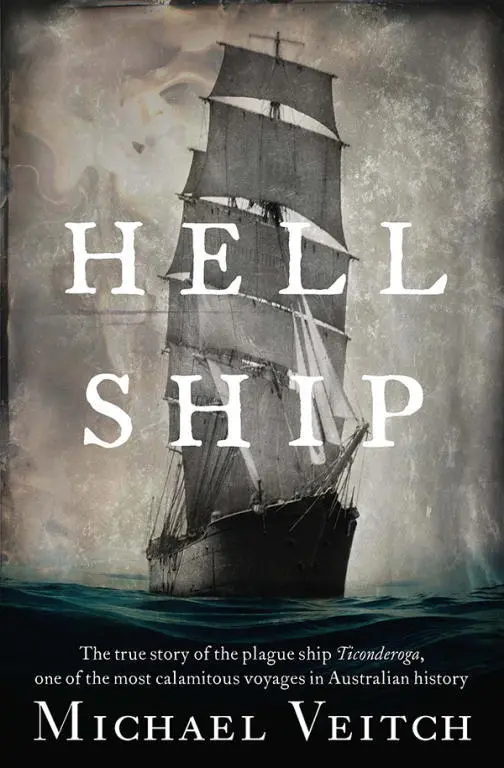
- Название:Hell Ship
- Автор:
- Издательство:Allen & Unwin
- Жанр:
- Год:2018
- Город:Sydney
- ISBN:978-1-76063-084-3
- Рейтинг книги:4 / 5. Голосов: 1
-
Избранное:Добавить в избранное
- Отзывы:
-
Ваша оценка:
Hell Ship: краткое содержание, описание и аннотация
Предлагаем к чтению аннотацию, описание, краткое содержание или предисловие (зависит от того, что написал сам автор книги «Hell Ship»). Если вы не нашли необходимую информацию о книге — напишите в комментариях, мы постараемся отыскать её.
that left England for Victoria with 800 doomed emigrants on board. For more than a century and a half, a grim tale has passed down through Michael Veitch’s family: the story of the
, a clipper ship that sailed from Liverpool in August 1852, crammed with poor but hopeful emigrants—mostly Scottish victims of the Clearances and the potato famine. A better life, they believed, awaited them in Australia.
Three months later, a ghost ship crept into Port Phillip Bay flying the dreaded yellow flag of contagion. On her horrific three-month voyage, deadly typhus had erupted, killing a quarter of
’s passengers and leaving many more desperately ill. Sharks, it was said, had followed her passage as the victims were buried at sea.
Panic struck Melbourne. Forbidden to dock at the gold-boom town, the ship was directed to a lonely beach on the far tip of the Mornington Peninsula, a place now called Ticonderoga Bay.
James William Henry Veitch was the ship’s assistant surgeon, on his first appointment at sea. Among the volunteers who helped him tend to the sick and dying was a young woman from the island of Mull, Annie Morrison. What happened between them on that terrible voyage is a testament to human resilience, and to love.
Michael Veitch is their great-great-grandson, and
is his brilliantly researched narrative of one of the biggest stories of its day, now all but forgotten. Broader than his own family’s story, it brings to life the hardships and horrors endured by those who came by sea to seek a new life in Australia.
Hell Ship — читать онлайн бесплатно полную книгу (весь текст) целиком
Ниже представлен текст книги, разбитый по страницам. Система сохранения места последней прочитанной страницы, позволяет с удобством читать онлайн бесплатно книгу «Hell Ship», без необходимости каждый раз заново искать на чём Вы остановились. Поставьте закладку, и сможете в любой момент перейти на страницу, на которой закончили чтение.
Интервал:
Закладка:
At one stage, Captain Boyle ordered his second mate to venture below to the passenger decks and attempt to organise some kind of clean-up. He at first flatly refused but further pressure eventually compelled him to do so. His report to Boyle about conditions below deck so appalled him that he immediately appointed a number of the still fit men from the single men’s quarters to become cleaning constables. This supposedly, led to some improvement, but the descriptions of the ship when it was inspected after it arrived in Melbourne indicate that little was in fact achieved.
Now, in mid-October, the ship was heading on a course roughly 140 degrees east, making fast for the entrance to Bass Strait. As the Ticonderoga closed on her final destination, however, the rate of mortality from the disease increased. Death, it seemed, was making a final lunge as the finish line drew near. The end of October was particularly grim.
On 23 October, Margaret Stewart, 22 years of age and travelling alone in the single women’s quarters, died along with her dreams of meeting a husband with good prospects in Australia. The following days saw a gaggle of little children perish: Jane Smith, three; Mary Rutter, two; Elizabeth Drinnan, one. Nor were mature patients spared. James Dochard, 22, left his wife Mary, 23, and younger brother, William, eighteen, to finish the journey alone. A young mother, Mary Ann Henderson from Ross in the heart of the Highlands, joined her infant son, David, leaving behind her husband and a two-year-old, James. Another Scot, Jane Kay, died, leaving her husband and five children, all under the age of eight. A few weeks later, their youngest, William, would die in quarantine.
The Ticonderoga ’s crew also became sick, but as they berthed separately, the rate of infection among them was not as severe as it might have been. Some estimates of ten seamen falling ill have been quoted, which represents slightly less than one-fifth of the 48-member crew. One of those was William Boyle, the ship’s third mate and younger brother of Captain Boyle. Deep in a coma, the captain knew his brother was in a parlous state, unlikely to recover.
The group that seems to have been least affected by the disease was older children and teenagers, only 5 per cent of whom died from the typhus, despite many more than that contracting the disease. Most of those who did fall sick usually recovered and survived. Apart from a naturally robust constitution, many may have been spared, ironically, by being compelled to man the ship, particularly in the trials of the Southern Ocean. Captain Boyle seems to have encouraged many of the young men in the single quarters to learn as much as they could about the art of sailing, and he drew upon their help when the ship needed all the manpower that could be mustered during the storms. It was dangerous work—although not nearly as dangerous, it would seem under the circumstances, as staying below deck.
Undaunted, the two doctors continued to make their presence felt in the dreadful lower decks of the ship alongside Captain Boyle, who in every recollection of this terrible part of the voyage to have survived, is remembered by all to have displayed the utmost consideration for his ailing passengers: ‘Captain Boyle was as careful as possible for the wellbeing of those committed to his charge,’ recalled Christopher McRae. ‘From a sense of duty and the possession of a human and kindly disposition, he used every means at his command to prevent such a condition of filth.’ [5] Letter from Christopher McRae to Mr Kendall, 1917
Simply observing the regular presence of the foremost authorities of the ship—the captain and his two surgeons—seems to have given many people the sense that, at the very least, they had not been completely abandoned. Boyle would do his best to assure people that the ship was making good time, and that any day now they would arrive at Port Phillip, where the best of care would be arranged for them—a promise he quietly prayed he could honour.
Drs Sanger and Veitch, now overwhelmed, sought more help among the passengers, as some of those recruited earlier had become sick and even died. Few came forward. An exception remained the Fannings—John, his wife Mary and now their son Patrick, sixteen—who throughout had served as nurses and attendants amid the chaos of both the male and female hospitals. This steadfast family all risked their health—indeed, their lives—to assist their fellow passengers in dire need, and remained until the end of the voyage, and even well after, battling at the forefront of the disease.
Two young women put forward their services. Mary Dochard, a young Scot from Stirling who had recently lost her husband, James, to the disease, was travelling with her extended family, including her late husband’s parents and several siblings and in-laws. Perhaps she felt obliged to assist the surgeons, if only to offer some protection for the rest of her family. The second young woman had lost no family, as she travelled alone in the single women’s section. She also appeared to be in good health and, being somewhat older than most of her companions, possessed a maturity that Sanger and particularly Veitch found compelling. Rather than sit out the weather and hope to remain free of illness, Annie Morrison, who had farewelled her father from the ferry at Tobermory, stepped forward to offer her limited experience of nursing.
In the putrid decks and in the ship’s hospitals, the small band of two doctors and a handful of volunteer nurses and other assistants worked tirelessly among the Ticonderoga ’s sick, which in the latter stages of the voyage was estimated to be around 300 wrestling with various stages of the disease.
One morning, after another dismal night of broken sleep, Dr Veitch arose to once again proceed with Dr Sanger to the hell of the lower decks. Undoubtedly, there would be more grief and sickness than they had seen just the previous evening, and there would be little they could do to relieve the passengers’ suffering, but both felt it was their duty and purpose to make their presence felt, and to try. A knock on the door of Dr Sanger’s small cabin did not meet with its usual answer, however. Veitch called, but still no response came. Another entreaty was at last met with a hoarse response. Veitch quickly pushed open the small wooden door to find Sanger, still on his small bed, covered in sweat, his temperature sky high. His worst fears realised, Veitch began to administer what he could to his superior, even managing to retrieve some of the medicinal wine he had kept in reserve for just such an emergency. Sanger was presenting with the early stages of typhus and seemed utterly incapacitated. The mantle of care would now pass from one of the most experienced doctors in the emigration service to a virtual novice on his first appointment, facing one of the greatest disasters ever to have taken place in the history of peacetime emigration.
Veitch comforted Sanger as much as he could, but privately had little faith that he would recover. He seemed to be alarmingly advanced. No red rash had yet appeared, but Sanger was definitely febrile, nauseous and showing early signs of delirium. He managed, however, to impress on Veitch that he should carry on the work they had started, and that even with little medicine to administer, they were still of great value. Besides, they could not now be too far from Port Phillip and must surely soon be weighing anchor. Then, he said, help on a grand scale would be at hand.
Feeling a dread weight of responsibility, Veitch gathered his handful of nurses and assistants and got to work. After a short time, he asked the dependable Annie to inform the Captain—but no one else—of Sanger’s condition. She did not flinch.
Amazingly, amid the chaos, somewhere between twelve and nineteen (sources vary) babies were born during the voyage—mostly to Scottish women. It being impossible, particularly in the latter stages, to use the female hospital, most of these births took place in the mothers’ own bunks in the married quarters, where they were attended by Mary Fanning or others acting as midwives. Utterly against the odds, each of these newborns, though surrounded by death, survived not only the birth, but the remainder of the journey. Amid the terrible jangle of the dying, the grieving and the demented, the cries of just-delivered life could also be heard on board the Ticonderoga , contributing to an already surreal symphony. To the further encouragement of all, some of the patients—particularly the older children and youths—began to show signs of recovery, their fever dropping, and the rash and delirium abating. Those who had been lucky enough to be washed, largely removing the infestations of lice from their body and clothing, stood a better chance of recovery. These incidences were, however, some of the few moments of joy.
Читать дальшеИнтервал:
Закладка:
Похожие книги на «Hell Ship»
Представляем Вашему вниманию похожие книги на «Hell Ship» списком для выбора. Мы отобрали схожую по названию и смыслу литературу в надежде предоставить читателям больше вариантов отыскать новые, интересные, ещё непрочитанные произведения.











Обсуждение, отзывы о книге «Hell Ship» и просто собственные мнения читателей. Оставьте ваши комментарии, напишите, что Вы думаете о произведении, его смысле или главных героях. Укажите что конкретно понравилось, а что нет, и почему Вы так считаете.