Michael Veitch - Hell Ship
Здесь есть возможность читать онлайн «Michael Veitch - Hell Ship» весь текст электронной книги совершенно бесплатно (целиком полную версию без сокращений). В некоторых случаях можно слушать аудио, скачать через торрент в формате fb2 и присутствует краткое содержание. Город: Sydney, Год выпуска: 2018, ISBN: 2018, Издательство: Allen & Unwin, Жанр: История, на английском языке. Описание произведения, (предисловие) а так же отзывы посетителей доступны на портале библиотеки ЛибКат.
- Название:Hell Ship
- Автор:
- Издательство:Allen & Unwin
- Жанр:
- Год:2018
- Город:Sydney
- ISBN:978-1-76063-084-3
- Рейтинг книги:4 / 5. Голосов: 1
-
Избранное:Добавить в избранное
- Отзывы:
-
Ваша оценка:
Hell Ship: краткое содержание, описание и аннотация
Предлагаем к чтению аннотацию, описание, краткое содержание или предисловие (зависит от того, что написал сам автор книги «Hell Ship»). Если вы не нашли необходимую информацию о книге — напишите в комментариях, мы постараемся отыскать её.
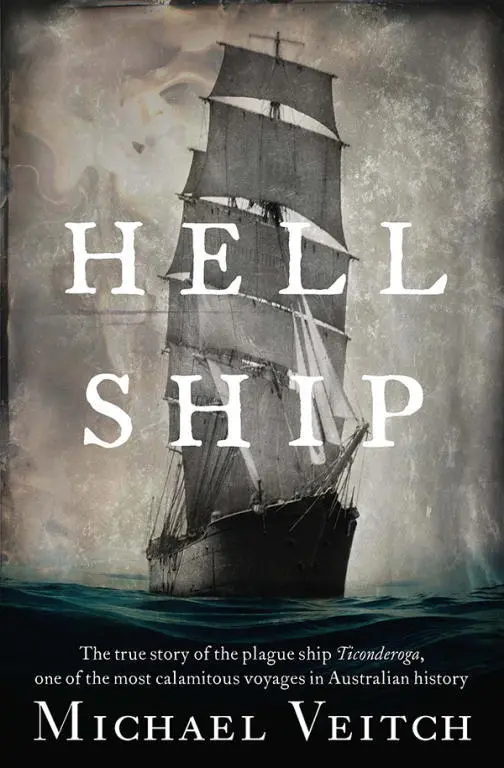
that left England for Victoria with 800 doomed emigrants on board. For more than a century and a half, a grim tale has passed down through Michael Veitch’s family: the story of the
, a clipper ship that sailed from Liverpool in August 1852, crammed with poor but hopeful emigrants—mostly Scottish victims of the Clearances and the potato famine. A better life, they believed, awaited them in Australia.
Three months later, a ghost ship crept into Port Phillip Bay flying the dreaded yellow flag of contagion. On her horrific three-month voyage, deadly typhus had erupted, killing a quarter of
’s passengers and leaving many more desperately ill. Sharks, it was said, had followed her passage as the victims were buried at sea.
Panic struck Melbourne. Forbidden to dock at the gold-boom town, the ship was directed to a lonely beach on the far tip of the Mornington Peninsula, a place now called Ticonderoga Bay.
James William Henry Veitch was the ship’s assistant surgeon, on his first appointment at sea. Among the volunteers who helped him tend to the sick and dying was a young woman from the island of Mull, Annie Morrison. What happened between them on that terrible voyage is a testament to human resilience, and to love.
Michael Veitch is their great-great-grandson, and
is his brilliantly researched narrative of one of the biggest stories of its day, now all but forgotten. Broader than his own family’s story, it brings to life the hardships and horrors endured by those who came by sea to seek a new life in Australia.
Hell Ship — читать онлайн бесплатно полную книгу (весь текст) целиком
Ниже представлен текст книги, разбитый по страницам. Система сохранения места последней прочитанной страницы, позволяет с удобством читать онлайн бесплатно книгу «Hell Ship», без необходимости каждый раз заново искать на чём Вы остановились. Поставьте закладку, и сможете в любой момент перейти на страницу, на которой закончили чтение.
Интервал:
Закладка:
Patience and caution were attributes not highly sought after in sea captains of the emigrant clippers during the gold rush. Dash, nerve and the skill to drive their great vessels to a quick passage through the high seas and gales of the Great Circle and Southern Ocean were qualities far more sought after by shipowners and agents. Apart from the wonderful headlines generated by a quick passage to Melbourne, it delivered passengers to the goldfields faster, and could cut short the inevitable spread of disease. ‘Hell or Melbourne!’ had been Bully Forbes’ audacious response when asked to slow down the Marco Polo a little for the sake of his passengers. [12] S. Jefferson, 2014, Clipper Ships and the Golden Age of Sail: Races and Rivalries on the Nineteenth Century High Seas , London: Bloomsbury, p. 60
So driven was the famous mariner that it was rumoured he padlocked his sails in storms to prevent the more timid of his crew hauling in some of the dangerously strained canvas. Captain Boyle, though, as Christopher McRae remembered, was a different man entirely:
To show how very solicitous the Captain had been for the comfort of the passengers and to prevent any panic amongst them, he had frequently been known, when coming on deck and finding the ship carrying full sail—which the second officer was given to do—gave order to shorten sail. Not so much because the ship could not carry it, as concern for those on board. There was no doubt of the ship being overcrowded. [13] Letter from Christopher McRae to Mr Kendall, 1917
The sole advantage of the Ticonderoga ’s arrival in southern waters was that her speed picked up considerably. Dropping roughly two degrees in latitude every day, three weeks was all it had taken for her to exchange the balmy equator for the fury of the Roaring Forties and beyond. Now, large Southern Ocean whales, unlike any seen further north, began to surface beside the ship, eying her curiously. Unfamiliar southern latitude birds, such as cape petrels and shear-waters, made their appearance, and albatross stalked her for any scraps she might leave behind in her wake. The upper deck, recently the scene of languid evening promenades, now became the setting for children’s snowball fights in the day or two of respite between storms. Down in their beds, however, the passengers huddled for warmth, wearing every scrap of clothing they could find.
On calmer days, the departure of the wind often gave way to the Southern Ocean’s famous fogs, which rolled across the seas like a wet and freezing blanket. At these times, visibility was cut to almost nothing, at least equalling the thickest ‘soups’ dished up by the English Channel. Through the cloying mist, sailors on watch strained their ears to pick up a new and unsettling sound: ice. The icebergs that drift up from the Antarctic ice shelf in the southern autumn are far greater in size than those in the northern hemisphere and frequently measured in miles, with ice of significant size being not unheard of as far north as 40 degrees. The Ticonderoga ’s route took her well inside Antarctica’s northern ice zone, making the danger of sudden and catastrophic collision real, with the iceberg’s unseen mass below the water being capable of splitting a ship’s timber hull like balsa wood, particularly travelling at strong speed before the southerly gales. Nor was it only the larger ice that presented danger.
Smaller, melting ‘growlers’, clear and almost impossible to see, also lay in her path. Only the strange hollow wash of the sea breaking over them, or the popping and sizzling as ancient air bubbles were released as the ice melted gave their positions away, prompting the lookouts to shout frantic course corrections for the helmsman to steer around them. Such caution was only possible on calmer days. During the storms, when the ship was bolting through the water, there was almost no chance of receiving warning of them, and simple luck had to be relied upon.
In the days of the clipper, the farther south a master steered into the Great Circle, the shorter was his route and the faster his time. Some captains, driving their ships as far south as 60 degrees, could cut as much as 1000 nautical miles off the route to Australia, but here the danger of ice increased exponentially. When ships began sailing the Great Circle, the Board had been advised by the Secretary of State to prohibit such vessels employed by them to drop below certain southern latitudes. This, however, prompted such a fierce outcry against perceived government interference in the sacred freedoms of navigation from shipowners and masters wanting to set ever-faster records to Australia that the provision was dropped. In any case, they realised, it was impossible to prescribe rules for each charter due to the different seasons and accidents of weather. The choice of route therefore continued to be left to the discretion of individual masters. [14] J.H. Welch, 1969, From Hell to Health: The History of Quarantine at Port Phillip Heads 1895–1966 , Penrith: Nepean Historical Society, p. 18
Assuming the Ticonderoga followed roughly the same route as previous emigrant clippers such as the Marco Polo , which had left Liverpool exactly a month earlier, on 4 July 1852, Captain Boyle would have steered his ship as low as 55 degrees south—below the remote French territory of the Kerguelen Islands, below even the ice-covered sub-Antarctic rock of Herd Island, to well under a thousand nautical miles from the coldest place on Earth, the great icy mass of Antarctica. [15] Kruithof, 2002, p. 51
Then, finally, with the second half of the entire journey completed in just a few weeks, he would begin to climb back towards the north-east and Australia.
In the meantime, a full outbreak of typhus fever had erupted across the length of the ship.
20
Hell Ship
Although largely poor, the Ticonderoga ’s 800 or so Scots and English emigrant passengers had been selected by the Board for their general intelligence, hardiness and willingness to adapt to the travails and privations of a long voyage at sea. Embarking on their one-way journey in a spirit of gratitude and adventure, they endured conditions that would be completely and utterly abominable to any traveller today. Nevertheless, they accepted the horrendous cramping of their quarters, the seasickness, the stifling heat and drenching downpours of the tropics, the monotonous and largely inedible food, the storms, the leaking and the general terror of the voyage with good grace and few or no complaints. Even in their most challenging moments, most remained conscious of the fortune that had smiled on them in being handed this once-in-a-lifetime opportunity to escape destitution of their homeland and begin a new and more prosperous life on the other side of the world.
In the first month of the Ticonderoga ’s journey, deaths had indeed occurred—largely among infants—but this was an accepted part of the risks they had undertaken. The strange and challenging routines of ship life were largely adhered to, allotted tasks were performed with diligence, and consideration and respect for the needs of their fellow passengers were generally observed.
No one, however, could possibly have been expected to withstand the terrible confluence of circumstances that overtook the great clipper as the month of October arrived. It was at this stage—over the last third of her journey—that the routines of ship life would begin to break down, that order and morale would collapse and that, despite the best and most strenuous efforts of Captain Boyle and his two steadfast doctors, Sanger and Veitch, as well as the stewards, death and chaos would stalk the decks of the Ticonderoga. Now she would begin to earn the terrible epithet she would be ascribed when, disease-ridden and desperate, she finally limped to her destination: ‘Hell Ship’.
Читать дальшеИнтервал:
Закладка:
Похожие книги на «Hell Ship»
Представляем Вашему вниманию похожие книги на «Hell Ship» списком для выбора. Мы отобрали схожую по названию и смыслу литературу в надежде предоставить читателям больше вариантов отыскать новые, интересные, ещё непрочитанные произведения.








Обсуждение, отзывы о книге «Hell Ship» и просто собственные мнения читателей. Оставьте ваши комментарии, напишите, что Вы думаете о произведении, его смысле или главных героях. Укажите что конкретно понравилось, а что нет, и почему Вы так считаете.