Michael Veitch - Hell Ship
Здесь есть возможность читать онлайн «Michael Veitch - Hell Ship» весь текст электронной книги совершенно бесплатно (целиком полную версию без сокращений). В некоторых случаях можно слушать аудио, скачать через торрент в формате fb2 и присутствует краткое содержание. Город: Sydney, Год выпуска: 2018, ISBN: 2018, Издательство: Allen & Unwin, Жанр: История, на английском языке. Описание произведения, (предисловие) а так же отзывы посетителей доступны на портале библиотеки ЛибКат.
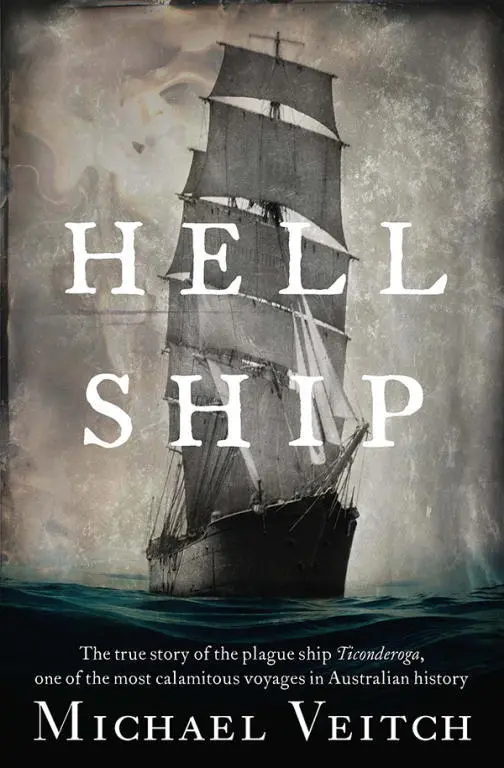
- Название:Hell Ship
- Автор:
- Издательство:Allen & Unwin
- Жанр:
- Год:2018
- Город:Sydney
- ISBN:978-1-76063-084-3
- Рейтинг книги:4 / 5. Голосов: 1
-
Избранное:Добавить в избранное
- Отзывы:
-
Ваша оценка:
Hell Ship: краткое содержание, описание и аннотация
Предлагаем к чтению аннотацию, описание, краткое содержание или предисловие (зависит от того, что написал сам автор книги «Hell Ship»). Если вы не нашли необходимую информацию о книге — напишите в комментариях, мы постараемся отыскать её.
that left England for Victoria with 800 doomed emigrants on board. For more than a century and a half, a grim tale has passed down through Michael Veitch’s family: the story of the
, a clipper ship that sailed from Liverpool in August 1852, crammed with poor but hopeful emigrants—mostly Scottish victims of the Clearances and the potato famine. A better life, they believed, awaited them in Australia.
Three months later, a ghost ship crept into Port Phillip Bay flying the dreaded yellow flag of contagion. On her horrific three-month voyage, deadly typhus had erupted, killing a quarter of
’s passengers and leaving many more desperately ill. Sharks, it was said, had followed her passage as the victims were buried at sea.
Panic struck Melbourne. Forbidden to dock at the gold-boom town, the ship was directed to a lonely beach on the far tip of the Mornington Peninsula, a place now called Ticonderoga Bay.
James William Henry Veitch was the ship’s assistant surgeon, on his first appointment at sea. Among the volunteers who helped him tend to the sick and dying was a young woman from the island of Mull, Annie Morrison. What happened between them on that terrible voyage is a testament to human resilience, and to love.
Michael Veitch is their great-great-grandson, and
is his brilliantly researched narrative of one of the biggest stories of its day, now all but forgotten. Broader than his own family’s story, it brings to life the hardships and horrors endured by those who came by sea to seek a new life in Australia.
Hell Ship — читать онлайн бесплатно полную книгу (весь текст) целиком
Ниже представлен текст книги, разбитый по страницам. Система сохранения места последней прочитанной страницы, позволяет с удобством читать онлайн бесплатно книгу «Hell Ship», без необходимости каждый раз заново искать на чём Вы остановились. Поставьте закладку, и сможете в любой момент перейти на страницу, на которой закончили чтение.
Интервал:
Закладка:
Ship Ticonderoga, Thursday, Midnight, November 4, 1852.
Sir, I have the honour to announce the arrival of the Ship ‘Ticonderoga’ from Liverpool with a large number of Government Emigrants on board under my superintendence—I deeply regret to have to inform you of the serious amount of formidable sickness prevalent during the whole voyage especially the latter part, and of the long list of fatal cases resulting therefrom. [3] Letter from Dr Joseph Charles Sanger, November 4, 1852, Victorian Public Records, VPRS 1189/1112/8252
Sanger’s letter, written at midnight on one of the worst days of the saga, is a desperate cry for help, the first official description to the wider world of the still-unfolding tragedy. Then, about two-thirds down the first page,
There are at present at least 250 patients requiring treatment, and both my coadjutor, Mr Veitch, and myself are almost wearied out by the constant demand for our services, especially as it is impossible to get proper nurses for the sick in sufficient numbers. [4] Letter from Dr Joseph Charles Sanger, November 4, 1852
Although no shadow of doubt had ever clouded my appreciation of the story, seeing my great-great-grandfather’s name, written in such dramatic fashion, as proof of the part he played in the drama of the Ticonderoga , nevertheless sent a surge of relief coursing through me, sitting that day in the little room in the great building on the other side of the world. Much of the excitement I felt was for my father.
I thanked the librarian, before arranging for as many photocopies of the letters as the few pounds in my pocket would allow. On the train journey back to my digs in Islington, I pictured my father opening the big yellow envelope that I intended to mail him, and his eyes scanning the hand-written lines, revealing the story of the terrible second half of Ticonderoga ’s journey to Australia.
19
The Southern Ocean
To the best of their efforts, the authorities at Birkenhead organised the Ticonderoga ’s passengers in berths as close as possible to others of similar national, ethnic or religious backgrounds. Beyond that, it was pure chance that determined exactly where, and with whom, they would spend the voyage. The luckiest passengers were the 103 families assigned positions on the ship’s main accommodation deck. [1] Kruithof, 2002, p. 39
As claustrophobic as their tiny berths may have seemed as they settled themselves into them at the Birkenhead depot back in August, it was with a shudder of horror—and no little relief—that they had watched those other families—56 in all—shuffle past to line up above the dark, yawning hatch that led down to their own berths in the Stygian bowels of Ticonderoga ’s lower deck. It was here in these gloomy confines that the epidemic that seized the ship at the end of September would wreak its most terrible havoc.
Meanwhile, the passengers were forced to deal with another tormenter, one that visited all decks and did not discriminate on the basis of class, sex or age: the weather. From five weeks into the voyage until almost the very end, it had begun to seem to all on board that it represented nothing but a long and continuous torture.
A few days after dropping below the equator, excitement rippled through the ship as the voice of one of the crew, high in the rigging, announced ‘land to starboard!’, and all on the upper deck rushed to the rail. There, about 20 miles distant, rising from a blueish sea mist, stood a tall and majestic finger of rock pointed directly at the sky. Captain Boyle appeared on deck with his officer of the watch and the two consulted closely. Dr Sanger was beckoned over and handed the spyglass. The captain seemed pleased:
Sir, you may inform the passengers that we are passing the island of Fernando de Noronha—a little over 200 miles from the coast of Brazil. The ship is making excellent time. Tell them also, if you will, that this is the last land we shall see for some time. [2] B. Carroll, 1970, ‘Fever Ship’, Parade , August 1970, p. 25
The last comment sent a slight shudder through those who heard it, and all eyes strained for a better view of the distant and mysterious island—in fact, a Portuguese prison colony—surprised at how hungry they had become to step foot upon something solid after so many weeks at sea.
A day or so later, on 12 September, the mother of one of the English families, Mary Sharpin, 35, listed as ‘Wesleyan’ from Norfolk, succumbed to what Dr Sanger again noted simply as ‘fever’. She left behind her husband, Robert, and three daughters, aged four, seven and ten. Nor would this be the final tragedy to visit the family.
An eighteen-year-old girl, Christine Rankin, plus two more infants, Lawrence Fulton and Helen Gartshore, were all buried at sea a few days later. In just over a week, from 10 September, Sanger and Veitch had lost fourteen passengers, in equal numbers of children and adults. Any notion that the epidemic now starting to rage on board the Ticonderoga could be confined to children was now confounded, and it was becoming clear that a catastrophe was looming.
With no understanding of the true cause or origins of the disease, and with its relationship to the bacteria carried in the common body louse not to be revealed for another half-century, the common treatment for typhus in the mid-nineteenth century revolved around the supposed invigorating qualities of wine. In one of the most respected naval medical texts of the time, William Turnbull’s The Naval Surgeon Comprising the Entire Duties of Professional Men at Sea (a copy of which Dr Veitch’s father, James, would undoubtedly have pressed into his son’s hand, entrusting it to him like a precious tome), the primary method of treatment for typhus fever was described as ‘wine, in liberal quantity, suited to the circumstances of the case, but given in small doses at once and judiciously repeated’. [3] William Turnbull, 1806, The Naval Surgeon Comprising the Entire Duties of Professional Men at Sea , London: Richard Phillips, p. 122
This was preceded by a period of induced purging and vomiting brought on by the administration of a compound of antimony, a metallic element that had a particularly violent effect on a patient’s bowels and stomach. Though unpleasant, the treatment was not uncommon.
Only after this ordeal could the already suffering patient be rested and kept warm, after which ‘a nourishing diet is to be administered in the most soluble form, and such as is most grateful to the patient’. [4] Turnbull, 1806, p. 122
By this general plan, assures Turnbull, ‘a cure will, for the most part be effected’. [5] Turnbull, 1806, p. 122
As the two struggling doctors were to witness on board the Ticonderoga , Turnbull’s breezy optimism was grotesquely misplaced.
A few days later, as the south-east trade winds pushed the Ticonderoga far out into the South Atlantic, the first of the storms hit. None of the passengers had experienced anything like it. In just two weeks, they had travelled from the cloying sauna of the equatorial tropics to the storm-tossed fury of a southern hemisphere winter. They had, of course, been warned to expect the weather to turn, and many had taken the advice of packing warmer clothing for the second half of the journey, but the winds and the seas that picked up the great ship, and seemed bent on tearing her apart, were beyond imagining.
As stated, no direct first-hand account of the journey survives from any of the Ticonderoga ’s passengers, but writing at around the same time, another emigrant on a similarly assisted passage, Englishwoman Fanny Davis, described in vivid detail her experience on board the Conway, an emigrant vessel of just over 1100 tons but carrying only half the number of passengers as the Ticonderoga. Fanny likewise sailed from Birkenhead and experienced the hardships of the Great Circle, but her extensive and descriptive diaries give us an insight into what effect the experience of storms, hundreds of miles from any land, had on the passengers. Two months and ten days into the voyage, somewhere out in the Atlantic, Fanny Davis records:
Читать дальшеИнтервал:
Закладка:
Похожие книги на «Hell Ship»
Представляем Вашему вниманию похожие книги на «Hell Ship» списком для выбора. Мы отобрали схожую по названию и смыслу литературу в надежде предоставить читателям больше вариантов отыскать новые, интересные, ещё непрочитанные произведения.










Обсуждение, отзывы о книге «Hell Ship» и просто собственные мнения читателей. Оставьте ваши комментарии, напишите, что Вы думаете о произведении, его смысле или главных героях. Укажите что конкретно понравилось, а что нет, и почему Вы так считаете.