Michael Veitch - Hell Ship
Здесь есть возможность читать онлайн «Michael Veitch - Hell Ship» весь текст электронной книги совершенно бесплатно (целиком полную версию без сокращений). В некоторых случаях можно слушать аудио, скачать через торрент в формате fb2 и присутствует краткое содержание. Город: Sydney, Год выпуска: 2018, ISBN: 2018, Издательство: Allen & Unwin, Жанр: История, на английском языке. Описание произведения, (предисловие) а так же отзывы посетителей доступны на портале библиотеки ЛибКат.
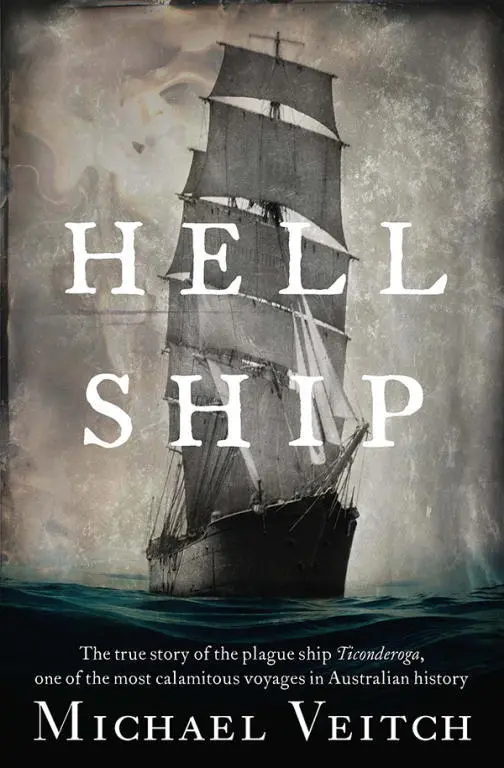
- Название:Hell Ship
- Автор:
- Издательство:Allen & Unwin
- Жанр:
- Год:2018
- Город:Sydney
- ISBN:978-1-76063-084-3
- Рейтинг книги:4 / 5. Голосов: 1
-
Избранное:Добавить в избранное
- Отзывы:
-
Ваша оценка:
Hell Ship: краткое содержание, описание и аннотация
Предлагаем к чтению аннотацию, описание, краткое содержание или предисловие (зависит от того, что написал сам автор книги «Hell Ship»). Если вы не нашли необходимую информацию о книге — напишите в комментариях, мы постараемся отыскать её.
that left England for Victoria with 800 doomed emigrants on board. For more than a century and a half, a grim tale has passed down through Michael Veitch’s family: the story of the
, a clipper ship that sailed from Liverpool in August 1852, crammed with poor but hopeful emigrants—mostly Scottish victims of the Clearances and the potato famine. A better life, they believed, awaited them in Australia.
Three months later, a ghost ship crept into Port Phillip Bay flying the dreaded yellow flag of contagion. On her horrific three-month voyage, deadly typhus had erupted, killing a quarter of
’s passengers and leaving many more desperately ill. Sharks, it was said, had followed her passage as the victims were buried at sea.
Panic struck Melbourne. Forbidden to dock at the gold-boom town, the ship was directed to a lonely beach on the far tip of the Mornington Peninsula, a place now called Ticonderoga Bay.
James William Henry Veitch was the ship’s assistant surgeon, on his first appointment at sea. Among the volunteers who helped him tend to the sick and dying was a young woman from the island of Mull, Annie Morrison. What happened between them on that terrible voyage is a testament to human resilience, and to love.
Michael Veitch is their great-great-grandson, and
is his brilliantly researched narrative of one of the biggest stories of its day, now all but forgotten. Broader than his own family’s story, it brings to life the hardships and horrors endured by those who came by sea to seek a new life in Australia.
Hell Ship — читать онлайн бесплатно полную книгу (весь текст) целиком
Ниже представлен текст книги, разбитый по страницам. Система сохранения места последней прочитанной страницы, позволяет с удобством читать онлайн бесплатно книгу «Hell Ship», без необходимости каждый раз заново искать на чём Вы остановились. Поставьте закладку, и сможете в любой момент перейти на страницу, на которой закончили чтение.
Интервал:
Закладка:
As I began to tackle the complicated knot of ribbon, I pondered how many years had passed since some unknown hands had first tied it. Ten? A hundred? I felt myself to be at the end of a long, but private, quest. In fact, it was just the beginning.
My father, who I resemble in myriad ways both good and bad, but particularly physically, enjoyed a successful career in newspapers, though I suspect he preferred to think of himself more as a writer rather than a journalist. His forte was human interest. Even in such roles as court reporter he had a knack of bringing the emotional drama of a trial to life, rather than simply offering the usual dry procession of witnesses and judgments. Inheriting that gene myself, at school I found writing was the only thing I was remotely good at, and my father agreed. My writing became to him something of a project. In high school, he would mark up my essays and stories with the mysterious signs and symbols of a newspaper subeditor. He was ruthless, but when praise came, I knew it was genuine and hard-earned. In the end, writing became a bond—perhaps the only bond—between us.
One night he told me a story of his own. It was a true story, that of the terrible journey of the ‘plague ship’ Ticonderoga , and the dramatic arrival of the first of our family, our clan, in this country—my great-great-grandfather, James William Henry Veitch. In solemn tones, he spoke of the awful disease which erupted on board the overcrowded vessel, how death stalked the passengers, carrying off entire families, and the miracles our revered ancestor performed among the sick and the dying, both at sea and later in quarantine. It sounded like a dark and heroic epic, which of course is how it had been told to him. ‘This is your story too, you know’, he said. ‘You should write about it’. I agreed with him wholeheartedly. But I never did.
It was only several years later I came to appreciate just what the Ticonderoga story must have meant to my father. In all, Dr James William Henry Veitch and Annie bore nine children, six of whom survived. Their last, Henry, lived to the venerable age of 92, dying only in the year I was born, 1962. For reasons long forgotten, however, a family feud had split him from my grandfather, Alfred, and the two were not reconciled until late in life.
It was only well into his adulthood therefore, that my own father encountered his grandfather, Henry. Although he had always been aware of the Ticonderoga story, it was for him inchoate, and in fragments. Only after meeting Henry did it become something of an obsession for him.
A gentle and, by all accounts, beautifully spoken man, Henry Veitch told my father of his life growing up in central Victoria in the late 1800s, of his father, then a respected councillor, of his mother’s lilting Highland brogue which never left her, and of the harrowing account of their journey to Australia on board the Ticonderoga . Why my father did not seek out Henry earlier—feud or no feud—remains a mystery to me, as is the reason why he never attempted to write the story himself.
Many years later, as I prepared to leave for Europe as a twenty-year-old backpacker, my father requested that I chase down some of the original documentation pertaining to the Ticonderoga and James William Henry Veitch, which he suspected to be held in London. I gave him a half-hearted assurance that I would try, though in fact barely intended to keep the promise. In the weeks leading up to my departure, however, it was virtually all he talked of. Over the previous weeks, he had corresponded furiously with the Kew Public Record Office via mail, tracking down files and catalogue numbers, distilling them all into a folder, which he pressed solemnly into my hand a few days before the flight. As I passed through the airport gate, the look of expectation in his eyes made me realise that, like it or not, I too had now been burdened with the saga of the Ticonderoga.
A few weeks later, I lifted the lid of the box marked ‘54829 Colonial Correspondence—Victoria—Colonial Land and Emigration Society, 1852–53’. Inside was a pile of official letters, folded longways into rectangles and all written with a steel-nibbed pen in the long-vanished hand of copperplate. Some were bound by more pink ribbon. I opened the first one, smoothing out the century-and-a-half-old crease, quietly amazed that I was not required to wear special white gloves, or at least be watched over by the librarian. My own enthusiasm for the quest now thoroughly awakened, the contents of the box seemed far too precious to be handled by someone such as myself.
Although exquisite, the handwriting was at first almost impossible to decipher. Only after a few minutes could one word be made out, then another. Then, gradually, like cracking a code, the sentences appeared to almost shift into place and come alive. The first few documents seemed of little relevance, being written by one or other unknown government official concerning such topics as schedules and ships’ insurance tables, but a third of the way through the pile, one word on one letter leaped off the page. ‘We have to acknowledge the receipt of your letter of the 17th instant, enclosing a Despatch from Lieutenant Governor Latrobe relative to the mortality which occurred among the Emigrants by the “Ticonderoga” both during her voyage and in Quarantine.’ [1] British Parliamentary Papers, 1854, vol. XLVI, pp. 52, available from: www.mylore.net/files/Download/Parl%20Papers%201854.pdf
It was written by Sir Thomas William Murdoch, the Board’s then chairman, to Herman Merivale, Permanent UnderSecretary for the Colonies, and dated June 29, 1853. It runs for fourteen pages, without a single mistake or correction, and represents the Board’s initial reaction to the report of the Ticonderoga disaster, which Murdoch had received only a few days earlier direct from Victoria and penned by Governor Charles La Trobe himself.
When La Trobe’s report had hit Merivale’s desk, it was like an explosion. The barely controlled panic in Murdoch’s words to his superior is palpable. In it, he quotes La Trobe’s report extensively, choosing those passages that could be turned to ameliorate any responsibility on the part of the Board. The impression was of a man trying to position himself in the best possible light before an impending disaster. The very next letter in the pile was Governor La Trobe’s report itself.
It is referenced with the number CO 309/13 and dated 26 January 1853. Addressed to the Right Honourable Sir John Pakington, 1st Baron Hampton, member of the Privy Council and Queen Victoria’s Secretary of State for War and the Colonies, who would later rise to First Lord of the Admiralty, it begins,
My despatch No 163 of November 9, 1852 apprized you of my having received intelligence of the arrival of the Government Emigrant Ship ‘Ticonderoga’, the lamentable loss of life by disease which had been experienced during the passage and the great extent to which the sickness of a very serious character still prevails… [2] Letter from Governor La Trobe to Sir John Pakington, January 4, 1853, Public Record Office, CO 309/13
Holding in my hand the personally written words of the first Governor of my home state of Victoria, after whom one of Melbourne’s main streets is named, was something of a thrill; that he was writing about the arrival of my ancestor’s vessel was doubly so. What I craved, however, was some direct reference to James William Henry himself, and this did not seem to be forthcoming. Several other letters again seemed to be of no relevance, then at the very bottom of the box, a two-page document written in the far less legible, almost hurried-looking hand of Dr Joseph Charles Sanger, offering the dramatic heading,
Читать дальшеИнтервал:
Закладка:
Похожие книги на «Hell Ship»
Представляем Вашему вниманию похожие книги на «Hell Ship» списком для выбора. Мы отобрали схожую по названию и смыслу литературу в надежде предоставить читателям больше вариантов отыскать новые, интересные, ещё непрочитанные произведения.





Обсуждение, отзывы о книге «Hell Ship» и просто собственные мнения читателей. Оставьте ваши комментарии, напишите, что Вы думаете о произведении, его смысле или главных героях. Укажите что конкретно понравилось, а что нет, и почему Вы так считаете.