Robert Reed - Marrow
Здесь есть возможность читать онлайн «Robert Reed - Marrow» весь текст электронной книги совершенно бесплатно (целиком полную версию без сокращений). В некоторых случаях можно слушать аудио, скачать через торрент в формате fb2 и присутствует краткое содержание. Год выпуска: 2000, ISBN: 2000, Издательство: Tor Books, Жанр: Фантастика и фэнтези, на английском языке. Описание произведения, (предисловие) а так же отзывы посетителей доступны на портале библиотеки ЛибКат.
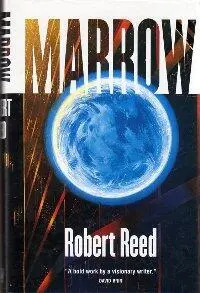
- Название:Marrow
- Автор:
- Издательство:Tor Books
- Жанр:
- Год:2000
- ISBN:0-312-86801-4
- Рейтинг книги:5 / 5. Голосов: 1
-
Избранное:Добавить в избранное
- Отзывы:
-
Ваша оценка:
Marrow: краткое содержание, описание и аннотация
Предлагаем к чтению аннотацию, описание, краткое содержание или предисловие (зависит от того, что написал сам автор книги «Marrow»). Если вы не нашли необходимую информацию о книге — напишите в комментариях, мы постараемся отыскать её.
Marrow — читать онлайн бесплатно полную книгу (весь текст) целиком
Ниже представлен текст книги, разбитый по страницам. Система сохранения места последней прочитанной страницы, позволяет с удобством читать онлайн бесплатно книгу «Marrow», без необходимости каждый раз заново искать на чём Вы остановились. Поставьте закладку, и сможете в любой момент перейти на страницу, на которой закончили чтение.
Интервал:
Закладка:
There weren’t any native viruses to catch, or toxins that their reinforced genetics couldn’t destroy or piss away. Miocene was playing the role of the cautious mother, and where was the harm?
Washen passed out the ceremonial meat.
Wanting to please her team leader, Saluki put the flesh to her tongue, then swallowed it whole.
Broq protested, then managed the same trick.
The next two, ship-born siblings named Promise and Dream, winked slyly at the sky and told Washen, “Thank you.”
Last to accept his share was Diu, and his first bite was tiny. But he didn’t grimace, and he took the rest of the carcass, his white teeth yanking out a fatrich chunk that he chewed before swallowing.
Then with an odd littie laugh, he told everyone, “It’s not too horrible.”
He said, “If my mouth just quit burning, I think I’d almost enjoy the taste.”
Ten
Weeks of relentless work made possibility look like hard fact.
Marrow had been carved from the ship’s heart. Or more properly, it was carved from the core of the young jupiter that would eventually become the Great Ship.
The world’s composition and their own common sense told the captains as much. Whoever the builders were, they must have started by wrenching the uranium and thorium and other radionuclides from the rest of the jupiter, then injecting them into the core. With buttressing fields, the world was compressed, its iron packed closer and closer before the exposed chamber wall was braced with hyperfiber. How that was accomplished, no one knew. Even Aasleen, with her engineering genius, just shook her head and said, “Damned if I know.” Yet billions of years later, without apparent help from the builders or anyone else, this vast machine was still purring along quite nicely.
But why bother with such a marvel?
The obvious, popular reason was that the ship needed to be a rigid body. Tectonics fueled by any internal heat would have melted the chambers and shattered every stone ceiling, probably within the first few thousand years. But why go to so much trouble and expense to create Marrow? If you’ve got this kind of energy at your disposal, why not just lift the uranium out into space where you could put it to good use?
Unless it was used here, of course.
Some captains suggested that Marrow was the nearly molten remnant of an enormous fission reactor.
“Except there are easier, more productive ways to make energy,” others pointed out, their voices more polite than gentle.
But what if the world was designed to store energy?
It was Aasleen*s suggestion: by tweaking the buttresses, the builders could have forced the world to rotate. With patience and power—two resources they must have had in abundance—the builders could have given it a tremendous velocity. Spinning inside a vacuum, held intact by the buttresses as well as a vanished blanket of hyperfiber, this massive iron ball would have served as a considerable flywheel.
Slowly, slowly, that energy was bled away by the empty ship.
Somewhere between the galaxies, the rotation fell to nothing, and that’s when the ship’s systems eased themselves into hibernation.
Aasleen went as far as creating an elaborate digital, as real to the eye as could be. In the early universe, heavy elements were scarce. The builders harvested the radionuclides from above and buried them here, and as Marrow grew hotter and hotter, its hyperfiber blanket began to decay. Degrade. And die.
Hyperfiber was rich in carbon and oxygen, hydrogen and nitrogen, every atom aligned just so and every bond strengthened with tiny predictable quantum pulses. Stressed past its limits, old hyperfiber would just fall apart, and the newly reactive elements would start dancing in celebration, giving life a reasonable chance to be born.
“It’s absolutely obvious,” Aasleen declared. “Once you see it, you can’t believe anything else. You just can’t!”
She made that dare at a weekly briefing.
Each of the team leaders was sitting in the illusion of a Master’s conference room, each perched in an black aerogel chair, sweating in Marrow’s heat. The surrounding room was sculpted from fight and shadow, and sitting at the head of the long pearlwood table, between imposing gold busts of herself, was the Master’s projection. She seemed alert but remarkably quiet. The expectation for these briefings was for crisp reports and upbeat attitudes. Grand theories were a surprise. But after Aasleen had finished, and after a contemplative pause, the Master smiled, telling her imaginative captain, “That’s an intriguing possibility. Thank you, darling. Very much.”
Then to the others, “Considerations? Any?”
Her smile brought a wave of complimentary noise.
Washen doubted they were exploring someone’s dead battery. But this wasn’t the polite moment to list the problems with flywheels and life’s origins. Besides, the bioteams were reporting next, and she had her own illuminations to share.
A tremor interrupted the compliments.
The image of one captain shook, followed by others. Knowing who sat where made it possible to guess the epicenter. When Washen felt the first jolt, then the rolling aftershocks, she realized it was a big quake, even for Marrow.
An alert silence took hold.
Washen was suddenly aware of her own sweat. A sweet oil, volatile and sweetly scented, rose up out of her nervous pores, then evaporated, leaving her flesh chilled despite the endless heat.
Then the Master, immune to the quake, lifted her wide hand, announcing in a smooth, abrupt way, “We need to discuss your timetable.”
What about the bioteams?
“You’re being missed up here. Which is what you hope to hear, I’m sure.” The woman laughed for a moment, alone. Then she added, “Our delegation fiction isn’t clever enough, or flexible enough, and the crew are getting suspicious.”
Miocene nodded knowingly.
Then the Master lowered her hand, explaining, “Before I have a panic to fend off, I need to bring you home again.” Smiles broke out.
Some of the captains were tired of the discomforts; others simply thought about the honors and promotions waiting above.
Washen cleared her throat, then asked, “Do you mean everyone, madam?”
“For the moment. Yes.”
She shouldn’t have been surprised that the cover story was leaking. Hundreds of captains couldn’t just vanish without comment. And Washen shouldn’t have felt disappointment. Even during the last busy weeks, she found herself wishing that the fiction was real. She wanted her and her colleagues off visiting some high-technology exophobes, trying to coax them into a useful trust. That would a difficult, rewarding challenge. But now, hearing that their mission was finished, she suddenly thought of hundreds of projects worth doing with her little lake—enough work to float an entire century.
As mission leader, it was Miocene’s place to ask:
“Do you want us cutting our work short, madam?”
The Master set one hand on one of the busts. For her, the room and its furnishings were genuine, and the captains were illusions.
“Mission plans can always be rewritten,” she reminded them. “What’s vital is that you finish your surveys of both hemispheres. Be sure there aren’t any big surprises. And I’d like your most critical studies wrapped up. Ten ship-days should be adequate. More than. Then you’ll come home again, leaving drones to carry on the work, and we can take our time deciding on our next important step.”
Smiles wavered, but none crumbled.
Miocene whispered, “Ten days,” with a tentative respect.
“Is there a problem?”
“Madam,” the Submaster began, “I would feel a little more at ease if we could be sure. That Marrow isn’t a threat. Madam.”
Читать дальшеИнтервал:
Закладка:
Похожие книги на «Marrow»
Представляем Вашему вниманию похожие книги на «Marrow» списком для выбора. Мы отобрали схожую по названию и смыслу литературу в надежде предоставить читателям больше вариантов отыскать новые, интересные, ещё непрочитанные произведения.









Обсуждение, отзывы о книге «Marrow» и просто собственные мнения читателей. Оставьте ваши комментарии, напишите, что Вы думаете о произведении, его смысле или главных героях. Укажите что конкретно понравилось, а что нет, и почему Вы так считаете.