Robert Reed - Marrow
Здесь есть возможность читать онлайн «Robert Reed - Marrow» весь текст электронной книги совершенно бесплатно (целиком полную версию без сокращений). В некоторых случаях можно слушать аудио, скачать через торрент в формате fb2 и присутствует краткое содержание. Год выпуска: 2000, ISBN: 2000, Издательство: Tor Books, Жанр: Фантастика и фэнтези, на английском языке. Описание произведения, (предисловие) а так же отзывы посетителей доступны на портале библиотеки ЛибКат.
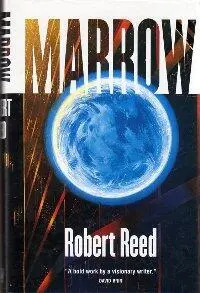
- Название:Marrow
- Автор:
- Издательство:Tor Books
- Жанр:
- Год:2000
- ISBN:0-312-86801-4
- Рейтинг книги:5 / 5. Голосов: 1
-
Избранное:Добавить в избранное
- Отзывы:
-
Ваша оценка:
Marrow: краткое содержание, описание и аннотация
Предлагаем к чтению аннотацию, описание, краткое содержание или предисловие (зависит от того, что написал сам автор книги «Marrow»). Если вы не нашли необходимую информацию о книге — напишите в комментариях, мы постараемся отыскать её.
Marrow — читать онлайн бесплатно полную книгу (весь текст) целиком
Ниже представлен текст книги, разбитый по страницам. Система сохранения места последней прочитанной страницы, позволяет с удобством читать онлайн бесплатно книгу «Marrow», без необходимости каждый раз заново искать на чём Вы остановились. Поставьте закладку, и сможете в любой момент перейти на страницу, на которой закончили чтение.
Интервал:
Закладка:
Washen was thinking about baboons and timetables. A familiar voice broke her reverie. “What are your impressions, darlings?” Miocene stood behind them. In uniform, she was even more imposing, and more cold. Yet Washen summoned her best smile, greeting the mission leader with a crisp, “Madam,” and a little bow. “I’m surprised, madam,” she admitted. “I didn’t know that this world would be so beautiful.”
“Is it?” The knife-edged face offered a smile. Without looking down, she added, “I wouldn’t know. I don’t have a feel for aesthetics.”
For one uncomfortable moment, no one spoke.
Then Dili offered, “It’s a spartan beauty, madam. But it’s there.”
“I believe you.” The Submaster smiled off into the distance. “But tell me. If this world proves as harmless as it is beautiful, what do you think our passengers will pay? To come here and have a look. Or perhaps go below and take a walk.”
“If it’s a little dangerous,” Washen ventured, “then they’ll pay more.”
Diu nodded in agreement.
Miocene’s smile came closer, growing harder. “And if it’s more than a little dangerous?”
“We’ll leave it alone,” Washen replied. “Dangerous to the ship?”
“Then we’ll have to collapse our new tunnel,” Diu suggested.
“With us safely above,” Miocene added.
“Of course,” the captains said together, in a shared voice.
A wide grin filled Diu’s face, and for a moment, it was as if he were grinning with his entire body.
Past the fledging bridge, clinging to the chamber’s smooth face, were dozens of mirrors and arrays of complex antennae. Gesturing toward them, Diu asked, “Have we seen any intelligent life, madam? Or perhaps a few artifacts?”
“No,” said Miocene, “and no.”
It would be a strange place for sentience to evolve, thought Washen. And even if the ship’s builders had left cities behind, they would have been destroyed long ago. Or at least swallowed up. The crust beneath them was probably not even a thousand years old. Marrow was an enormous forge constantly reworking not only its black face but also the hot bones beneath.
“This world has one big distinction,” Diu pointed out. “It’s the only part of the ship that comes with its own life-forms.”
True. When humans arrived, every passageway and giant room proved sterile. As life-free as the graceful clean hands of the finest autodoc, and then some.
“But that might just be coincidence,” Washen responded. “Life usually requires an active geology to be born. The rest of the ship is cold rock and hyperfiber, and the enormous purification plants would have destroyed every ambitious organic compound, almost as it was formed.”
“Yet I can’t help dream,” Diu confessed, staring at the two women. “In my dreams, the builders are down there, waiting for us.”
“A delirious dream,” Miocene warned him.
But Washen felt much the same. Standing here, seeing this wondrous realm, she could imagine an ancient species of bipeds slathering the hyperfiber on the chambers walls, then creating Marrow from the ship’s own core. Why they would do it, she didn’t know. She wouldn’t even dare a secret guess. But imagining someone like herself, five or ten billion years removed from here… it was a compelling, frightening, and focusing insight… and something she wouldn’t share with the others…
Who knew what they would find? This was a huge place, Washen reminded herself. They couldn’t see more than a sliver of the world from this one tiny vantage point. And who could say what was beneath any of those iron-belching mountains, or beyond that rough horizon…?
As she considered these weighty matters, Diu spoke. Buoyant words kept flowing from his tireless mouth. “This is fantastic,” he exclaimed, staring down through the platform’s diamond floor. “And it’s an enormous honor. I’m just thrilled that the Master, in her wisdom, included me in this project.”
The Submaster nodded, conspicuously saying nothing.
“Now that I’m here,” Diu blubbered, “I can almost see it. The purpose of this place, and the entire ship.”
With a level glance, Washen tried to tell her companion: “Be quiet.”
But Miocene had already tilted her head, eyeing her eleventh-grade colleague. “I, for one, would love to hear all of your ideas, darling.”
Diu lifted his dark eyebrows.
An instant later, with a bleak amusement, he remarked, “My apologies. But I think not, madam.” Then he glanced at his own hands, and with a captain’s cool judgment, he added, “Once spoken, the useful thought belongs to at least one other soul.”
Eight
Even inside her quarters, with the windows blackened and every lamp put to sleep, Miocene could sense the light outside. In her mind, she could see its harsh blueness even when her eyes were firmly closed, and she could feel its radiance slipping through the tiniest cracks, then piercing her flesh, wanting nothing more than to bother her old bones.
When did she last sleep well? She couldn’t remember the night, which only made it worse. The pressure of this mission and its peculiar environment were ravaging her nerves, her confidence, and splitting her carefully crafted veneer.
Awake and knowing that she shouldn’t be, the Submaster stared up into the darkness, imagining a different ceiling, and a different self. When Miocene was little more than a baby, her parents—people of extremely modest means—presented her with an unexpected, wondrous toy. It was an aerogel-and-diamond miniature of the deep-space probe that had recently discovered the Great Ship. At the girl’s insistence, the toy was suspended over her bed. It resembled a bluish spiderweb that had somehow snared half a hundred tiny round mirrors. In its center was a fist-sized housing. Inside the housing was a simple AI holding the memories and personality of its historic predecessor. At night, while the girl lay still beneath the covers, the AI spoke with a deep, patient voice, describing the distant worlds that it had charted and how its brave trajectory had eventually carried it out of the Milky Way. The false mirrors projected images that showed thousands of worlds, then the cold black vacuum, and finally, the first dim glow of the ship. The glow brightened, swelling into the battered, ancient face, and then Miocene was past the ship, looking back at the mammoth engines that had helped throw that wonder toward her. Because the Great Ship was thrown toward her, she knew. At that age, and always.
Come morning, the toy always greeted her with envious words.
“I wish I had legs and could walk,” it claimed. “And I so wish I had your mind and your freedom, and just half of your glorious future, too.”
She loved that toy. Sometimes it seemed to be her finest friend and staunchest ally.
“You don’t need legs,” Miocene would tell it. “Wherever I go, I’ll take you.”
“People would laugh,” her friend warned.
Even as a child, Miocene hated being anyone’s joke.
“I know you,” said her toy, laughing at her foolishness. “When the time comes, you’ll leave me. And sooner than you think.”
“I wont,” she blurted. “Never.”
Naturally, she was wrong. Barely twenty years later, Miocene had an adult’s body and the beginnings of an adult’s intellect, and against brutal odds, she had won a full scholarship to the Belter Academy. Her illustrious career had begun in earnest, and of course she left her toys behind. Today her one-time friend was in storage, or lost, or most likely her parents—people not too bothered by sentimentality—had simply thrown it away.
And yet.
There were moments when she lay awake, alone or otherwise, and looking up, she would see her friend hanging over her again, and she would hear its deep heroic voice whispering just to her, telling her how it was to sail alone between the stars.
Читать дальшеИнтервал:
Закладка:
Похожие книги на «Marrow»
Представляем Вашему вниманию похожие книги на «Marrow» списком для выбора. Мы отобрали схожую по названию и смыслу литературу в надежде предоставить читателям больше вариантов отыскать новые, интересные, ещё непрочитанные произведения.







Обсуждение, отзывы о книге «Marrow» и просто собственные мнения читателей. Оставьте ваши комментарии, напишите, что Вы думаете о произведении, его смысле или главных героях. Укажите что конкретно понравилось, а что нет, и почему Вы так считаете.