Robert Reed - Marrow
Здесь есть возможность читать онлайн «Robert Reed - Marrow» весь текст электронной книги совершенно бесплатно (целиком полную версию без сокращений). В некоторых случаях можно слушать аудио, скачать через торрент в формате fb2 и присутствует краткое содержание. Год выпуска: 2000, ISBN: 2000, Издательство: Tor Books, Жанр: Фантастика и фэнтези, на английском языке. Описание произведения, (предисловие) а так же отзывы посетителей доступны на портале библиотеки ЛибКат.
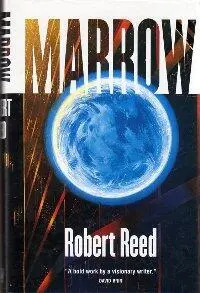
- Название:Marrow
- Автор:
- Издательство:Tor Books
- Жанр:
- Год:2000
- ISBN:0-312-86801-4
- Рейтинг книги:5 / 5. Голосов: 1
-
Избранное:Добавить в избранное
- Отзывы:
-
Ваша оценка:
Marrow: краткое содержание, описание и аннотация
Предлагаем к чтению аннотацию, описание, краткое содержание или предисловие (зависит от того, что написал сам автор книги «Marrow»). Если вы не нашли необходимую информацию о книге — напишите в комментариях, мы постараемся отыскать её.
Marrow — читать онлайн бесплатно полную книгу (весь текст) целиком
Ниже представлен текст книги, разбитый по страницам. Система сохранения места последней прочитанной страницы, позволяет с удобством читать онлайн бесплатно книгу «Marrow», без необходимости каждый раз заново искать на чём Вы остановились. Поставьте закладку, и сможете в любой момент перейти на страницу, на которой закончили чтение.
Интервал:
Закладка:
“Here we are,” the Master announced.
The projection had shrunk by nearly half. The ship’s main fuel tanks were emerging from the frozen mantle, appearing as six tiny bumps evenly spaced along the ship’s waist—each tank set directly beneath one of the main ports. The leech habitat was beneath the Master’s straightened finger, and on this scale, it was no larger than a fat protozoan.
“And now, we vanish.”
Without sound or fuss, another layer of stone was removed. Then, another. And deeper slices of the fuel tanks revealed great spheres filled with hydrogen that changed from a peaceful liquid into a blackish solid, and deeper still, an eerily transparent metal.
“These hydrogen seas have always been the deepest features,” she commented. “Below them is nothing but iron and a stew of other metals squashed under fantastic pressures.”
The ship had been reduced to a smooth black ball—the essential ingredient in a multitude of parlor games.
“Until now, we knew everything about the core.” The Master paused, allowing herself a knowing grin. “Clear, consistent evidence proved that when the ship was built, its crust and mande and core were stripped of radionuclides.The goal, we presumed, was to help cool the interior. To make the rock and metal still and predictable. We didn’t know how the builders managed their trick, but there was a network of narrow tunnels leading down, branching as they dropped deeper, all reinforced with hyperfiber and energy buttresses.”
Washen was breathing faster now. Nodding.
“By design or the force of time, those little tunnels collapsed.” The Master paused, sighed, and shook her golden face. “Not enough room for a microchine to pass. Or so we’ve always believed.”
Washen felt her heart beating, a suffused and persistent and delicious joy building.
“There was never, ever, the feeblest hint of any hidden chamber,” the Master proclaimed. “I won’t allow criticism on this matter. Every possible test was carried out. Seismic. Neutrino imaging. Even palm-of-the-hand calculations of mass and volume. Until some fifty-three years ago, there wasn’t one sane reason to think that our maps were in any sense incomplete.”
A silence had engulfed the audience.
Quietly, smoothly, the Master said, “The full ship. Please.”
Again, the iron ball was dressed in cold rock and hyper-fiber.
“We pivot ninety,” she said.
As if suddenly bashful, the ship’s leading face turned away from her. Rocket nozzles swung into view, each large enough to cradle a moon. None were firing, and according to the schedule, none would fire for another three decades.
“The impact, please.”
Washen stepped closer, anticipating what she would see. Fifty-three years ago, passing through the Black Nebula, the ship collided with a swarm of comets. Nobody was surprised by the event. Brigades of captains and their staff had spent decades making preparations, mapping and remapping the space before them, searching for hazards as well as paying customers. But avoiding those comets would have cost too much fuel. And why bother? The swarm wasn’t harmless, but it was believed to be as close to harmless as possible.
Gobs of antimatter were thrown at the largest hazards.
Lasers evaporated the tumbling fragments.
The captains watched the drama play out again, in rigorous detail: off in distant portions of the room, little suns flickered in and out of existence. Gradually the explosions moved closer, and finally, too close. Lasers fired without pause, evaporating trillions of tons of ice and rock. The shields brightened, moving from a dull blanket of red into a livid purple cloak, fighting to push gas and dust aside. But debris still peppered the hull, a thousand pinpricks dancing on its silver-gray face. And at the bombardment’s peak, there was a blistering white flash that dwarfed the other explosions. The captains blinked and grimaced, remembering the instant, and their shared sense of utter embarrassment.
A mountain of nickel-iron had slipped through their vaunted defenses.
The impact rattled the ship. Gelatin dinners wiggled on their plates, and quiet seas rippled, and the most alert or sensitive passengers said, “Goodness,” and perhaps grabbed hold of something more solid than themselves. Then for months, Remoras had worked to fill the new crater with fresh hyperfiber, and the nervous and bored passengers talked endlessly about that single scary moment.
The ship was never in danger.
In response, the captains had publicly paraded their careful schematics and rigorous calculations, proving that the hull could absorb a thousand times that much energy, and there would still be no reason to be nervous, much less terrified. But just the same, certain people and certain species had insisted on being afraid.
With a palpable relish, the Master said, “Now the cross section. Please.”
The nearest hemisphere evaporated. In the new schematic, pressure waves appeared as subtle colors emerging from the blast site, spreading out and diluting, then pulling together again at the stern, shaking a lot of the ship’s plumbing before the waves met and bounced, passing back the way they had come, back to the blast site where they met again, and again bounced. Even today, a thin vibration was detectable, whispering its way through the ship as well as the captains’ own bones. “AI analysis. Please.”
A map was laid over the cross section, everything expected and familiar. Except for the largest feature, that is.
“Madam,” said a sturdy voice. Miocene’s voice. “It’s an anomaly, granted. But doesn’t that feature… doesn’t it seem… unlikely…?”
“Which was why I thought it was nothing,” the Master concurred. “And my most trustworthy AI—part of my own neural net—agreed with me. This region defines some change in composition. Or in density. Certainly nothing more.” She paused for a long moment, carefully watching her captains. Then with a gracious, oversized smile, she admitted, “The possibility of a hollow core has to seem ludicrous.”
Submasters and captains nodded with a ragged hopefulness.
But they hadn’t come here because of anomalies. Washen knew it, and she stepped closer. How large was that hole? Estimates were easy, but the simple math created some staggering numbers.
“Ludicrous,” the Master repeated. “But then I thought back to when I was a baby, barely a century old. Who would have guessed then that a jovian world could be made into a starship, and that I would inherit such a wonder for myself?”
Just the same, thought Washen, some ideas will always be insane.
“Madam,” Miocene said with a certain delicacy. “I’m sure you realize that a chamber of these proportions would make our ship considerably less massive. Assuming we know the densities of the intervening iron, naturally…”
“But you’re assuming that our hollow core is hollow.” The Master grinned at her favorite officer, then at everyone. Her golden face was serene, wringing pleasure out of her audience’s confusion and ignorance. Calmly, she reminded them, “This began as someone else’s vessel. And we shouldn’t forget that we still don’t know why our home was built. For all we can say, this was someone’s cargo ship, designed for moving things other than people, and here, finally, we’ve stumbled across the ships cargo hold.”
Most of the captains shuddered.
“Imagine that something is hiding inside us,” the Master commanded. “Cargo, particularly anything substantial, has to be restrained, protected. So imagine a series of buttressing fields that would keep our cargo from rattling around every time we adjusted our course. Then imagine that these buttresses are so powerful and so enduring that they can mask whatever it is that’s down there—”
Читать дальшеИнтервал:
Закладка:
Похожие книги на «Marrow»
Представляем Вашему вниманию похожие книги на «Marrow» списком для выбора. Мы отобрали схожую по названию и смыслу литературу в надежде предоставить читателям больше вариантов отыскать новые, интересные, ещё непрочитанные произведения.









Обсуждение, отзывы о книге «Marrow» и просто собственные мнения читателей. Оставьте ваши комментарии, напишите, что Вы думаете о произведении, его смысле или главных героях. Укажите что конкретно понравилось, а что нет, и почему Вы так считаете.