Robert Reed - Marrow
Здесь есть возможность читать онлайн «Robert Reed - Marrow» весь текст электронной книги совершенно бесплатно (целиком полную версию без сокращений). В некоторых случаях можно слушать аудио, скачать через торрент в формате fb2 и присутствует краткое содержание. Год выпуска: 2000, ISBN: 2000, Издательство: Tor Books, Жанр: Фантастика и фэнтези, на английском языке. Описание произведения, (предисловие) а так же отзывы посетителей доступны на портале библиотеки ЛибКат.
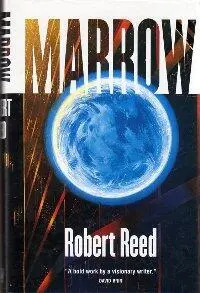
- Название:Marrow
- Автор:
- Издательство:Tor Books
- Жанр:
- Год:2000
- ISBN:0-312-86801-4
- Рейтинг книги:5 / 5. Голосов: 1
-
Избранное:Добавить в избранное
- Отзывы:
-
Ваша оценка:
Marrow: краткое содержание, описание и аннотация
Предлагаем к чтению аннотацию, описание, краткое содержание или предисловие (зависит от того, что написал сам автор книги «Marrow»). Если вы не нашли необходимую информацию о книге — напишите в комментариях, мы постараемся отыскать её.
Marrow — читать онлайн бесплатно полную книгу (весь текст) целиком
Ниже представлен текст книги, разбитый по страницам. Система сохранения места последней прочитанной страницы, позволяет с удобством читать онлайн бесплатно книгу «Marrow», без необходимости каждый раз заново искать на чём Вы остановились. Поставьте закладку, и сможете в любой момент перейти на страницу, на которой закончили чтение.
Интервал:
Закладка:
Finally, he asked, “Are you like me?”
She volunteered nothing.
A thick, effortlessly strong hand reached out, touching her through the sleeve of her silk blouse. Then he quiedy, and firmly, and with certainty said, “No. You aren’t like me. That’s pretty obvious.”
She shook her head. “I’m not a wanted felon, if that’s what you mean.”
“Who is?” he asked. Then he laughed, adding, “I’ve never met a genuine criminal. Ask the worst sociopath if he is, and he says he isn’t. He talks a lot about good reasons and bad circumstances and the unfairness of his luck.”
“Is that what you talk about?” she inquired.
The grin strengthened. “Perpetually”
“Have you heard?” she went on. “Have any other captains vanished?”
“No,” he replied. “No, I haven’t heard.”
She watched his hands.
“Do you know if they have, Washen?”
Carefully, she gave away nothing with her eyes.
“But all of you could vanish, and we wouldn’t notice.” He said it, then gave a low laugh, adding, “And we wouldn’t care. At all.”
“Wouldn’t you?”
A softer laugh. Then he explained. “Living any life but a captain’s teaches you. Among all the good lessons, you learn that captains aren’t as important as they tell yourselves they are. Not in the day-to-day business of running this ship, or even in the big, slow, massive matters, either.”
“I’m crushed,” she replied, and laughed.
He shrugged and said, “You don’t believe me.”
“You’d be astonished if I did believe you.” Washen shook her newest drink—a reliable narcotic exploded with the carbon dioxide bubbles—and after sniffing her fill, she suggested, “You just wish that we were unimportant. But without us doing our important work, everything would collapse. In less than a century. Maybe less than a decade.”
The one-time captain shrugged his shoulders again. The subject bored him; it was time to move on.
Washen agreed. She emptied her glass, then let the silence last for as long as her old friend could stand it.
For almost an hour, as it happened.
Then with a delicate caution, he asked, “Is something wrong? You’ve gone underground… so is there some sort of disaster looming…?”
She shook her head with confidence.
And Pamir, bless him, was still enough of a captain not to ask anything else, or even look too deeply into her wide chocolate eyes.
They spent two full days together, and as many nights. Wanting privacy, they rented a shelter inside an alien habitat, filling their days hiking through a dense violet jungle, special boots allowing them to keep their feet since the only pathways were the thick and slippery slime ribbons left by the passing landlords. During their second night, as something massive dragged itself past their little front door, Washen moved into Pamir’s bed, and with a mixture of nervousness and bawdy zest, they made love until they could fall into a deep sleep.
Washen hugged the Child in her dreams. She hugged it ferociously, and sadly. But when she woke again, she realized that it wasn’t the Child that she’d held in her dream arms. It was the ship itself. She had reached around that great and beautiful body of hyperfiber and metal and stone and machinery, begging it not to leave her. For absolutely no good reason, she hurt enough to ache now, and in a captainly way, she wept.
Pamir sat up in bed, watching without comment. A sloppy gaze would have missed the empathy in his eyes and in his pressed-together lips.
Washen wasn’t sloppy. She sniffed and wiped at her face with the backs of both hands, then calmly admitted, “I need to be somewhere. I should be there already, honestly.”
Pamir nodded. Then after a deep, bracing breath, he asked, “How long would it take?”
“Would what take?”
“If I happened to turn myself over to the Master, bent low and begged for her forgiveness… how long would she keep me locked up… and how soon could I get back to being some sort of captain…?”
In her mind’s eye, Washen saw the rigid, colder-than-death Phoenix.
Remembering its punishment and appreciating the Master’s quixotic moods, she touched her newest lover on his lips, pressing down as she told him, “Whatever you do, don’t do that.”
“She’d keep me locked up forever. Is that it?”
Washen said, “I don’t know. But let’s not test the woman, all right? Promise me?”
Yet Pamir was too stubborn even to offer a comforting lie. He just pulled away from her hand, and smiled at a faraway point, and said to Washen, or himself, “I still haven’t made my mind up. And maybe I never will.”
Four
There were six primary fuel tanks, each as large as a good-sized moon, set in a balanced configuration deep inside the ship—spheres of hyperfiber and shaped-vacuum insulation far beneath the hull and the inhabited districts, below even the sewage plants and giant reactors and the deepest stomachs of the great engines. Every tank was a wilderness.
Only the occasional maintenance crew or adventurer would visit them. In boats carved from aerogels, they would voyage across the liquid hydrogen, nothing to see but their own cold lights, the frigid and glassy ocean, and beyond, a seamless, soul-searing night that left most visitors feeling profoundly uneasy.
Aliens occasionally asked permission to live inside one of the fuel tanks.
The leech were an obscure species. Ascetic and pathologically secretive, they had built their settlement where they could be alone. Weaving together thick plastics and diamond threads, they dangled their home from the tank’s ceiling. It was a large structure, yet following leech logic, its interior was a single room. The room stretched on forever in two dimensions while the glowing gray ceiling was near enough to touch. Washen would do just that from time to time. She would stop walking and lay both hands against the plastic’s surprising warmth, and she would breathe, shaking off the worst of her claustrophobia. Voices lured her on.
She couldn’t count all the voices, and they were too cluttered to make sense or even tell her which species was speaking.
Washen had never met the leech.
Not directly, she hadn’t.
But she had been part of the delegation of captains who spoke to the leech’s bravest diplomats, nothing between the parties but a windowless slab of hyperfiber. The aliens spoke with clicks and squeals, neither of which she could hear now. But if it wasn’t the leech, who was it? A dim memory was triggered. At one of the Master’s annual dinners—how many years ago now?—some fellow captain had mentioned in passing that the leech had abandoned their habitat.
Why?
For the moment, she couldn’t recall any reason, or even if she had asked for one.
Washen hoped that the leech had reached their destination, disembarking without incident. Or perhaps they had simply found a more isolated home, if that was possible. But there was always the sad chance that some great disaster had struck, and the poor exophobes had perished.
Shipboard extinctions were more common than the captains admitted in public, or admitted to themselves. Some passengers proved too frail to endure long voyages. Mass suicides and private wars claimed others. Yet as Washen liked to remind herself, for every failed guest there were a hundred species that thrived, or at least managed to etch out a life in some little part of this glorious machine.
To herself, in a whisper, she asked, “Who are you?”
An hour had passed since Washen stepped from the simple elevator. She had begun walking in the habitat’s center, passing first through a necklace of cleansing chambers meant to purify the newly arrived. None of the chambers worked, and every doorway was propped open or dismantled. Obviously someone had been here. But there were no instructions, not even a handwritten note fixed to the last door. Washen had covered eight or nine kilometers in this subearth gravity, which was a few steps more than halfway to the habitat’s single circular wall.
Читать дальшеИнтервал:
Закладка:
Похожие книги на «Marrow»
Представляем Вашему вниманию похожие книги на «Marrow» списком для выбора. Мы отобрали схожую по названию и смыслу литературу в надежде предоставить читателям больше вариантов отыскать новые, интересные, ещё непрочитанные произведения.









Обсуждение, отзывы о книге «Marrow» и просто собственные мнения читателей. Оставьте ваши комментарии, напишите, что Вы думаете о произведении, его смысле или главных героях. Укажите что конкретно понравилось, а что нет, и почему Вы так считаете.