Robert Reed - Marrow
Здесь есть возможность читать онлайн «Robert Reed - Marrow» весь текст электронной книги совершенно бесплатно (целиком полную версию без сокращений). В некоторых случаях можно слушать аудио, скачать через торрент в формате fb2 и присутствует краткое содержание. Год выпуска: 2000, ISBN: 2000, Издательство: Tor Books, Жанр: Фантастика и фэнтези, на английском языке. Описание произведения, (предисловие) а так же отзывы посетителей доступны на портале библиотеки ЛибКат.
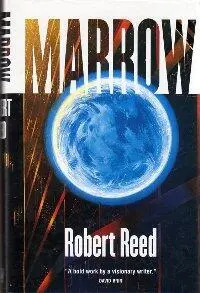
- Название:Marrow
- Автор:
- Издательство:Tor Books
- Жанр:
- Год:2000
- ISBN:0-312-86801-4
- Рейтинг книги:5 / 5. Голосов: 1
-
Избранное:Добавить в избранное
- Отзывы:
-
Ваша оценка:
Marrow: краткое содержание, описание и аннотация
Предлагаем к чтению аннотацию, описание, краткое содержание или предисловие (зависит от того, что написал сам автор книги «Marrow»). Если вы не нашли необходимую информацию о книге — напишите в комментариях, мы постараемся отыскать её.
Marrow — читать онлайн бесплатно полную книгу (весь текст) целиком
Ниже представлен текст книги, разбитый по страницам. Система сохранения места последней прочитанной страницы, позволяет с удобством читать онлайн бесплатно книгу «Marrow», без необходимости каждый раз заново искать на чём Вы остановились. Поставьте закладку, и сможете в любой момент перейти на страницу, на которой закончили чтение.
Интервал:
Закладка:
There was a rumor that the Master herself was coming to take part. But like most rumors, it proved untrue, and afterward it seemed like a faintly ridiculous story. Why, after such careful security, would the woman take the obnoxious risk now?
It was Miocene who shouldered the privilege.
Accompanied by a swarm of cameras and security AIs, she stepped carefully onto Marrow’s surface. Watching from base camp, Washen saw that too-calm face gazing at the alien landscape, and she noticed something in the wide, unblinking eyes. An amazement, perhaps. A genuine awe. Then the look, whatever it was, evaporated, and the narrow mouth opened, and with a forced sense of importance, Miocene declared, ‘In service of the Master, we have arrived.”
The captains overhead cheered and broke into song.
The landing party took ceremonial samples of soil and foliage, then made the expected retreat back to base camp.
Dinner was late, and it was a feast. Bottomless glasses of authentic champagne washed down spiced meats and odd vegetables, and when the party was at its loudest, the distant Master sent her hearty congratulations.
In front of everyone, she called Miocene “Your brave leader.” Then the projected body did a graceful turn, gesturing at the world beneath as she proclaimed, “This is a momentous day in our ship’s momentous history.”
No it wasn’t, thought Washen.
A nagging disappointment only grew. Six teams, including Miocene’s, journeyed to Marrow that next day, and studying the data harvests and live images, Washen found exactly what she expected to find. Captains were administrators, not explorers. Every historic moment was choreographed, routine. What Miocene wanted was for every bush and bug to have a name, and every rusty piece of soil to be memorized. Not even tiny surprises were allowed to ambush those hardworking, utterly earnest first teams.
That second day was thorough, and it was stifling. But Washen didn’t mention her disappointment, or even put a name to her emotions.
Habit was habit, and she’d always been an exemplary captain. Besides, what sort of person hopes for injuries, or mistakes, or any kind of trouble? Which is what can come from the unexpected. And yet.
On the third day, when her own team was set to embark, Washen forced herself to sound like a captain. “We’ll take our walk on the iron,” she told the others, “and we’ll exceed every objective. On schedule, if not before.”
It was a swift, decidedly strange journey. Diu rode beside Washen. He made that request, just as he’d requested being part of her team. Their shielded car began by retreating back up the access tunnel, into the garage, acquiring some distance before flinging itself downward. Then it streaked through the buttresses while a trillion electric fingers reached through the superfluid shields, then through their thin skulls, momentarily playing with everyone’s sanity.
The car reached the upper atmosphere, and braked, the terrific gees bruising flesh and shattering minor bones. Emergency genes awoke, weaving protein analogs and knit-ring the most important aches in moments. The bridge was rooted in a hillside of cold rusting iron and black jungle. Despite a heavily overcast sky, the air was brilliant and furnace-hot, every breath tasting of metals and nervous sweat. The captains unloaded their supplies. As team leader, Washen gave orders that everyone already knew by heart. Their car was led from the bridge, then reconfigured. Their new vehicle was loaded and tested, and the captains were tested by their autodocs: newly implanted genes were already churning away, helping their flesh adapt to the heat and metal-rich environment. Then Miocene, sitting in a nearby encampment, gave her blessing, and Washen lifted off, steering toward their appointed study site.
The countryside was broken and twisted, split by fault fines and raw mountains and countless volcanic vents. The vents had been quiet, some for a century, some for a decade, or in some cases, for days. Yet the surrounding terrain was alive, adorned with pseudotrees reminiscent of enormous mushrooms, each pressed flush against its neighbors, their lacquered black faces feeding on the dazzling blue light.
Marrow was at least as durable as the captains flying above it. Growth rates were phenomenal, and for more reasons than the abundant light or a hyper-efficient photosynthesis. Early findings supported an early hypothesis: the jungle was also feeding through its roots, the chisellike tips forcing their way through fissures, finding hot springs fat with thermophilic bacteria.
But were the aquatic ecosystems as productive? That was Washen’s little question, and she had selected a small, metal-choked lake for study. They arrived on schedule, and after circling the lake twice, she set down on a slab of frozen black slag. The rest of the day was spent setting up their lab and quarters, and specimen traps, and as a precaution, installing a defense perimeter—three paranoid AIs chat did nothing but think the worst of every passing bug and spore.
Night was mandatory.
Despite the perpetual light, Miocene insisted that each captain sleep four full hours, then invest another hour in food and ritual chores.
On schedule, Washen’s team climbed into their six popup shelters, stripped out of their field uniforms, then lay awake, listening to the steady buzzing of the jungle, counting the seconds until it was time to rise again.
They sat in the open at breakfast, in a neat circle, and gazed up at the sky. A shifting wind had carried away the clouds, bringing hotter, drier air and even more fight. The chamber’s distant wall was silvery-white and smooth and remote. The captains’ base camp was a dark blemish visible only because of the clear air. With the distance and the glare, the bridge had vanished. If Washen was careful, she could almost believe they were the only people on the world. If she was lucky, she forgot that elaborate telescopes were watching her sitting on her aerogel chair, eating her scheduled rations, and now, with her right hand, scratching the damp back of her very damp right ear.
Diu sat on her right, and when she glanced at him, he smiled wistfully, as if reading her thoughts.
“I know what we need,’ Washen announced.
Diu asked, ‘What do we need?”
“A ceremony. Some little ritual before we can start.” She rose and walked down to the lake, not sure why until she arrived. Blackish water lapped against rusting stones. Bending at the knees, she let one of her hands dip beneath the surface, feeling its easy heat, and between the fingers, the greasy presence of mud and life. A stand of dome-headed bog plants caught her gaze, and beside it was a specimen trap. Filled, as it happened. Washen rose and wiped her hand dry against her uniform, then carefully unfastened the trap and brought it back to camp.
On Marrow, pseudoinsects filled most animal riches.
In their trap was a six-winged dragonfly, moonstone blue and longer than a forearm. With the other captains watching, Washen gently eased her victim from the netting, folding back the wings and holding the body steady with her left hand as the right wielded a laser torch. The head was cut free, and the body kicked, then died. Then she stripped the carcass of its wings and its tail, the fat thorax set inside their tiny field kitchen. The broiling took seconds. With a dull boom, the carapace split open. Then she grabbed a lump of the hot blackish meat, and with a grimace, made herself bite and chew.
Diu laughed gently.
Another captain, Saluki, was first to say, “We aren’t supposed to.”
A twelfth-grade named Broq added, “Miocene’s orders. Unless there’s an emergency, we stick to our rations.”
Washen forced herself to swallow.
Then with a wide smile, she told them, “And you won’t want to eat this again. Believe me.”
Читать дальшеИнтервал:
Закладка:
Похожие книги на «Marrow»
Представляем Вашему вниманию похожие книги на «Marrow» списком для выбора. Мы отобрали схожую по названию и смыслу литературу в надежде предоставить читателям больше вариантов отыскать новые, интересные, ещё непрочитанные произведения.







Обсуждение, отзывы о книге «Marrow» и просто собственные мнения читателей. Оставьте ваши комментарии, напишите, что Вы думаете о произведении, его смысле или главных героях. Укажите что конкретно понравилось, а что нет, и почему Вы так считаете.