Robert Reed - Marrow
Здесь есть возможность читать онлайн «Robert Reed - Marrow» весь текст электронной книги совершенно бесплатно (целиком полную версию без сокращений). В некоторых случаях можно слушать аудио, скачать через торрент в формате fb2 и присутствует краткое содержание. Год выпуска: 2000, ISBN: 2000, Издательство: Tor Books, Жанр: Фантастика и фэнтези, на английском языке. Описание произведения, (предисловие) а так же отзывы посетителей доступны на портале библиотеки ЛибКат.
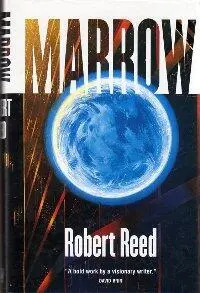
- Название:Marrow
- Автор:
- Издательство:Tor Books
- Жанр:
- Год:2000
- ISBN:0-312-86801-4
- Рейтинг книги:5 / 5. Голосов: 1
-
Избранное:Добавить в избранное
- Отзывы:
-
Ваша оценка:
Marrow: краткое содержание, описание и аннотация
Предлагаем к чтению аннотацию, описание, краткое содержание или предисловие (зависит от того, что написал сам автор книги «Marrow»). Если вы не нашли необходимую информацию о книге — напишите в комментариях, мы постараемся отыскать её.
Marrow — читать онлайн бесплатно полную книгу (весь текст) целиком
Ниже представлен текст книги, разбитый по страницам. Система сохранения места последней прочитанной страницы, позволяет с удобством читать онлайн бесплатно книгу «Marrow», без необходимости каждый раз заново искать на чём Вы остановились. Поставьте закладку, и сможете в любой момент перейти на страницу, на которой закончили чтение.
Интервал:
Закладка:
A disembodied voice said, “Miocene.”
She was awake, alert. Had never been asleep, she was certain. But the bed lifted her until she was sitting upright, and a lamp came on, and only then did she notice the passage of time. Ninety-five minutes of uninterrupted dream sleep, claimed her internal clock.
Again, she heard, “Miocene.”
The Master Captain was sitting on the far side of the room. Or rather, a simple projection of the Master sat in a hypothetical chair, looking massive even though she was composed of nothing but trained photons, that familiar voice telling her favorite and most loyal subordinate, “You look well.”
Implying the exact opposite.
The Submaster gathered up all the poise at her disposal, then with the perfect little bow, she said, “Thank you, madam. As always.”
A slight, lightspeed pause. Then, “You’re very welcome.”
The woman had a strange, quixotic sense of humor, which was why Miocene never tried to cultivate one of her own. The Master didn’t need a laughing friend, but a sober assistant full of reason and devotion.
“Your request for additional equipment—”
“Yes, madam?”
“Is denied.” The Master smiled, then shrugged. “You don’t absolutely need any more resources. And frankly, some of your colleagues are asking questions.”
“I can imagine,” Miocene replied. Then with a second, lesser bow, she added, ‘What equipment we have is adequate. We can reach our goal. But as I pointed out in my report, a second corn-line and a new field reactor would give us added flexibility”
“What resource wouldn’t help you?” the Master asked.
Then she laughed.
An eternity of practice kept Miocene from speaking or showing the simplest discomfort.
“They’re asking questions,” the Master repeated.
The Submaster knew how- to react, which was to say nothing.
“Your colleagues don’t believe our cover story, I’m afraid.” The round face smiled, absorbing the lamplight, the golden skin shining brighdy. “And I went to such trouble, too. A fully fueled taxi. Robot facsimiles of you walking on board. Then the momentous launch. But everyone knows how easy it is to lie, which makes it hard to coax anyone into believing anything…’ Again, Miocene said nothing.
Their cover was a simple fiction: a delegation of captains had left for a high-technology world. They were to meet with a species of exophobes, the humans trying to coax them into friendship, or least to trade for their profitable skills. Such missions had happened in the past, and they typically were wrapped in secrecy. Which was why those other captains—the less qualified ones left behind—should know better than to spit gossip.
“If I sent you a reactor,” the Master explained, “then someone might notice.”
Not likely, thought Miocene.
“And if we lay down a second corn-line, then we double our risk that someone will send or hear something they shouldn’t.”
A likely estimate, yes.
Quiedy, the Submaster replied, “Yes, madam. As you wish.”
“As I wish.’An amused nod. Then the Master asked the obvious question. “Are you keeping up with your timetable?”
“Yes.”
“You’ll reach the planet in six months?”
“Yes, madam.” As of yesterday, Aasleen’s bridge was halfway to Marrow. “We’ll make every deadline, if nothing unexpected happens.”
“Which is the way it should be,” the Master pointed out.
A circumspect nod. Then Miocene volunteered, “Our spirits are excellent, madam.”
“I have no doubt. They are in exceptional hands.”
Miocene felt the compliment warming her flesh, and she couldn’t help but nod and offer the tiniest of smiles before asking, “Is that all, madam?”
“For the moment,” said the ship’s leader.
“Then I shall leave you to more important duties,” Miocene offered.
“The important is finished,” she replied. “The rest of my day is nothing but routine.”
“Have a good day, madam.”
“And to you. And to yours, darling.”
The image dissolved, followed by a pulse of thoughtful light that would search the comlink for leaks and weaknesses.
Miocene rose, standing at her room’s only window. “Open,” she coaxed.
The blackness evaporated. The relentless daylight poured over her, blue and harsh. And hot. Gazing out across her abrupt little city, watching drones and captains in the midst of their important motions, Miocene allowed her thoughts to wander. Yes, she was honored to be here, and endlessly pleased to be leading this vital mission. Yet when she was honest about her ambitions, she had to be honest about her own skills, not to mention the skills of her colleagues. Why had the Master chosen her? Others were more graceful leaders, more imaginative and with better experience in the field. But she obviously was the best candidate. And when she looked hard at herself, there was only one quality in which Miocene excelled above all others.
Devotion.
Aeons ago, she and the Master had attended the Academy together. They were much alike—ambitious students who absorbed their studies together, and who socialized as friends, and who occasionally confessed their deep feelings on matters they wouldn’t admit to lovers, and sometimes wouldn’t admit to themselves.
Both young women declared, “I want to be first to that great ship.”
In the Master’s dreams, she was leading the first mission. While in Miocene’s dreams, she was merely an important organ in the mission’s body.
A critical distinction, that.
Why, wondered Miocene, hadn’t the Master herself come here?
Yes, there would have been problems. Logistical barriers and security nightmares, absolutely. But with holoprojections and robot facsimiles, she could rule the ship from anywhere. Which was why a bold, dynamic soul like hers must hate being so far removed from here. Perhaps in the end, at the last possible minute, the Master would swallow her good sense, then cram herself into one of the tiny cap-cars, coming here on the eve of their planetfall. Stealing Miocenes historic moment, in essence.
For the first time, the Submaster sensed how much she hated that prospect. A small anger began to practice inside her. It felt strangely delicious, and even better, it felt appropriate. A justified anger, and it would grow whenever it occurred to Miocene that maybe this was why she was here. The Master knew that she could take every advantage of her endless devotion. She could come here and steal the honor, and her Submaster would have no choice but to smile and nod, deflecting the credit and the fame that should have belonged to her.
Quietly, Miocene told the window to extend.
The transparent panel bowed outward, thinning like a bubble as it expanded.
Leaning forward, she looked down the side of the dormitory, through the diamond street, peering at the hot black face of that strange world… and to herself, with a quiet dry voice, she said, “Please don’t come here, madam.”
She said, “Leave me the glory. Just this once, please,”
Nine
Captains are nothing without plans and without routines.
Planetfall occurred nine days and a year after the Master’s briefing, and every historic event, small and otherwise, transpired exactly as the captains had anticipated. The touchdown site was selected for the maturity and apparent stability of its crust. The bridge was tweaked and teased into position, then lowered into the upper atmosphere, bellows taking a great breath, the stolen air subjected to every imaginable test. The bridge’s final kilometers were added in a carefully orchestrated rush. At the last instant, sensors studied the rising land, mapping details to a microscopic level. Then a tip of razor-edged hyperfiber was shoved into the iron ground, and a specially designed car raced downward, protected by elaborate fields as well as its speed. The journey through the corrosive buttresses was swift and uneventful, and the first landing party arrived with a strict minimum of fuss.
Читать дальшеИнтервал:
Закладка:
Похожие книги на «Marrow»
Представляем Вашему вниманию похожие книги на «Marrow» списком для выбора. Мы отобрали схожую по названию и смыслу литературу в надежде предоставить читателям больше вариантов отыскать новые, интересные, ещё непрочитанные произведения.









Обсуждение, отзывы о книге «Marrow» и просто собственные мнения читателей. Оставьте ваши комментарии, напишите, что Вы думаете о произведении, его смысле или главных героях. Укажите что конкретно понравилось, а что нет, и почему Вы так считаете.