Adolf Hitler - Hitler’s Second Book
Здесь есть возможность читать онлайн «Adolf Hitler - Hitler’s Second Book» весь текст электронной книги совершенно бесплатно (целиком полную версию без сокращений). В некоторых случаях можно слушать аудио, скачать через торрент в формате fb2 и присутствует краткое содержание. Город: New York, Год выпуска: 2003, ISBN: 2003, Издательство: Enigma Books, Жанр: Публицистика, на английском языке. Описание произведения, (предисловие) а так же отзывы посетителей доступны на портале библиотеки ЛибКат.
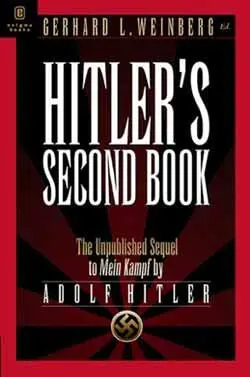
- Название:Hitler’s Second Book
- Автор:
- Издательство:Enigma Books
- Жанр:
- Год:2003
- Город:New York
- ISBN:978-1929631162
- Рейтинг книги:4 / 5. Голосов: 1
-
Избранное:Добавить в избранное
- Отзывы:
-
Ваша оценка:
Hitler’s Second Book: краткое содержание, описание и аннотация
Предлагаем к чтению аннотацию, описание, краткое содержание или предисловие (зависит от того, что написал сам автор книги «Hitler’s Second Book»). Если вы не нашли необходимую информацию о книге — напишите в комментариях, мы постараемся отыскать её.
* * * In 1958, while directing the microfilming and organization of a trove of archives that the U.S. forces had taken from the Nazis at the end of WWII, historian Weinberg (
) discovered the manuscript of a second book that Hitler had written but never published. The manuscript was published in German in 1961, accompanied by Weinberg’s annotations, but this is the first authoritative English version (a pirated and poor translation appeared in the 1960s). The text bears all of Hitler's hallmarks: rambling thoughts, half-baked ideas, pedantic writing-along with a terrifying, sustained belief in war and violence as the means to ensure that Germans would flourish. Compared to
, there are fewer pages devoted to Jews. Nonetheless, what comes across most strongly is Hitler’s abiding commitment to the principle of race and his identification of Jews as the enemy that threatened to undo all that Germans had created. Hitler dwells at length on foreign policy, and outlines a strategy of alliance with Fascist Italy and Great Britain. (He actually believed that Britain would accept a German-dominated European continent so long as Germany did not challenge the overseas British empire.) He also foresees an inevitable clash with the United States. This provides solid historical background on Hitler's thinking in the late 1920s, when his party was nothing more than a tiny, radical sect. Weinberg provides helpful notes and a very informative introduction.
Copyright 2003 Reed Business Information, Inc. “Politics is history in the making.”
Such were the words of Adolf Hitler in his untitled, unpublished, and long suppressed second work written only a few years after the publication of
.
Only two copies of the 200 page manuscript were originally made, and only one of these has ever been made public. Kept strictly secret under Hitler’s orders, the document was placed in an air raid shelter in 1935 where it remained until it’s discovery by an American officer in 1945.
Written in 1928, the authenticity of the book has been verified by Josef Berg (former employee of the Nazi publishing house Eher Verlag), and Telford Taylor (former Brigadier General U.S.A.R., and Chief Counsel at the Nuremburg war-crimes trials) who, after an analysis made in 1961, comments:
*as quoted by http://www.pharo.com/lost&found.htm
“If Hitler’s book of 1928 is read against the background of the intervening years, it should interest not scholars only, but the general reader.”*
Hitler’s Second Book — читать онлайн бесплатно полную книгу (весь текст) целиком
Ниже представлен текст книги, разбитый по страницам. Система сохранения места последней прочитанной страницы, позволяет с удобством читать онлайн бесплатно книгу «Hitler’s Second Book», без необходимости каждый раз заново искать на чём Вы остановились. Поставьте закладку, и сможете в любой момент перейти на страницу, на которой закончили чтение.
Интервал:
Закладка:
When Prussia entered her Silesian War, this too was a relatively secondary phenomenon alongside the violent dispute between England and France, which at that time was already in full swing. Perhaps Frederick The Great can be reproached for having pulled English chestnuts out of the fire. But would the Prussia ever have arisen with which a Bismarck could create a new Reich, if at that time a Hohenzollern prince had sat on the throne who, in the knowledge of the future greater evens of world history, preserved his Prussia in a State of pious neutrality? The three Silesian Wars brought Prussia more than Silesia. On these battlefields grew those Regiments which in the future were to carry the German banners from Weissenburg and Wörth up to Sedan, in order finally to greet the new emperor of the new Reich in the Hall Of Mirrors in the Palace Of Versailles.
Prussia at that time was certainly a small State, unimportant in population and territorial size. But by leaping into the middle of the great actions of world history, this little State had obtained for itself a legitimisation for the founding of the later German Reich.
And once, even the neutralists triumphed in the Prussian State. This was in the period of Napoleon I. At that time it was believed at first that Prussia could remain neutral, and for this she was later punished with the most terrible defeat. Both conceptions confronted one another sharply even in the year 1812. The one for neutrality, and the other, headed by Baron vom Stein, for intervention. The fact that the neutralists won out in 1812 cost Prussia and Germany infinite blood and brought them infinite suffering. And the fact that at last in 1813 the interventionists broke through saved Prussia.
The World War gave the clearest answer to the opinion that one can achieve political success by preserving a careful neutrality as a third power. What have the neutrals of the World War achieved practically? Were they the laughing third one, for instance? Or does one believe that, in a similar event, Germany would play another role?
And let no one think that the reason for this lies only in the magnitude of the World War. No, in the future, all wars, insofar as they involve great nations, will be Folk’s wars of the most gigantic dimensions. As a neutral State in any other European conflict, Germany, however, would possess no more importance than Holland or Switzerland or Denmark, and so on, in the World War. Does one really think that after the event we would get out of nowhere the strength to play the role against the remaining victor which we did not venture to play in a union with one of the two combatants?
At any rate, the World War has proven one thing explicitly: whoever conducts himself as a neutral in great world historical conflicts, may perhaps at first make a little business, but, in terms of power politics, he will thereby ultimately also be excluded from a codetermination of the world’s fate.
Thus, had the American Union preserved her neutrality in the World War, today she would be regarded as a power of the second rank, regardless of whether England or Germany had emerged as a victor. By entering the War, she raised herself to England’s naval strength, but in international political terms marked herself as a power of decisive importance. Since her entry into the World War the American Union is appraised in a completely different way. It lies in the nature of mankind’s forgetfulness no longer to know [to forget], after only a short time, what the general judgement of a situation had been only a few years before. Just as today we detect a complete disregard of Germany’s former greatness in the speeches of many foreign statesmen, just as little, conversely, can we appraise the extent of the increase in value that the American Union has experienced in our judgement since her entry into the World War.
This is also the most compelling statesmanlike justification for Italy’s entry into the War against her former allies. Had Italy not taken this step, she would now share the role of Spain, no matter how the dice had rolled.
The fact that she carried out the much criticised step to an active participation in the World War brought a rise in her position and a strengthening of the same which has found its ultimate crowning expression in Fascism.
Without her entry into the War, the latter would have been a completely unthinkable phenomenon.
The German can ponder this with or without bitterness. It is important to learn from history, especially if its teachings speak to us in such a compelling way.
Thus the belief that through a prudent, reserved neutrality vis-à-vis the developing conflicts in Europe and elsewhere, one can some day reap the benefits thereof as a laughing third one, is false and idiotic. In general, freedom is preserved neither by begging nor by cheating. And also not by work and industry, but exclusively by struggle, and indeed by one’s own struggle. Thus it is very easily possible that more weight is attached to the will than to the deed. Not seldom, in the framework of a wise alliance policy, nations have achieved successes unrelated to the success of their arms. But fate does not always measure a nation which boldly stakes its life according to the dimensions of its deeds, but rather, very frequently, according to the dimensions of its will. The history of Italian unification in the nineteenth century is noteworthy for this. But the World War also shows how a whole number of States can achieve extraordinary political successes less through their military accomplishments [successes] than through the foolhardy boldness with which they take sides and the doggedness with which they hold out.
If Germany wants to put an end to her period of enslavement by all, she must under all circumstances actively try to enter into a combination of powers in order to participate in the future shaping of European life in terms of power politics.
The objection that such participation contains a grievous risk is correct. But, after all, does one really believe that we will achieve freedom without taking a risk? Or does one think that there has ever been a deed of world history which was not linked with a risk? Was Frederick The Great’s decision, for instance, to participate in the first Silesian War, not linked with a risk? Or did Germany’s unification by Bismarck entail no dangers? No, a thousand times no! Beginning with man’s birth up to his death, everything is questionable. Only death seems certain. But for this very reason the ultimate commitment is not the worst for the reason that one day, in one way or another, it will be demanded.
Naturally it is a matter of political sagacity to choose the stake in such a way that it yields the highest possible gain. But not to stake anything at all for fear, perhaps, of picking the wrong horse means to renounce a Folk’s future. The objection that such an action may have the character of a risky gamble can most easily be refuted by simple reference to previous historical experience. By a risky gamble we understand a game in which from the outset the chances of winning are subject to the fate of chance. This will never be the case in politics. For the more the ultimate decision lies in the darkness of the future, the more is the conviction of the possibility or impossibility of a success erected on humanly perceptible factors. The task of a nation’s political leadership is to weigh these factors. The result of this examination, then, must also lead to a decision. Thus this decision is consonant with one’s own insight, and is sustained by faith in possible success on the basis of this insight. Hence I can just as little call a politically decisive deed a risky gamble, just because its outcome is not one hundred percent certain, as an operation undertaken by a surgeon the outcome of which likewise will not necessarily be successful. From time immemorial it has always been in keeping with the nature of great men to execute deeds whose success is even doubtful and indefinite with the utmost energy, if the necessity thereof as such lay before them, and if after a mature examination of all conditions this very action alone could be considered.
Читать дальшеИнтервал:
Закладка:
Похожие книги на «Hitler’s Second Book»
Представляем Вашему вниманию похожие книги на «Hitler’s Second Book» списком для выбора. Мы отобрали схожую по названию и смыслу литературу в надежде предоставить читателям больше вариантов отыскать новые, интересные, ещё непрочитанные произведения.


Обсуждение, отзывы о книге «Hitler’s Second Book» и просто собственные мнения читателей. Оставьте ваши комментарии, напишите, что Вы думаете о произведении, его смысле или главных героях. Укажите что конкретно понравилось, а что нет, и почему Вы так считаете.