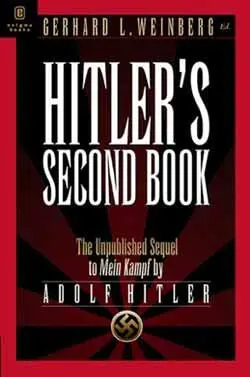
Adolf Hitler - Hitler’s Second Book
Здесь есть возможность читать онлайн «Adolf Hitler - Hitler’s Second Book» весь текст электронной книги совершенно бесплатно (целиком полную версию без сокращений). В некоторых случаях можно слушать аудио, скачать через торрент в формате fb2 и присутствует краткое содержание. Город: New York, Год выпуска: 2003, ISBN: 2003, Издательство: Enigma Books, Жанр: Публицистика, на английском языке. Описание произведения, (предисловие) а так же отзывы посетителей доступны на портале библиотеки ЛибКат.
- Название:Hitler’s Second Book
- Автор:
- Издательство:Enigma Books
- Жанр:
- Год:2003
- Город:New York
- ISBN:978-1929631162
- Рейтинг книги:4 / 5. Голосов: 1
-
Избранное:Добавить в избранное
- Отзывы:
-
Ваша оценка:
Hitler’s Second Book: краткое содержание, описание и аннотация
Предлагаем к чтению аннотацию, описание, краткое содержание или предисловие (зависит от того, что написал сам автор книги «Hitler’s Second Book»). Если вы не нашли необходимую информацию о книге — напишите в комментариях, мы постараемся отыскать её.
* * * In 1958, while directing the microfilming and organization of a trove of archives that the U.S. forces had taken from the Nazis at the end of WWII, historian Weinberg (
) discovered the manuscript of a second book that Hitler had written but never published. The manuscript was published in German in 1961, accompanied by Weinberg’s annotations, but this is the first authoritative English version (a pirated and poor translation appeared in the 1960s). The text bears all of Hitler's hallmarks: rambling thoughts, half-baked ideas, pedantic writing-along with a terrifying, sustained belief in war and violence as the means to ensure that Germans would flourish. Compared to
, there are fewer pages devoted to Jews. Nonetheless, what comes across most strongly is Hitler’s abiding commitment to the principle of race and his identification of Jews as the enemy that threatened to undo all that Germans had created. Hitler dwells at length on foreign policy, and outlines a strategy of alliance with Fascist Italy and Great Britain. (He actually believed that Britain would accept a German-dominated European continent so long as Germany did not challenge the overseas British empire.) He also foresees an inevitable clash with the United States. This provides solid historical background on Hitler's thinking in the late 1920s, when his party was nothing more than a tiny, radical sect. Weinberg provides helpful notes and a very informative introduction.
Copyright 2003 Reed Business Information, Inc. “Politics is history in the making.”
Such were the words of Adolf Hitler in his untitled, unpublished, and long suppressed second work written only a few years after the publication of
.
Only two copies of the 200 page manuscript were originally made, and only one of these has ever been made public. Kept strictly secret under Hitler’s orders, the document was placed in an air raid shelter in 1935 where it remained until it’s discovery by an American officer in 1945.
Written in 1928, the authenticity of the book has been verified by Josef Berg (former employee of the Nazi publishing house Eher Verlag), and Telford Taylor (former Brigadier General U.S.A.R., and Chief Counsel at the Nuremburg war-crimes trials) who, after an analysis made in 1961, comments:
*as quoted by http://www.pharo.com/lost&found.htm
“If Hitler’s book of 1928 is read against the background of the intervening years, it should interest not scholars only, but the general reader.”*
Hitler’s Second Book — читать онлайн бесплатно полную книгу (весь текст) целиком
Ниже представлен текст книги, разбитый по страницам. Система сохранения места последней прочитанной страницы, позволяет с удобством читать онлайн бесплатно книгу «Hitler’s Second Book», без необходимости каждый раз заново искать на чём Вы остановились. Поставьте закладку, и сможете в любой момент перейти на страницу, на которой закончили чтение.
Интервал:
Закладка:
The joy of responsibility in the framing of great decisions in the struggles of nations will, of course, be all the greater the more the actors, by observation of their Folk, can conclude that even a miscarriage will not be able to destroy the nation’s vital strength. For in the long run a Folk, inwardly healthy at its core, can never be effaced through defeats on the battlefield. Thus insofar as a Folk possesses this inner health, with the prerequisite of a sufficient racial importance, the courage for difficult undertakings can be the greater since even the failure of the same would not, by far, signify the downfall of such a Folk. And here Clausewitz is right, when in his principles he asserts that, with a healthy Folk, such a defeat may repeatedly lead to a later resurgence, and that, conversely, only cowardly subjection, that is, a supine surrender to fate, can lead to ultimate destruction. The neutrality, however, which is today recommended to our Folk as the only action possible, is really nothing but a volitionless surrender to a fate determined by foreign powers. And only therein lies the symptom and the possibility of our decline. If, on the contrary, our Folk itself had undertaken abortive attempts to achieve freedom, a factor that could be beneficial to our Folk’s strength would lie in the very manifestation of this attitude. For let it not be said that it is political sagacity which holds us back from such steps. No, it is a wretched cowardice and a lack of principle which in this case, as so often in history, one tries to confuse with intelligence. Obviously a Folk under the duress of foreign powers can be forced by circumstances to endure years of foreign oppression. But the less a Folk can seriously do outwardly against overpowering forces, the more, however, will its internal life press toward freedom and leave nothing untried that could be suitable for changing the momentarily given condition one day by staking such a Folk’s entire strength. One will then endure the yoke of a foreign conqueror, but with clenched fists and gritted teeth, waiting for the hour which offers the first opportunity of shaking off the tyrant.
Something like this can be possible under the pressure of conditions. But what presents itself today as political sagacity, however, is as a matter of fact a spirit of voluntary subjection, of unprincipled renunciation of any resistance, indeed the shameless persecution of those who dare to think of such a resistance and whose work obviously could serve their Folk’s resurgence. It is the spirit of inner self disarmament, of the destruction of all moral factors which one day could serve a resurrection of this Folk and State. This spirit can really not give itself the airs of political sagacity, for actually it is a State destroying dishonourableness.
And, to be sure, this spirit must hate every attempt at an active participation of our Folk in future European developments, because the necessity of a struggle against this spirit indeed lies in the mere attempt at such a participation.
If, however, a State leadership seems to be affected by this corrupting spirit, it becomes the task of the opposition which perceives, represents and thus espouses a Folk’s real vital forces to inscribe the struggle [the education] for national resurgence, and through it for national honour, on its banners. And it must not let itself be intimidated by the assertion that foreign policy is the task of responsible State leadership, for there has not been such a responsible leadership for a long time. On the contrary, it must adhere to the conception that, besides the formal laws of momentary governments, there exist eternal obligations which compel every member of a nation to do what is perceived as necessary for the existence of the Folkish Community. Even if this stands a thousand times in opposition to the intentions of bad and incompetent governments.
Hence precisely in Germany today the highest obligation should devolve on the so called National Opposition, in view of the unworthiness of the general leadership of our Folk to establish a clear foreign policy aim, and to prepare and educate our Folk for the execution of these ideas. Primarily, it must launch the sharpest war against the hope, widely spread today, that our fate can be changed somewhat by active cooperation with the League Of Nations. In general, it must see to it that our Folk gradually realises that we must not expect an amelioration of the German situation from institutions the representatives of which are the interested parties in our present misfortune. Further, it must deepen the conviction that all social aspirations are Utopian promises devoid of any real worth without the regaining of German freedom. It must further bring our Folk the knowledge that, for this freedom, one way or another, only the staking of its own strength can be considered. And that, consequently, our whole domestic and foreign policy must be such that by virtue of it our Folk’s inner strength grows and increases. Finally, it must enlighten the Folk to the effect that this staking of strength must take place for a really worthwhile aim, and that for this purpose we cannot go forward to meet our fate alone, but will need allies.
Chapter 11
GERMANY AND RUSSIA
The size of the possible military commitment as well as the relation of this means of power to those of the surrounding States is of decisive importance for the question of the future shaping of German foreign policy, apart from the inner power of our Folk, of its strength and assessment of character.
I need not express myself further on the moral inner weakness of our presentday Folk in this work. Our general weaknesses which are in part grounded in a matter of blood, and in part lie in the nature of our present governmental organisation, or must be attributed to the effects of our poor leadership, are perhaps less familiar to the German public than, unfortunately, they are to the rest of the world, which knows them well. Most of the measures of our oppressors are occasioned by knowledge of this weakness. But with all acknowledgment of the factual conditions, it should still never be forgotten that the same people of today hardly ten years ago accomplished deeds unrivalled in history. The German Folk which at the moment leaves such a depressing impression has, nevertheless, more than once proved its powerful merit in world history. The World War itself is the most glorious evidence of our Folk’s heroism and spirit of sacrifice, of its death defying discipline and its brilliant capability in thousands upon thousands of areas in the organisation of its life. Its purely military leadership has also achieved immortal successes. Only the political leadership has failed. It was already the precursor of that of today, even so much worse.
Today the inner qualities of our Folk may be a thousandfold unsatisfactory, but in one blow they will yield another image, as soon as another fist takes the reins of events in order to lead our Folk out of its present decline.
In our own history, we see how wonderful is precisely our Folk’s capacity for transformation. Prussia in 1806 and Prussia in 1813. What a difference! In 1806, the State characterised by the most abject capitulation everywhere, an unheard of wretchedness in the civic attitude, and in 1813 the State characterised by the most glowing hatred against foreign domination and a sense of patriotic sacrifice for one’s own Folk, the most heroic will to fight for freedom! What, in truth, has changed since then? The Folk? No, in its inner essence it has remained as before, only its leadership had come into other hands. A new spirit followed the weakness of the Prussian governmental administration and the ossified and aged leadership of the post Frederick period. Baron vom Stein and Gneisenau, Scharnhorst, Clausewitz and Blücher were the representatives of the new Prussia.
Читать дальшеИнтервал:
Закладка:
Похожие книги на «Hitler’s Second Book»
Представляем Вашему вниманию похожие книги на «Hitler’s Second Book» списком для выбора. Мы отобрали схожую по названию и смыслу литературу в надежде предоставить читателям больше вариантов отыскать новые, интересные, ещё непрочитанные произведения.




Обсуждение, отзывы о книге «Hitler’s Second Book» и просто собственные мнения читателей. Оставьте ваши комментарии, напишите, что Вы думаете о произведении, его смысле или главных героях. Укажите что конкретно понравилось, а что нет, и почему Вы так считаете.