Adolf Hitler - Hitler’s Second Book
Здесь есть возможность читать онлайн «Adolf Hitler - Hitler’s Second Book» весь текст электронной книги совершенно бесплатно (целиком полную версию без сокращений). В некоторых случаях можно слушать аудио, скачать через торрент в формате fb2 и присутствует краткое содержание. Город: New York, Год выпуска: 2003, ISBN: 2003, Издательство: Enigma Books, Жанр: Публицистика, на английском языке. Описание произведения, (предисловие) а так же отзывы посетителей доступны на портале библиотеки ЛибКат.
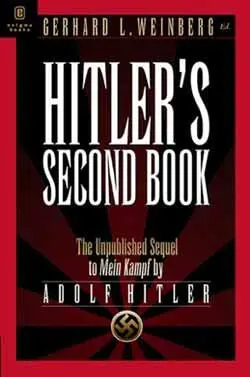
- Название:Hitler’s Second Book
- Автор:
- Издательство:Enigma Books
- Жанр:
- Год:2003
- Город:New York
- ISBN:978-1929631162
- Рейтинг книги:4 / 5. Голосов: 1
-
Избранное:Добавить в избранное
- Отзывы:
-
Ваша оценка:
Hitler’s Second Book: краткое содержание, описание и аннотация
Предлагаем к чтению аннотацию, описание, краткое содержание или предисловие (зависит от того, что написал сам автор книги «Hitler’s Second Book»). Если вы не нашли необходимую информацию о книге — напишите в комментариях, мы постараемся отыскать её.
* * * In 1958, while directing the microfilming and organization of a trove of archives that the U.S. forces had taken from the Nazis at the end of WWII, historian Weinberg (
) discovered the manuscript of a second book that Hitler had written but never published. The manuscript was published in German in 1961, accompanied by Weinberg’s annotations, but this is the first authoritative English version (a pirated and poor translation appeared in the 1960s). The text bears all of Hitler's hallmarks: rambling thoughts, half-baked ideas, pedantic writing-along with a terrifying, sustained belief in war and violence as the means to ensure that Germans would flourish. Compared to
, there are fewer pages devoted to Jews. Nonetheless, what comes across most strongly is Hitler’s abiding commitment to the principle of race and his identification of Jews as the enemy that threatened to undo all that Germans had created. Hitler dwells at length on foreign policy, and outlines a strategy of alliance with Fascist Italy and Great Britain. (He actually believed that Britain would accept a German-dominated European continent so long as Germany did not challenge the overseas British empire.) He also foresees an inevitable clash with the United States. This provides solid historical background on Hitler's thinking in the late 1920s, when his party was nothing more than a tiny, radical sect. Weinberg provides helpful notes and a very informative introduction.
Copyright 2003 Reed Business Information, Inc. “Politics is history in the making.”
Such were the words of Adolf Hitler in his untitled, unpublished, and long suppressed second work written only a few years after the publication of
.
Only two copies of the 200 page manuscript were originally made, and only one of these has ever been made public. Kept strictly secret under Hitler’s orders, the document was placed in an air raid shelter in 1935 where it remained until it’s discovery by an American officer in 1945.
Written in 1928, the authenticity of the book has been verified by Josef Berg (former employee of the Nazi publishing house Eher Verlag), and Telford Taylor (former Brigadier General U.S.A.R., and Chief Counsel at the Nuremburg war-crimes trials) who, after an analysis made in 1961, comments:
*as quoted by http://www.pharo.com/lost&found.htm
“If Hitler’s book of 1928 is read against the background of the intervening years, it should interest not scholars only, but the general reader.”*
Hitler’s Second Book — читать онлайн бесплатно полную книгу (весь текст) целиком
Ниже представлен текст книги, разбитый по страницам. Система сохранения места последней прочитанной страницы, позволяет с удобством читать онлайн бесплатно книгу «Hitler’s Second Book», без необходимости каждый раз заново искать на чём Вы остановились. Поставьте закладку, и сможете в любой момент перейти на страницу, на которой закончили чтение.
Интервал:
Закладка:
And the world in a few months had again forgotten that seven years before this Prussia had undergone the experience of Jena.
And was it, for instance, otherwise before the founding of the Reich? Hardly a decade was required for a new Reich, which in the eyes of many seemed to be the most powerful embodiment of German power and mastery, to arise out of the German decline, the German disunity, and the general political dishonourableness. A single head, towering above all, had restored freedom of development to the German genius in a battle against the mediocrity of the majority. Let us dispense with Bismarck in our history, and only wretched mediocrity would fill the most glorious period for our Folk in centuries.
Just as the German Folk could in a few years be hurled down from its unprecedented greatness, by the mediocrity of its leadership, into its present chaos, so can it be pulled up again by an iron fist. Its inner value will then make its appearance so visibly before the entire world that merely the actuality of its existence must compel a regard for and an appraisal of this fact.
If at the start, however, this value is a slumbering one, it is more than ever necessary to provide clarity on Germany’s real power value existing at the moment.
I have already tried to draw a brief picture of the momentary German instrument of military power, the Reich Defence. Here I wish to sketch Germany’s general military situation in relation to the surrounding world.
Germany at the present time is encircled by three power factors or power groups.
England, Russia and France are at present, militarily, the most threatening of Germany’s neighbours. At the same time, French power appears strengthened by a system of European alliances which reach from Paris to Belgrade via Warsaw and Prague.
Germany lies wedged between these States, with completely open borders. What is especially threatening thereby is that the western border of the Reich runs through Germany’s greatest industrial region. This western border, however, in consequence of its length and of the lack of all real natural barriers, offers only a few possibilities for defence by a State whose military means seem most extremely limited. Even the Rhine cannot be viewed as a fully effective line of military resistance. Not only because the possibility of finding the necessary technical preparations for this has been taken away from Germany by the peace treaties, but because the river itself offers even fewer obstacles to the passage of armies with modern equipment than the slight means of German defence which must be dispersed over too long a front. Moreover, this river runs through Germany’s greatest industrial area, and consequently a struggle over it from the outset would mean the destruction of the industrial areas and factories technically most important for national defence. But if in consequence of a French German conflict Czechoslovakia should come under consideration as a further opponent of Germany, a second great industrial region, Saxony, which could be useful industrially for the conduct of the war, would be exposed to the greatest danger of war. Here too the border, without natural defence, runs down to Bavaria, so broadly and openly that the prospect of a resistance promising success can hardly be considered. If Poland also were to take part in such a war, the entire eastern border in addition, apart from a few inadequate fortifications, would be defenceless against attack.
Whereas on the one hand the German borders are militarily indefensible and are surrounded openly in long lines by enemies, our North Sea coast is especially small and confined. The naval power for its defence is laughable, and completely worthless as such. The Fleet which we claim today, beginning with our so called battleships, is at best the finest target material for enemy firing practice. The two newly built ships, light cruisers, modern in themselves, have no decisive value, indeed not even an apparent one. The Fleet we are allowed is inadequate even for the Baltic Sea. All in all, the only value of our Fleet is at most that of a floating gunnery school.
Thus, in case of a conflict with any naval power, not only would German trade be ended in a moment, but there would also be the danger of landings.
The entire unpropitiousness of our military situation stems from this other consideration: Berlin, the Reich’s capital, is barely 175 kilometres from the Polish border. It lies scarcely 190 kilometres from the nearest Czech border, just as far as the distance between Wismar and the Stettin Lagoon as the crow flies.
Thus this means that Berlin can be reached by modern aircraft in less than one hour from these borders. If we draw a line stretching 60 kilometres east of the Rhine River, within it will lie almost the entire western German industrial region. From Frankfurt to Dortmund there is hardly one major German industrial locality which does not lie within this zone. As long as France occupies a part of the left bank of the Rhine, she is in a position to push forward by aircraft into the heart of our western German industrial region in hardly 30 minutes. München is just as far from the Czech borders as Berlin is from the Polish and Czech borders. Czech military aircraft would need approximately 60 minutes to reach München, 40 minutes to Nuremberg, 30 minutes to reach Regensburg; even Augsburg lies only 200 kilometres from the Czech border, and consequently could also be easily reached in scarcely an hour by presentday aeroplanes. As the crow flies, however, Augsburg is almost as distant from the Czech border as it is from the French border. From Augsburg to Straßburg the line of flight is 230 kilometres, but it is only 210 kilometres to the nearest French border. Hence Augsburg also lies within a zone which can be reached by hostile aircraft in an hour. Indeed, if we examine the German border from this point of view, it turns out that within an hour’s flight time the following can be reached: the entire industrial region in western Germany, including Osnabrück, Bielefeld, Kassel, Würzburg, Stuttgart, Ulm, Augsburg. In the east: München, Augsburg, Würzburg, Magdeburg, Berlin, Stettin. In other words, with the present situation of the German borders, there is only a very small area embracing a few square kilometres which could not be visited by hostile aircraft within the first hour.
Hence France must be considered as the most dangerous enemy because she alone, thanks to her alliances, is in a position to be able to threaten almost the whole of Germany with aircraft, even an hour after the outbreak of a conflict.
At the present time, the military counteractions Germany could take against the application of this weapon, all in all, are quite nil.
This single observation already shows the hopeless situation into which a German resistance against France, based only on itself, must land at once. Whoever has himself been often subjected in the field to the effects of an enemy air attack best knows how to appraise especially the moral effects resulting therefrom.
But Hamburg and Bremen, too, in general all our coastal cities, would today no longer escape this fate since the large navies have the possibility of bringing floating landing places very close to the coast by means of aircraft carriers.
But Germany today not only has no technically effective weapons in a sufficient amount to oppose to air attacks. Even otherwise the purely technical equipment of our small Reich Defence is hopelessly inferior to that of our enemy. The lack of heavy artillery might be put up with more easily than the lack of a really promising possibility of defence against armoured tanks. If Germany today were thrust into a war against France and her allies without beforehand being in a position to be able to find at least the most necessary preparations for defence, the issue would be decided in a few days on the basis of the purely technical superiority of our adversaries. Measures required for defence against such a hostile attack could no longer be taken during the struggle itself.
Читать дальшеИнтервал:
Закладка:
Похожие книги на «Hitler’s Second Book»
Представляем Вашему вниманию похожие книги на «Hitler’s Second Book» списком для выбора. Мы отобрали схожую по названию и смыслу литературу в надежде предоставить читателям больше вариантов отыскать новые, интересные, ещё непрочитанные произведения.





Обсуждение, отзывы о книге «Hitler’s Second Book» и просто собственные мнения читателей. Оставьте ваши комментарии, напишите, что Вы думаете о произведении, его смысле или главных героях. Укажите что конкретно понравилось, а что нет, и почему Вы так считаете.