Adolf Hitler - Hitler’s Second Book
Здесь есть возможность читать онлайн «Adolf Hitler - Hitler’s Second Book» весь текст электронной книги совершенно бесплатно (целиком полную версию без сокращений). В некоторых случаях можно слушать аудио, скачать через торрент в формате fb2 и присутствует краткое содержание. Город: New York, Год выпуска: 2003, ISBN: 2003, Издательство: Enigma Books, Жанр: Публицистика, на английском языке. Описание произведения, (предисловие) а так же отзывы посетителей доступны на портале библиотеки ЛибКат.
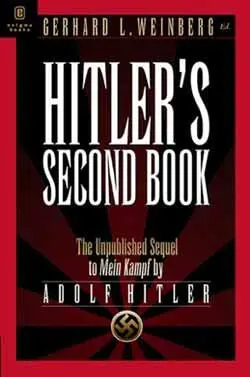
- Название:Hitler’s Second Book
- Автор:
- Издательство:Enigma Books
- Жанр:
- Год:2003
- Город:New York
- ISBN:978-1929631162
- Рейтинг книги:4 / 5. Голосов: 1
-
Избранное:Добавить в избранное
- Отзывы:
-
Ваша оценка:
Hitler’s Second Book: краткое содержание, описание и аннотация
Предлагаем к чтению аннотацию, описание, краткое содержание или предисловие (зависит от того, что написал сам автор книги «Hitler’s Second Book»). Если вы не нашли необходимую информацию о книге — напишите в комментариях, мы постараемся отыскать её.
* * * In 1958, while directing the microfilming and organization of a trove of archives that the U.S. forces had taken from the Nazis at the end of WWII, historian Weinberg (
) discovered the manuscript of a second book that Hitler had written but never published. The manuscript was published in German in 1961, accompanied by Weinberg’s annotations, but this is the first authoritative English version (a pirated and poor translation appeared in the 1960s). The text bears all of Hitler's hallmarks: rambling thoughts, half-baked ideas, pedantic writing-along with a terrifying, sustained belief in war and violence as the means to ensure that Germans would flourish. Compared to
, there are fewer pages devoted to Jews. Nonetheless, what comes across most strongly is Hitler’s abiding commitment to the principle of race and his identification of Jews as the enemy that threatened to undo all that Germans had created. Hitler dwells at length on foreign policy, and outlines a strategy of alliance with Fascist Italy and Great Britain. (He actually believed that Britain would accept a German-dominated European continent so long as Germany did not challenge the overseas British empire.) He also foresees an inevitable clash with the United States. This provides solid historical background on Hitler's thinking in the late 1920s, when his party was nothing more than a tiny, radical sect. Weinberg provides helpful notes and a very informative introduction.
Copyright 2003 Reed Business Information, Inc. “Politics is history in the making.”
Such were the words of Adolf Hitler in his untitled, unpublished, and long suppressed second work written only a few years after the publication of
.
Only two copies of the 200 page manuscript were originally made, and only one of these has ever been made public. Kept strictly secret under Hitler’s orders, the document was placed in an air raid shelter in 1935 where it remained until it’s discovery by an American officer in 1945.
Written in 1928, the authenticity of the book has been verified by Josef Berg (former employee of the Nazi publishing house Eher Verlag), and Telford Taylor (former Brigadier General U.S.A.R., and Chief Counsel at the Nuremburg war-crimes trials) who, after an analysis made in 1961, comments:
*as quoted by http://www.pharo.com/lost&found.htm
“If Hitler’s book of 1928 is read against the background of the intervening years, it should interest not scholars only, but the general reader.”*
Hitler’s Second Book — читать онлайн бесплатно полную книгу (весь текст) целиком
Ниже представлен текст книги, разбитый по страницам. Система сохранения места последней прочитанной страницы, позволяет с удобством читать онлайн бесплатно книгу «Hitler’s Second Book», без необходимости каждый раз заново искать на чём Вы остановились. Поставьте закладку, и сможете в любой момент перейти на страницу, на которой закончили чтение.
Интервал:
Закладка:
But now there remains the question of just what meaning a German Russian alliance should have in general.
Only the one of preserving Russia from destruction and sacrificing Germany for that? Regardless of how this alliance would turn out in the end, Germany could not arrive at setting a decisive foreign policy goal. For thereby nothing would be changed regarding the fundamental vital question, indeed regarding the vital needs, of our Folk. On the contrary, Germany, thereby, would be more than ever cut off from the only rational territorial policy in order to pad out her future with the scuffle over unimportant border adjustments. For the question of space for our Folk cannot be solved either in the west or in the south of Europe.
The hope in a German Russian alliance, which haunts the minds of even many German national politicians, however, is more than questionable for still another reason.
In general, it seems self evident in national circles that we cannot very well ally ourselves with a Jewish Bolshevist Russia, since the result, according to all probability, would be a Bolshevisation of Germany.
Obviously, we do not want this. But we base ourselves on the hope that one day the Jewish character — and thereby the most fundamentally international capitalistic character of Bolshevism in Russia — might disappear in order to make place for a national communism, anticapitalist on a world scale. Then this Russia, permeated once more by national tendencies, might very well come up for consideration in terms of an alliance with Germany.
This is a very great error. It rests on an extraordinary ignorance of the psyche of the Slavic Folk Soul. This should not amaze anybody if we reflect on how little knowledge even politically minded Germany had of the spiritual conditions of her erstwhile allies. Otherwise we would never have fallen so low. If, therefore, today the national politicians in favour of friendship with Russia try to motivate their policy by reference to Bismarck’s analogous attitudes, they disregard a whole multitude of important factors which at that time, but not today, spoke in favour of Russian friendship.
The Russia which Bismarck knew was not a typical Slavic State, at least insofar as it was a question of the political leadership of the same. In general, Slavdom is lacking in Stateforming forces. In Russia especially, government formations were always attended to by foreign elements. Since the time of Peter The Great there were, above all, very many Baltic Germans who formed the skeleton and the brains of the Russian State. In the course of centuries, countless thousands of these Germans have been Russified, but only in the sense in which our own bourgeoisie, our national bourgeoisie, would like to Germanise or Teutonise Poles or Czechs. Just as in this case the new fledged German is in truth only a German speaking Pole or Czech, likewise did these artificial Russians remain German, or better, Teutons, according to their blood and hence their capabilities. Russia is indebted to this Teutonic upper stratum for her political State as well as for what little exists of her cultural value. A great Russia would neither have arisen nor would she have been able to preserve herself without this really German upper and intellectual stratum. As long as Russia had been a State with an autocratic form of government, this upper stratum, which in truth was not at all Russian, also decisively influenced the political life of the gigantic empire. Even Bismarck knew this Russia at least in part. It was with this Russia that the master of German political statesmanship had political dealings. But, even in his lifetime, the reliability and stability of Russian policy, both domestic and foreign, fluctuated precariously and became in part incalculable.
This lay in the gradual suppression of the German upper stratum. This process of the transformation of the Russian intelligentsia was caused in part by a bleeding of the Russian nation in consequence of many wars, which, as has been already mentioned in this book, primarily decimate the racially more valuable forces.
Actually the officer corps especially was for the most part non Slav by descent, but in every case not of Russian blood. On top of this came the slight increase in the upper stratum of the intelligentsia as such, and finally the artificial training by the schools of a real Russiandom with regard to blood. The slight Statepreserving value of the new Russian intelligentsia as such was grounded on blood, and revealed itself most sharply perhaps in the nihilism of the Russian universities. Most fundamentally, however, this nihilism was nothing but the opposition, determined by blood, of real Russiandom to the racially alien upper stratum.
The Pan Slavic idea was counterposed to the Russian idea of the State in proportion as Russia’s Teutonic, Stateforming upper stratum was replaced by a racially pure Russian bourgeois class. From the first hour of its birth it was Folkish, Slavish [Russian], and anti German. The anti German disposition of the newly emerging Russiandom, especially in the strata of the so called intelligentsia, however, was not only a pure reflex action against the former autocratic alien upper class in Russia, for instance, on the grounds of politically liberal modes of thought. Rather, in the most intrinsic sense, it was the protest of the Slavic nature against the German.
They are two Folk Souls which have only very little in common, whereby indeed it must first be established whether this littleness they have in common has its cause in the confusedly broken racial individual elements of which the Russian as well as the German Folk seems to be constituted. Thus what is common to us and to the Russians is as little consonant with the German as with the Russian character but, instead, is to be ascribed only to our mixture of bloods which has brought just as many eastern Slavic elements to Germany as Nordic German ones to Russia.
But if as a test of the two spiritual endowments we were to take a purely Nordic German, from Westphalia let us say, and place a purely Slavic Russian opposite to him, an infinite chasm would yawn between these two representatives of the two Folks. Actually the Slavic Russian Folk has always felt this, and has therefore always had an instinctive antipathy toward the German. Solid thoroughness as well as the cold logic of sober thought, are something which the real Russian inwardly finds unsympathetic and in part even incomprehensible. Our sense of order will not only find no reciprocal love, but will always elicit aversion. What with us is felt as something self evident is for the Russian, however, an affliction, since it represents a restriction of his natural, differently structured spiritual and instinctual life. Hence Slavic Russia will feel itself drawn more and more to France. And indeed to an increasing degree, since the Frankish Nordic element is also being suppressed in France. The facile, superficial, more or less effeminate French life was more able to fascinate the Slav because inwardly it is closer to him than the severities of our German struggle for existence. Hence it is no accident if Pan Slavic Russia waxes politically enthusiastic over France, exactly as the Russian intelligentsia of Slavic blood found in Paris the Mecca of its own needs for civilisation.
The process of the rise of a Russian national bourgeoisie at the same time caused [signified] an inner alienation of this new Russia vis-à-vis Germany, which now could no longer build on a racially related Russian upper stratum.
As a matter of fact, already at the turn of the century, the anti German orientation of the representatives of the Folkish Pan Slav idea was so strong and its influence on Russian policy had grown to such an extent that even Germany’s more than decent attitude vis-à-vis Russia, on the occasion of the Russian Japanese war, could no longer check the further estrangement of the two States. Then came the World War which to no little extent had also been kindled by the Pan Slavist agitation. The real governmental Russia, insofar as it had been represented by the erstwhile upper stratum, therefore could hardly put in a word anymore.
Читать дальшеИнтервал:
Закладка:
Похожие книги на «Hitler’s Second Book»
Представляем Вашему вниманию похожие книги на «Hitler’s Second Book» списком для выбора. Мы отобрали схожую по названию и смыслу литературу в надежде предоставить читателям больше вариантов отыскать новые, интересные, ещё непрочитанные произведения.

Обсуждение, отзывы о книге «Hitler’s Second Book» и просто собственные мнения читателей. Оставьте ваши комментарии, напишите, что Вы думаете о произведении, его смысле или главных героях. Укажите что конкретно понравилось, а что нет, и почему Вы так считаете.