Adolf Hitler - Hitler’s Second Book
Здесь есть возможность читать онлайн «Adolf Hitler - Hitler’s Second Book» весь текст электронной книги совершенно бесплатно (целиком полную версию без сокращений). В некоторых случаях можно слушать аудио, скачать через торрент в формате fb2 и присутствует краткое содержание. Город: New York, Год выпуска: 2003, ISBN: 2003, Издательство: Enigma Books, Жанр: Публицистика, на английском языке. Описание произведения, (предисловие) а так же отзывы посетителей доступны на портале библиотеки ЛибКат.
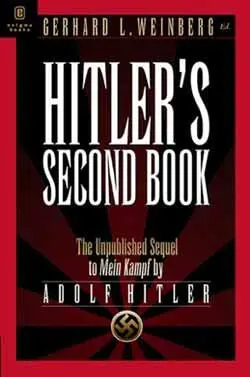
- Название:Hitler’s Second Book
- Автор:
- Издательство:Enigma Books
- Жанр:
- Год:2003
- Город:New York
- ISBN:978-1929631162
- Рейтинг книги:4 / 5. Голосов: 1
-
Избранное:Добавить в избранное
- Отзывы:
-
Ваша оценка:
Hitler’s Second Book: краткое содержание, описание и аннотация
Предлагаем к чтению аннотацию, описание, краткое содержание или предисловие (зависит от того, что написал сам автор книги «Hitler’s Second Book»). Если вы не нашли необходимую информацию о книге — напишите в комментариях, мы постараемся отыскать её.
* * * In 1958, while directing the microfilming and organization of a trove of archives that the U.S. forces had taken from the Nazis at the end of WWII, historian Weinberg (
) discovered the manuscript of a second book that Hitler had written but never published. The manuscript was published in German in 1961, accompanied by Weinberg’s annotations, but this is the first authoritative English version (a pirated and poor translation appeared in the 1960s). The text bears all of Hitler's hallmarks: rambling thoughts, half-baked ideas, pedantic writing-along with a terrifying, sustained belief in war and violence as the means to ensure that Germans would flourish. Compared to
, there are fewer pages devoted to Jews. Nonetheless, what comes across most strongly is Hitler’s abiding commitment to the principle of race and his identification of Jews as the enemy that threatened to undo all that Germans had created. Hitler dwells at length on foreign policy, and outlines a strategy of alliance with Fascist Italy and Great Britain. (He actually believed that Britain would accept a German-dominated European continent so long as Germany did not challenge the overseas British empire.) He also foresees an inevitable clash with the United States. This provides solid historical background on Hitler's thinking in the late 1920s, when his party was nothing more than a tiny, radical sect. Weinberg provides helpful notes and a very informative introduction.
Copyright 2003 Reed Business Information, Inc. “Politics is history in the making.”
Such were the words of Adolf Hitler in his untitled, unpublished, and long suppressed second work written only a few years after the publication of
.
Only two copies of the 200 page manuscript were originally made, and only one of these has ever been made public. Kept strictly secret under Hitler’s orders, the document was placed in an air raid shelter in 1935 where it remained until it’s discovery by an American officer in 1945.
Written in 1928, the authenticity of the book has been verified by Josef Berg (former employee of the Nazi publishing house Eher Verlag), and Telford Taylor (former Brigadier General U.S.A.R., and Chief Counsel at the Nuremburg war-crimes trials) who, after an analysis made in 1961, comments:
*as quoted by http://www.pharo.com/lost&found.htm
“If Hitler’s book of 1928 is read against the background of the intervening years, it should interest not scholars only, but the general reader.”*
Hitler’s Second Book — читать онлайн бесплатно полную книгу (весь текст) целиком
Ниже представлен текст книги, разбитый по страницам. Система сохранения места последней прочитанной страницы, позволяет с удобством читать онлайн бесплатно книгу «Hitler’s Second Book», без необходимости каждый раз заново искать на чём Вы остановились. Поставьте закладку, и сможете в любой момент перейти на страницу, на которой закончили чтение.
Интервал:
Закладка:
Germany’s situation in Europe today is such that she is far from allowing herself to hope that she may go forward to a condition of contemplative peace with her own political aimlessness. No such possibility exists for a nation located in the heart of Europe. Either Germany itself tries actively to take part in the shaping of life, or she will be a passive object of the lifeshaping activity of other nations. All the sagacity hitherto supposedly able to extricate nations from historical dangers through declarations of a general disinterest has, up to now, always shown itself to be an error as cowardly as it is stupid. Whoever will not be a hammer in history, will be an anvil.
In all its development up to now, our German Folk has had a choice only between these two possibilities. When it itself wanted to make history, and accordingly joyfully and boldly staked all, then it was still the hammer.
When it believed that it could renounce the obligations of the struggle for existence, it remained, up to now, the anvil on which others fought out their struggle for existence, or it itself served the alien world as nutriment.
Hence, if Germany wants to live, she must take the defence of this life upon herself, and even here the best parry is a thrust. Indeed, Germany may not hope at all that she can still do something for shaping her own life, if she does not make a strong effort to set a clear foreign policy aim which seems suitable for bringing the German struggle for existence into an intelligent relation to the interests of other nations.
If we do not do this, however, aimlessness on a large scale will cause planlessness in particulars. This planlessness will gradually turn us into a second Poland in Europe. In the very proportion that we let our own forces become weaker, thanks to our general political defeatism, and the only activity of our life is spent in a mere domestic policy, we will sink to being a puppet of historical events whose motive forces spring from the struggle for existence and for their interests waged by other nations.
Moreover, nations which are not able to take clear decisions over their own future and accordingly would like best of all not to participate in the game of world development, will be viewed by all the other players as a spoilsport and equally hated. Indeed, it can even happen that, on the contrary, the planlessness of individual political actions, grounded in the general foreign policy aimlessness, is regarded as a very shrewd impenetrable game and responded to accordingly. It was this which befell us as a misfortune in the pre War period. The more impenetrable, because they were incomprehensible, were the political decisions of the German Governments of that time, the more suspicious they seemed. And all the more, therefore, were especially dangerous ideas suspected behind the most stupid step.
Thus, if today Germany no longer makes an effort to arrive at a clear political goal, in practice she renounces all possibilities of a revision of her present fate, without in the least being able to avoid future dangers.
2) Germany desires to effect the sustenance of the German Folk by peaceful economic means, as up to now.
Accordingly, even in the future, she will participate most decisively in world industry, export and trade. Thus she will again want a great merchant fleet, she will want coaling stations and bases in other parts of the world, and finally she will want not only international sales markets, but also her own sources of raw material, if possible, in the form of colonies. In the future such a development will necessarily have to be protected, especially by maritime means of power.
This whole political goal for the future is a Utopia, unless England is seen as defeated beforehand. It establishes anew all the causes which in 1914 resulted in the World War. Any attempt by Germany to renew her past along this way must end with England’s mortal emnity, alongside which France may be reckoned as a most certain partner from the outset.
From a Folkish standpoint setting, this foreign policy aim is calamitous, and it is madness from the point of view of power politics.
3) Germany establishes the restoration of the borders of the year 1914 as her foreign policy aim.
This goal is insufficient from a national standpoint, unsatisfactory from a military point of view, impossible from a Folkish standpoint with its eye on the future, and mad from the viewpoint of its consequences. Thereby, even in the future, Germany would have the whole coalition of former victors against her in a compact front. In view of our present military position, which with a continuation of the present situation will worsen from year to year, just how we are to restore the old borders is the impenetrable secret of our national bourgeois and patriotic government politicians.
4) Germany decides to go over to a clear, farseeing territorial policy. Thereby she abandons all attempts at world industry and world trade, and instead concentrates all her strength in order, through the allotment of sufficient living space for the next hundred years to our Folk, also to prescribe a path of life. Since this territory can be only in the east, the obligation to be a naval power also recedes into the background. Germany tries anew to champion her interests through the formation of a decisive power on land.
This aim is equally in keeping with the highest national as well as Folkish requirements. It likewise presupposes great military power means for its execution, but does not necessarily bring Germany into conflict with all European great powers. As surely as France here will remain Germany’s enemy, just as little does the nature of such a political aim contain a reason for England, and especially for Italy, to maintain the enmity of the World War.
Chapter 14
ENGLAND AS AN ALLY
It is fitting to review the great foreign aims of the other European powers for a closer understanding of the possibilities just adduced. In part these aims are recognisable in the previous activity and efficacy of these States, in part they are virtually laid down programmatically, and otherwise lie in vital needs that are so clearly recognisable that even if the States momentarily embark on other paths, the compulsion of a harsher reality necessarily leads them back to these aims.
That England has a clear foreign policy goal is proved by the fact of the existence and therewith of the rise of this giant empire. Let no one fancy, after all, that a world empire can ever be forged without a clear will thereto.
Obviously not every single member of such a nation goes to work every day with the idea of setting a great foreign policy goal, but in a completely natural way even an entire Folk will be gripped by such a goal so that even the unconscious acts of individuals nevertheless lie in the general line of the aim that has been set and actually benefit it. Indeed the general political goal will slowly stamp itself on the very character of such a Folk, and the pride of the presentday Englishman is no different from the pride of the former Romans. The opinion that a world empire owes its rise to chance, or that, at least, the events which conditioned its establishment were accidental historical processes which always turned out luckily for a nation, is false. Ancient Rome owed its greatness, exactly as does presentday England, to the soundness of Moltke’s assertion that in the long run luck is always with the fit. This fitness of a Folk in no way lies only in racial value, but also in the ability and skill with which these values are applied. A world empire of the size of ancient Rome, or of present day Great Britain, is always the result of a marriage between the highest race value and the clearest political aim. As soon as one of these two factors begins to be lacking, first a weakening sets in, and ultimately perhaps even a decline.
Читать дальшеИнтервал:
Закладка:
Похожие книги на «Hitler’s Second Book»
Представляем Вашему вниманию похожие книги на «Hitler’s Second Book» списком для выбора. Мы отобрали схожую по названию и смыслу литературу в надежде предоставить читателям больше вариантов отыскать новые, интересные, ещё непрочитанные произведения.



Обсуждение, отзывы о книге «Hitler’s Second Book» и просто собственные мнения читателей. Оставьте ваши комментарии, напишите, что Вы думаете о произведении, его смысле или главных героях. Укажите что конкретно понравилось, а что нет, и почему Вы так считаете.