Adolf Hitler - Hitler’s Second Book
Здесь есть возможность читать онлайн «Adolf Hitler - Hitler’s Second Book» весь текст электронной книги совершенно бесплатно (целиком полную версию без сокращений). В некоторых случаях можно слушать аудио, скачать через торрент в формате fb2 и присутствует краткое содержание. Город: New York, Год выпуска: 2003, ISBN: 2003, Издательство: Enigma Books, Жанр: Публицистика, на английском языке. Описание произведения, (предисловие) а так же отзывы посетителей доступны на портале библиотеки ЛибКат.
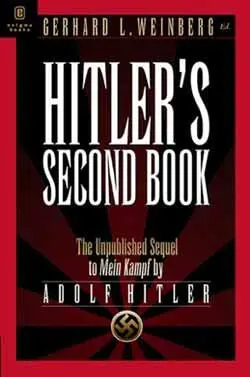
- Название:Hitler’s Second Book
- Автор:
- Издательство:Enigma Books
- Жанр:
- Год:2003
- Город:New York
- ISBN:978-1929631162
- Рейтинг книги:4 / 5. Голосов: 1
-
Избранное:Добавить в избранное
- Отзывы:
-
Ваша оценка:
Hitler’s Second Book: краткое содержание, описание и аннотация
Предлагаем к чтению аннотацию, описание, краткое содержание или предисловие (зависит от того, что написал сам автор книги «Hitler’s Second Book»). Если вы не нашли необходимую информацию о книге — напишите в комментариях, мы постараемся отыскать её.
* * * In 1958, while directing the microfilming and organization of a trove of archives that the U.S. forces had taken from the Nazis at the end of WWII, historian Weinberg (
) discovered the manuscript of a second book that Hitler had written but never published. The manuscript was published in German in 1961, accompanied by Weinberg’s annotations, but this is the first authoritative English version (a pirated and poor translation appeared in the 1960s). The text bears all of Hitler's hallmarks: rambling thoughts, half-baked ideas, pedantic writing-along with a terrifying, sustained belief in war and violence as the means to ensure that Germans would flourish. Compared to
, there are fewer pages devoted to Jews. Nonetheless, what comes across most strongly is Hitler’s abiding commitment to the principle of race and his identification of Jews as the enemy that threatened to undo all that Germans had created. Hitler dwells at length on foreign policy, and outlines a strategy of alliance with Fascist Italy and Great Britain. (He actually believed that Britain would accept a German-dominated European continent so long as Germany did not challenge the overseas British empire.) He also foresees an inevitable clash with the United States. This provides solid historical background on Hitler's thinking in the late 1920s, when his party was nothing more than a tiny, radical sect. Weinberg provides helpful notes and a very informative introduction.
Copyright 2003 Reed Business Information, Inc. “Politics is history in the making.”
Such were the words of Adolf Hitler in his untitled, unpublished, and long suppressed second work written only a few years after the publication of
.
Only two copies of the 200 page manuscript were originally made, and only one of these has ever been made public. Kept strictly secret under Hitler’s orders, the document was placed in an air raid shelter in 1935 where it remained until it’s discovery by an American officer in 1945.
Written in 1928, the authenticity of the book has been verified by Josef Berg (former employee of the Nazi publishing house Eher Verlag), and Telford Taylor (former Brigadier General U.S.A.R., and Chief Counsel at the Nuremburg war-crimes trials) who, after an analysis made in 1961, comments:
*as quoted by http://www.pharo.com/lost&found.htm
“If Hitler’s book of 1928 is read against the background of the intervening years, it should interest not scholars only, but the general reader.”*
Hitler’s Second Book — читать онлайн бесплатно полную книгу (весь текст) целиком
Ниже представлен текст книги, разбитый по страницам. Система сохранения места последней прочитанной страницы, позволяет с удобством читать онлайн бесплатно книгу «Hitler’s Second Book», без необходимости каждый раз заново искать на чём Вы остановились. Поставьте закладку, и сможете в любой момент перейти на страницу, на которой закончили чтение.
Интервал:
Закладка:
The World War itself then brought about a further [the last] bleeding of Russia’s Nordic German elements, and the last remains were finally extirpated by the Revolution and Bolshevism. It was not as if the Slav race instinct had deliberately carried out the struggle for the extermination of the former non Russian upper stratum by itself.
No, it had acquired new leaders meantime in Jewry. Jewry, pressing toward the upper strata and therefore toward supreme leadership, has exterminated the former alien upper class with the help of the Slav race instinct.
Thus it is a quite understandable process if Jewry has taken over the leadership of all areas of Russian life with the Bolshevik revolution, since by itself and out of itself Slavdom is altogether lacking in any organising ability and thereby also in any Stateforming and Statepreserving power. Take away all the elements which are not purely Slavic from Slavdom, and it will immediately succumb to disintegration as a State. To be sure, fundamentally, any formation of States may at first have its innermost inducement in the encounter between Folks of a higher and lower order, whereby the bearers of the higher blood value — for reasons of self preservation — develop a definite community spirit which first allows them the possibility of an organisation and a rule over inferior Folks. Only the overcoming of common tasks compels the adoption of organisational forms. But the difference between the Stateforming and the non Stateforming elements lies precisely in the fact that the formation of an organisation for the preservation of their stock vis-à-vis other types becomes possible for the former, whereas the non Stateforming incompetents are not capable by themselves of finding those organisational forms which would guarantee their existence vis-à-vis others.
Thus presentday Russia or, better said, presentday Slavdom of Russian nationality, has received as master the Jew, who first eliminated the former upper stratum, and now must prove his own Stateforming power. In view of the endowment of Jewry, which after all is only destructive, it will operate even here only as the historical ferment of decomposition. It has summoned to its help spirits of which it can no longer rid itself, and the struggle of the inwardly anti State Pan Slav idea against the Bolshevist Jewish State idea will end with the destruction of Jewry. What will then remain will be a Russia as insignificant in governmental power as she will be deeply rooted in an anti German attitude. Since this State will no longer possess a Statepreserving upper stratum anchored anywhere, it will become a source of eternal unrest and eternal insecurity. A gigantic land area will thus be surrendered to the most variegated fate, and instead of stabilisation of relations between States on Earth, a period of the most restless changes will begin.
Thus the first phase of these developments will be that the most different nations of the world will try to enter into relations with this enormous complex of States in order thereby to bring about a strengthening of their own position and intentions. But such an attempt will always be linked to the effort also to exert their own intellectual and organisational influence on Russia at the same time.
Germany may not hope to come up for consideration in any way during this development. The whole mentality of presentday and future Russia is opposed to this. For the future, an alliance of Germany with Russia has no sense for Germany, neither from the standpoint of sober expediency, nor from that of human community. On the contrary, it is good fortune for the future that this development has taken place in just this way because, thereby, a spell has been broken which would have prevented us from seeking the goal of German foreign policy there where it solely and exclusively can lie: territory in the east.
Chapter 12
GERMAN FOREIGN POLICY
In view of Germany’s hopeless military situation, the following must be borne in mind in the formulation of future German foreign policy.
Germany cannot bring about a change in her present situation by herself, so far as this must ensue by means of military power. Germany cannot hope that a change of her situation will emerge through measures taken by the League Of Nations, as long as the determining representatives of this institution are at the same time the parties interested in Germany’s destruction. Germany cannot hope to change her present situation through a combination of powers which brings her into conflict with the French system of alliances surrounding Germany, without first acquiring the possibility of eliminating her sheer military powerlessness so that, in case the commitments of the alliance go into effect, she may be able to come forward immediately with the prospect of military success
Germany cannot hope to find such a combination of powers as long as her ultimate foreign policy aim does not seem clearly established, and, at the same time does not contradict the interests of those States which can be considered in terms of an alliance with Germany — indeed, even appear serviceable to them.
Germany cannot hope that these States can be found outside the League Of Nations. On the contrary, her only hope must consist in her eventual success in extricating individual States from the coalition of victor States, and building a new group of interested parties with new aims which cannot be realised through the League Of Nations because of its whole nature. Germany may only hope to achieve success in this way if she finally renounces her former vacillating seesaw policy, and fundamentally decides upon a single direction, and at the same time assumes and bears all the consequences.
Germany should never hope to make world history through alliances with nations whose military value seems sufficiently characterised by the fact of their former defeats, or whose general racial importance, is inferior. For the struggle for the regaining of German freedom will thereby again raise German history to the level of world history. Germany should never forget for a moment that regardless how, and along what ways, she thinks to change her fate, France will be her enemy, and that France from the outset can count on any combination of powers that turns against Germany.
Chapter 13
GERMAN GOALS
We cannot examine Germany’s foreign policy possibilities without first possessing clarity on what we want in Germany itself, that is, on how Germany itself thinks to shape her future. Further, we must then try to determine clearly the foreign policy goals of those powers in Europe which, as members of the coalition of victors, are important as world powers.
I have already dealt with Germany’s various foreign policy possibilities in this book. Nevertheless, I shall once more briefly present the possible foreign policy goals so that they may yield a basis for the critical examination of the relations of these individual foreign policy aims to those of other European States.
1) Germany can renounce setting a foreign policy goal altogether. This means that, in reality, she can decide for anything and need be committed to nothing at all.
Thus in the future she will continue the policy of the last thirty years, but under other conditions. If now the world consisted just of States with a similar political aimlessness, Germany could at least endure this even though it could hardly be justified. But this is not at all the case. Thus, just as in ordinary life a man with a fixed life goal that he tries to achieve at all events will always be superior to others who live aimlessly, exactly likewise is it in the life of nations. But, above all, this is far from saying that a State without a political goal is in the position to avoid dangers which such a goal may bring in its train. For just as it seems exempt from an active function, in consequence of its own political aimlessness, in its very passiveness it can also just as easily become the victim of the political aims of others. For the action of a State is not only determined by its own will, but also by that of others, with the sole difference that in one case it itself can determine the law of action, whereas in the other case the latter is forced upon it. Not to want a war because of a peaceful sentiment, is far from saying that it can also be avoided. And to avoid a war at any price is far from signifying saving life in the face of death.
Читать дальшеИнтервал:
Закладка:
Похожие книги на «Hitler’s Second Book»
Представляем Вашему вниманию похожие книги на «Hitler’s Second Book» списком для выбора. Мы отобрали схожую по названию и смыслу литературу в надежде предоставить читателям больше вариантов отыскать новые, интересные, ещё непрочитанные произведения.







Обсуждение, отзывы о книге «Hitler’s Second Book» и просто собственные мнения читателей. Оставьте ваши комментарии, напишите, что Вы думаете о произведении, его смысле или главных героях. Укажите что конкретно понравилось, а что нет, и почему Вы так считаете.