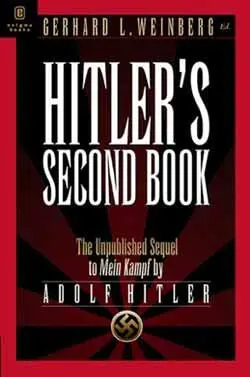
Adolf Hitler - Hitler’s Second Book
Здесь есть возможность читать онлайн «Adolf Hitler - Hitler’s Second Book» весь текст электронной книги совершенно бесплатно (целиком полную версию без сокращений). В некоторых случаях можно слушать аудио, скачать через торрент в формате fb2 и присутствует краткое содержание. Город: New York, Год выпуска: 2003, ISBN: 2003, Издательство: Enigma Books, Жанр: Публицистика, на английском языке. Описание произведения, (предисловие) а так же отзывы посетителей доступны на портале библиотеки ЛибКат.
- Название:Hitler’s Second Book
- Автор:
- Издательство:Enigma Books
- Жанр:
- Год:2003
- Город:New York
- ISBN:978-1929631162
- Рейтинг книги:4 / 5. Голосов: 1
-
Избранное:Добавить в избранное
- Отзывы:
-
Ваша оценка:
Hitler’s Second Book: краткое содержание, описание и аннотация
Предлагаем к чтению аннотацию, описание, краткое содержание или предисловие (зависит от того, что написал сам автор книги «Hitler’s Second Book»). Если вы не нашли необходимую информацию о книге — напишите в комментариях, мы постараемся отыскать её.
* * * In 1958, while directing the microfilming and organization of a trove of archives that the U.S. forces had taken from the Nazis at the end of WWII, historian Weinberg (
) discovered the manuscript of a second book that Hitler had written but never published. The manuscript was published in German in 1961, accompanied by Weinberg’s annotations, but this is the first authoritative English version (a pirated and poor translation appeared in the 1960s). The text bears all of Hitler's hallmarks: rambling thoughts, half-baked ideas, pedantic writing-along with a terrifying, sustained belief in war and violence as the means to ensure that Germans would flourish. Compared to
, there are fewer pages devoted to Jews. Nonetheless, what comes across most strongly is Hitler’s abiding commitment to the principle of race and his identification of Jews as the enemy that threatened to undo all that Germans had created. Hitler dwells at length on foreign policy, and outlines a strategy of alliance with Fascist Italy and Great Britain. (He actually believed that Britain would accept a German-dominated European continent so long as Germany did not challenge the overseas British empire.) He also foresees an inevitable clash with the United States. This provides solid historical background on Hitler's thinking in the late 1920s, when his party was nothing more than a tiny, radical sect. Weinberg provides helpful notes and a very informative introduction.
Copyright 2003 Reed Business Information, Inc. “Politics is history in the making.”
Such were the words of Adolf Hitler in his untitled, unpublished, and long suppressed second work written only a few years after the publication of
.
Only two copies of the 200 page manuscript were originally made, and only one of these has ever been made public. Kept strictly secret under Hitler’s orders, the document was placed in an air raid shelter in 1935 where it remained until it’s discovery by an American officer in 1945.
Written in 1928, the authenticity of the book has been verified by Josef Berg (former employee of the Nazi publishing house Eher Verlag), and Telford Taylor (former Brigadier General U.S.A.R., and Chief Counsel at the Nuremburg war-crimes trials) who, after an analysis made in 1961, comments:
*as quoted by http://www.pharo.com/lost&found.htm
“If Hitler’s book of 1928 is read against the background of the intervening years, it should interest not scholars only, but the general reader.”*
Hitler’s Second Book — читать онлайн бесплатно полную книгу (весь текст) целиком
Ниже представлен текст книги, разбитый по страницам. Система сохранения места последней прочитанной страницы, позволяет с удобством читать онлайн бесплатно книгу «Hitler’s Second Book», без необходимости каждый раз заново искать на чём Вы остановились. Поставьте закладку, и сможете в любой момент перейти на страницу, на которой закончили чтение.
Интервал:
Закладка:
The German Folk, which possesses neither a foreign policy tradition nor a foreign policy aim, will by itself rather be inclined to pay homage to Utopian ideals, and thereby neglect its real vital interest. For what has our Folk not raved over in the last hundred years? Now it was Greeks whom we wanted to save from the Turks, then Turks on whom we bestowed our affection against Russians and Italians, after which our Folk again found an enchantment in waxing enthusiastic over Polish freedom fighters, and then in indulging their feelings for the Boers, and so on. But what have all these most stupid soulful gushings, as incompetent politically as they were garrulous, cost our Folk?
Thus the relation to Austria, as was emphasised with special pride, was not one of practical understanding, but a true inner alliance of the heart. If only reason instead of the heart had spoken at this time, and understanding had decided, Germany would be saved today. But for the very reason that we are the kind of a Folk which lets its political actions be determined too little according to the grounds of a really reasonable, rational insight — for which reason we cannot look back on any great political tradition — we must, at least for the future, give our Folk an unshakeable foreign policy aim which seems suitable for making the political measures of the State leadership understandable to the broad masses in their particulars. Only thus will it be ultimately possible that millions with a divining faith will stand behind a government leadership which carries out decisions which in their particulars may have something painful about them. This is a prerequisite for bringing about a mutual understanding between the Folk and the State leadership and, to be sure, also a prerequisite for anchoring the State leadership itself in a certain tradition. It will not do that every German government have its own foreign policy goal. One can quarrel only over the means, one can dispute over them, but the goal itself must be established as unchangeable once and for all. Then politics can become the great art of the possible, that is, it is reserved to the brilliant abilities of the individual government leaders to perceive the possibilities, from instance to instance, of bringing the Folk and the Reich nearer to its foreign policy aim This setting of a foreign policy goal is altogether non existent in presentday Germany. Hence the unguided, wavering and unsure manner of attending to our Folk’s interests becomes understandable, as does also the whole confusion of our public opinion. Hence also the incredible capers of our foreign policy which always end unhappily without the Folk being even at least capable of judging the persons responsible and really calling them to account. No, one does not know what to do.
To be sure there are not a few people today who fully believe we should do nothing. They boil down their opinion to the effect that Germany today must be clever and reserved, that she engage herself nowhere, that we must keep the development of events well in view but ourselves not take part in them, in order, one day, to assume the role of the laughing third one, who reaps the benefits, while the other two quarrel.
Yes, yes, our present bourgeois statesmen are so clever and wise. A political judgement which is troubled by no knowledge of history. There are not a few proverbs which have become a real curse for our Folk. For example, the wiser one yields, or clothes make the man, or one can get through the whole land with hat in hand, or when two fight, the third rejoices.
In the life of nations, at least, the last proverb applies only in a wholly conditional sense. [And this for the following reason] Namely, if two quarrel hopelessly within a nation, then a third who is outside a nation can win. In the life of nations with one another, however, the ultimate success will be had by States which deliberately engage in disputes because the possibility of increasing their strength lies only in a quarrel. There is no historical event in the world that cannot be judged from two points of view. The neutrals on one side always confront the interventionist on the other. And, in general, the neutrals will always get the worst of it, whereas the interventionists rather can claim the benefits for themselves, insofar, indeed, as the party on which they wagered does not lose.
In the life of nations this means the following: If two mighty powers quarrel on this globe, the more or less small or large surrounding States either can take part in this struggle, or keep their distance from it. In one case the possibility of a gain is not excluded, insofar as the participation takes place on the side which carries off the victory. Regardless who wins, however, the neutrals will have no other fate save enmity with the remaining victor State. Up to now none of the globe’s great States has arisen on the basis of neutrality as a principle of political action, but only through struggle. If towering power States as such are on Earth, all that remains for small States to do is either to renounce their future altogether, or to fight with the more favourable coalition and under its protection, and thus increase their own strength. For the role of the laughing third always presupposes that this third already has a power. But whoever is always neutral will never achieve power. For to the extent that a Folk’s power lies in its inner value, the more does it find its ultimate expression in the organisational form of a Folk’s fighting forces on the battlefield, created by the will of this inner value. This form, however, will never rise if it is not put to the test from time to time. Only under the forge hammer of world history do a Folk’s eternal values become the steel and iron with which history is made. But he who avoids battles will never attain the strength to fight battles. And he who never fights battles will never be the heir of those who struggle with each other in a military conflict. For the previous heirs of world history were not, for instance, Folks with cowardly concepts of neutrality, but young Folks with better swords. Neither Antiquity nor the Middle Ages nor modern times knows even a single example of any power States coming into being save in permanent struggle. Up to now, however, the historical heirs have always been power States. In the life of nations, to be sure, even a third can be the heir when two quarrel. But then from the very outset this third is already the power which deliberately lets two other powers quarrel in order to defeat them once and for all later without a great sacrifice on its part.
Thereby neutrality loses the character of passive non participation in events altogether, and instead assumes that of a conscious political operation. Obviously no sagacious State leadership will begin a struggle without weighing the size of its possible stakes and comparing it with the size of the adversary’s stakes. But if it has perceived the impossibility of being able to fight against a certain powers, all the more so will it be forced to try to fight together with this power. For then the strength of the hitherto weaker power can eventually grow out of this common struggle, in order if necessary to fight for is own vital interests also against the latter. Let no one say that then no power would enter into an alliance with a State which some day itself might become a danger.
Alliances do not present policy aims, but only means to the aims. We must make use of them today even if we know a hundred times that the later development can possibly lead to the opposite. There is no alliance that lasts forever. Happy the nations which, in consequence of the complete divergence of their interests, can enter into an alliance relationship for a definite time without being forced to a mutual conflict after the cessation of the same.
But a weak State especially, which wants to achieve power and greatness, must always try to take an active part in the general political events of world history.
Читать дальшеИнтервал:
Закладка:
Похожие книги на «Hitler’s Second Book»
Представляем Вашему вниманию похожие книги на «Hitler’s Second Book» списком для выбора. Мы отобрали схожую по названию и смыслу литературу в надежде предоставить читателям больше вариантов отыскать новые, интересные, ещё непрочитанные произведения.



Обсуждение, отзывы о книге «Hitler’s Second Book» и просто собственные мнения читателей. Оставьте ваши комментарии, напишите, что Вы думаете о произведении, его смысле или главных героях. Укажите что конкретно понравилось, а что нет, и почему Вы так считаете.