Adolf Hitler - Hitler’s Second Book
Здесь есть возможность читать онлайн «Adolf Hitler - Hitler’s Second Book» весь текст электронной книги совершенно бесплатно (целиком полную версию без сокращений). В некоторых случаях можно слушать аудио, скачать через торрент в формате fb2 и присутствует краткое содержание. Город: New York, Год выпуска: 2003, ISBN: 2003, Издательство: Enigma Books, Жанр: Публицистика, на английском языке. Описание произведения, (предисловие) а так же отзывы посетителей доступны на портале библиотеки ЛибКат.
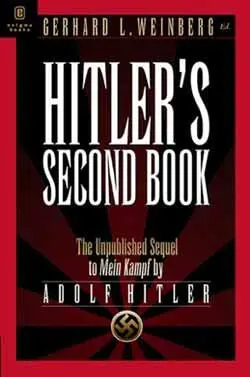
- Название:Hitler’s Second Book
- Автор:
- Издательство:Enigma Books
- Жанр:
- Год:2003
- Город:New York
- ISBN:978-1929631162
- Рейтинг книги:4 / 5. Голосов: 1
-
Избранное:Добавить в избранное
- Отзывы:
-
Ваша оценка:
Hitler’s Second Book: краткое содержание, описание и аннотация
Предлагаем к чтению аннотацию, описание, краткое содержание или предисловие (зависит от того, что написал сам автор книги «Hitler’s Second Book»). Если вы не нашли необходимую информацию о книге — напишите в комментариях, мы постараемся отыскать её.
* * * In 1958, while directing the microfilming and organization of a trove of archives that the U.S. forces had taken from the Nazis at the end of WWII, historian Weinberg (
) discovered the manuscript of a second book that Hitler had written but never published. The manuscript was published in German in 1961, accompanied by Weinberg’s annotations, but this is the first authoritative English version (a pirated and poor translation appeared in the 1960s). The text bears all of Hitler's hallmarks: rambling thoughts, half-baked ideas, pedantic writing-along with a terrifying, sustained belief in war and violence as the means to ensure that Germans would flourish. Compared to
, there are fewer pages devoted to Jews. Nonetheless, what comes across most strongly is Hitler’s abiding commitment to the principle of race and his identification of Jews as the enemy that threatened to undo all that Germans had created. Hitler dwells at length on foreign policy, and outlines a strategy of alliance with Fascist Italy and Great Britain. (He actually believed that Britain would accept a German-dominated European continent so long as Germany did not challenge the overseas British empire.) He also foresees an inevitable clash with the United States. This provides solid historical background on Hitler's thinking in the late 1920s, when his party was nothing more than a tiny, radical sect. Weinberg provides helpful notes and a very informative introduction.
Copyright 2003 Reed Business Information, Inc. “Politics is history in the making.”
Such were the words of Adolf Hitler in his untitled, unpublished, and long suppressed second work written only a few years after the publication of
.
Only two copies of the 200 page manuscript were originally made, and only one of these has ever been made public. Kept strictly secret under Hitler’s orders, the document was placed in an air raid shelter in 1935 where it remained until it’s discovery by an American officer in 1945.
Written in 1928, the authenticity of the book has been verified by Josef Berg (former employee of the Nazi publishing house Eher Verlag), and Telford Taylor (former Brigadier General U.S.A.R., and Chief Counsel at the Nuremburg war-crimes trials) who, after an analysis made in 1961, comments:
*as quoted by http://www.pharo.com/lost&found.htm
“If Hitler’s book of 1928 is read against the background of the intervening years, it should interest not scholars only, but the general reader.”*
Hitler’s Second Book — читать онлайн бесплатно полную книгу (весь текст) целиком
Ниже представлен текст книги, разбитый по страницам. Система сохранения места последней прочитанной страницы, позволяет с удобством читать онлайн бесплатно книгу «Hitler’s Second Book», без необходимости каждый раз заново искать на чём Вы остановились. Поставьте закладку, и сможете в любой момент перейти на страницу, на которой закончили чтение.
Интервал:
Закладка:
But even in such a case, the desired success would not materialise. For once any European great power today —
and naturally it could involve only a power which was valuable according to its Folkdom, that is, racially important — brings Europe to unity along these lines, the final completion of this unity would signify the racial submersion of its founders, and thereby remove even the last value from the whole structure. It would never be possible thereby to create a structure which could bear up against the American Union.
In the future only the State which has understood how to raise the value of its Folkdom and to bring it to the most expedient State form for this, through its inner life as well as through its foreign policy, will be able to face up to North America. By posing such a solution as possible, a whole number of States will be able to participate, which can and will lead to a heightened fitness if for no other reason than the mutual competition.
It is again the task of the National Socialist Movement to strengthen and to prepare to the utmost its own Fatherland itself for this task.
The attempt, however, to realise the Pan European idea through a purely formal unification of European nations, without having to be forced in centuries long struggles by a European ruling power, would lead to a structure whose whole strength and energy would be absorbed by the inner rivalries and disputes exactly as formerly the strength of the German clans in the German Union. Only when the internal German question had been finally solved through Prussia’s power superiority could a commitment of the Nation’s united strength beyond its borders ensue. It is frivolous, however, to believe that the contest between Europe and America will always be only of a peaceful economic nature, if economic motives develop into determining vital factors. In general, it lay in the nature of the rise of the North American State that at first it could exhibit little interest in foreign policy problems. Not only in consequence of the lack of a long governmental tradition, but rather simply in consequence of the fact that within the American continent itself extraordinarily large areas stood at the disposal of man’s natural urge for expansion. Hence, the policy of the American Union, from the moment of breaking away from the European mother State to most recent times, was primarily a domestic one. Indeed, the struggles for freedom were themselves at bottom nothing but the shaking off of foreign policy commitments in favour of a life viewed exclusively in terms of domestic policy. In proportion as the American Folk increasingly fulfil the tasks of internal colonisation, the natural, activist urge that is peculiar to young nations will turn outward. But then the surprises which the world may perchance still experience could least of all be seriously opposed by a pacifistic democratic Pan European hodgepodge State. According to the conception of that everybody’s bastard, Coudenhove, this Pan Europe would one day play the same role vis-à-vis the American Union, or a nationally awakened China that was formerly played by the old Austrian State vis-à-vis Germany or Russia.
Really, there is no need to refute the opinion that just because a fusion of Folks of different nationalities has taken place in the American Union, this must also be possible in Europe. The American Union, to be sure, has brought people of different nationalities together into a young nation. But closer scrutiny discloses that the overwhelming majority of these different ethnic groups racially belong to similar or at least related basic elements. For since the emigration process in Europe was a selection of the fittest, this fitness in all European Folks lying primarily in the Nordic admixture, the American Union, in fact, has drawn to itself the scattered Nordic elements from among Folks who were very different as such. If, in addition, we take into account that it involved people who were not the bearers of any kind of theory of government, and consequently were not burdened by any kind of tradition, and, further, the dimensions of the impact of the new world to which all people are more or less subject, it becomes understandable why a new nation, made up of peoples from all European countries, could arise in less than two hundred years. It must be considered, however, that already in the last century this fusion process became more difficult in proportion as, under the pressure of need, Europeans went to North America, who, as members of European national States, not only felt themselves united with them Folkishly for the future, but who particularly prized their national tradition more highly than citizenship in their new homeland. Moreover, even the American Union has not been able to fuse people of alien blood who are stamped with their own national feeling or race instinct. The American Union’s power of assimilation has failed vis-à-vis the Chinese as well as vis-à-vis the Japanese element. They also sense this well and know it, and therefore they would best prefer to exclude these alien bodies from immigration. But thereby American immigration policy itself confirms that the earlier fusion presupposed peoples of definite equal race foundations, and immediately miscarried as soon as it involved people who were fundamentally different. That the American Union itself feels itself to be a Nordic German State, and in no way an international mishmash of Folks, further emerges from the manner in which it allots immigration quotas to European nations.
Scandinavians, that is, Swedes, Norwegians, further Danes, then Englishmen, and finally Germans, are allotted the greatest contingents. Rumanians and Slavs very little, Japanese and Chinese they would prefer to exclude altogether. Consequently, it is a Utopia to oppose a European coalition or a Pan Europe, consisting of Mongols, Slavs, Germans, Latins, and so on, in which all others than Teutons would dominate, as a factor capable of resistance, to this racially dominant, Nordic State. A very dangerous Utopia, to be sure, if we consider that again countless Germans see a rosy future for which they will not have to make the most grievous sacrifices.
That this Utopia of all things came out of Austria is not without a certain comedy. For, after all, this State and its fate is the liveliest example of the enormous strength of structures artificially glued together but which are unnatural in themselves. It is the rootless spirit of the old imperial city of Vienna, that hybrid city of the Orient and the Occident, which thereby speaks to us.
Chapter 10
ON NECESSITY FOR AN ACTIVE FOREIGN POLICY
Summing up, therefore, it can be reiterated that our bourgeois national policy, the foreign policy aim of which is the restoration of the borders of the year 1914, is senseless and indeed catastrophic. It perforce brings us into conflict with all the States which took part in the World War. Thus it guarantees the continuance of the coalition of victors which is slowly choking us. It thereby always assures France a favourable official opinion in other parts of the world for her eternal proceedings against Germany. Even were it successful, it would signify nothing at all for Germany’s future in its results, and nevertheless compel us to fight with blood and steel. Further, it altogether prevents in particular any stability of German foreign policy.
It was characteristic of our pre War policy that it necessarily gave an outside observer the image of decisions often as wavering as they were incomprehensible. If we disregard the Triple Alliance, the maintenance of which could not be a foreign policy aim but only a means to such an aim, we can discover no stable idea in the leaders of our Folk’s fate in the pre War period. This is naturally incomprehensible. The moment the foreign policy aim no longer signified a struggle for the German Folk’s interests, but rather the preservation of world peace, we lost the ground under our feet. I can certainly outline a Folk’s interests, establish them, and, regardless of how the possibilities of their advocacy stand, I can nevertheless keep the great aim uninterruptedly in view. Gradually the rest of mankind will also acquire a general knowledge of a nation’s special, definite, chief foreign policy ideas.
Читать дальшеИнтервал:
Закладка:
Похожие книги на «Hitler’s Second Book»
Представляем Вашему вниманию похожие книги на «Hitler’s Second Book» списком для выбора. Мы отобрали схожую по названию и смыслу литературу в надежде предоставить читателям больше вариантов отыскать новые, интересные, ещё непрочитанные произведения.




Обсуждение, отзывы о книге «Hitler’s Second Book» и просто собственные мнения читателей. Оставьте ваши комментарии, напишите, что Вы думаете о произведении, его смысле или главных героях. Укажите что конкретно понравилось, а что нет, и почему Вы так считаете.