Adolf Hitler - Hitler’s Second Book
Здесь есть возможность читать онлайн «Adolf Hitler - Hitler’s Second Book» весь текст электронной книги совершенно бесплатно (целиком полную версию без сокращений). В некоторых случаях можно слушать аудио, скачать через торрент в формате fb2 и присутствует краткое содержание. Город: New York, Год выпуска: 2003, ISBN: 2003, Издательство: Enigma Books, Жанр: Публицистика, на английском языке. Описание произведения, (предисловие) а так же отзывы посетителей доступны на портале библиотеки ЛибКат.
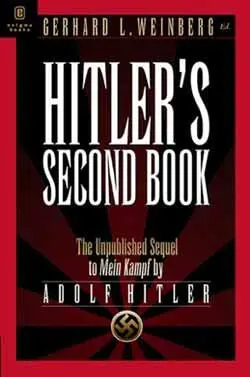
- Название:Hitler’s Second Book
- Автор:
- Издательство:Enigma Books
- Жанр:
- Год:2003
- Город:New York
- ISBN:978-1929631162
- Рейтинг книги:4 / 5. Голосов: 1
-
Избранное:Добавить в избранное
- Отзывы:
-
Ваша оценка:
Hitler’s Second Book: краткое содержание, описание и аннотация
Предлагаем к чтению аннотацию, описание, краткое содержание или предисловие (зависит от того, что написал сам автор книги «Hitler’s Second Book»). Если вы не нашли необходимую информацию о книге — напишите в комментариях, мы постараемся отыскать её.
* * * In 1958, while directing the microfilming and organization of a trove of archives that the U.S. forces had taken from the Nazis at the end of WWII, historian Weinberg (
) discovered the manuscript of a second book that Hitler had written but never published. The manuscript was published in German in 1961, accompanied by Weinberg’s annotations, but this is the first authoritative English version (a pirated and poor translation appeared in the 1960s). The text bears all of Hitler's hallmarks: rambling thoughts, half-baked ideas, pedantic writing-along with a terrifying, sustained belief in war and violence as the means to ensure that Germans would flourish. Compared to
, there are fewer pages devoted to Jews. Nonetheless, what comes across most strongly is Hitler’s abiding commitment to the principle of race and his identification of Jews as the enemy that threatened to undo all that Germans had created. Hitler dwells at length on foreign policy, and outlines a strategy of alliance with Fascist Italy and Great Britain. (He actually believed that Britain would accept a German-dominated European continent so long as Germany did not challenge the overseas British empire.) He also foresees an inevitable clash with the United States. This provides solid historical background on Hitler's thinking in the late 1920s, when his party was nothing more than a tiny, radical sect. Weinberg provides helpful notes and a very informative introduction.
Copyright 2003 Reed Business Information, Inc. “Politics is history in the making.”
Such were the words of Adolf Hitler in his untitled, unpublished, and long suppressed second work written only a few years after the publication of
.
Only two copies of the 200 page manuscript were originally made, and only one of these has ever been made public. Kept strictly secret under Hitler’s orders, the document was placed in an air raid shelter in 1935 where it remained until it’s discovery by an American officer in 1945.
Written in 1928, the authenticity of the book has been verified by Josef Berg (former employee of the Nazi publishing house Eher Verlag), and Telford Taylor (former Brigadier General U.S.A.R., and Chief Counsel at the Nuremburg war-crimes trials) who, after an analysis made in 1961, comments:
*as quoted by http://www.pharo.com/lost&found.htm
“If Hitler’s book of 1928 is read against the background of the intervening years, it should interest not scholars only, but the general reader.”*
Hitler’s Second Book — читать онлайн бесплатно полную книгу (весь текст) целиком
Ниже представлен текст книги, разбитый по страницам. Система сохранения места последней прочитанной страницы, позволяет с удобством читать онлайн бесплатно книгу «Hitler’s Second Book», без необходимости каждый раз заново искать на чём Вы остановились. Поставьте закладку, и сможете в любой момент перейти на страницу, на которой закончили чтение.
Интервал:
Закладка:
They feel the hardship; either they grumble against those who in their opinion are responsible — something which is dangerous at least in democratic States, since thereby they provide the reservoir for all attempts at revolutionary upheavals — or through their own measures they try to bring about a rectification as they understand it and as it arises from their own insight. The fight against the child begins. They want to lead a life like others, and cannot. What is more natural than that the responsibility is put on large families, in which no joy is taken any more, and which are limited as much as possible as a burdensome evil.
Hence it is false to believe that the German Folk in the future could acquire an increase in number by an increase of its domestic agricultural production. In the most favourable of cases, the upshot is only a satisfaction of the increased living requirements as such. But since the increase of these living requirements is dependent on the living standard of other nations which, however, stand in a much more favourable relation of population to land, they, in the future, too will be far ahead in their living equipment. Consequently this stimulus will never die out, and one day either a discrepancy will arise between the living standard of these Folks and those poorly provided with land, or the latter will be forced, or believe themselves forced, to reduce their number even further.
The German Folk’s prospects are hopeless. Neither the present living space, nor that achieved by a restoration of the borders of 1914, will allow us to lead a life analogous to that of the American Folk. If we want this, either our Folk’s territory must be considerably enlarged, or the German economy will again have to embark on paths already known to us since the pre War period. Power is necessary in both cases. Specifically, first of all, in the sense of a restoration of our Folk’s inner strength, and then in a military mounting of this strength.
Presentday National Germany, which sees the fulfilment of the national task in its limited border policy, cannot deceive herself that the problem of the nation’s sustenance will in any way be solved thereby. For even the utmost success of this policy of the restoration of the borders of 1914 would bring only a renewal of the economic situation of the year 1914. In other words, the question of sustenance which then, as now, was completely unsolved, will imperiously force us onto the tracks of world economy and world export. As a matter of fact, the German bourgeoisie, and the so called national leagues with it, also think only in economic political terms. Production, export and import are the catchwords with which they juggle and from which they hope for the Nation’s salvation in the future. It is hoped to raise the export capacity through an increase of production, and thereby be able to provide adequately for import needs. Only it is completely forgotten that for Germany this whole problem, as has already been stressed, is not at all a problem of increasing production, but rather a question of sales possibility; and that the export difficulties would not at all be obviated by a reduction of German production costs as, again, our bourgeois sly dogs presume. Because, inasmuch as this, in itself, is only partly possible in consequence of our limited domestic market, making German export commodities able to compete by lowering production costs — for instance, through the dismantling of our social legislation, and the duties and burdens resulting therefrom — it will only bring us thither, where we had landed on August 4th, 1914.
It really is part of the whole incredible bourgeois national naivete to presume that England would or ever could tolerate a German competition dangerous to her. Yet, these are the very same people who well know, and who always stress, that Germany did not want a war in 1914, but that instead she was literally pushed into it. And that it was England who, out of sheer competitive envy, gathered together former enemies and let loose against Germany. Today, however, these incorrigible economic dreamers imagine that England, after having risked the whole existence of her world empire in the monstrous four and one half year World War, and in which she remained the victor, will now view German competition differently than at that time. As if for England this whole question were a sporting matter. No. For decades before the War, England had tried to break the threatening German economic competition, the growing German maritime trade, and so on, with economic countermeasures. Only when they were forced to understand that this would not succeed, and when on the contrary Germany, by building her Navy, showed that she was actually determined to carry out her economic warfare to the extent of the peaceful conquest of the world, did England as a last resort invoke violence. And now, after she has remained the victor, they think they can play the game all over again; whereas, on top of all this, Germany today is not at all in a position to throw any kind of power factor into the scales, thanks indeed to her domestic and foreign policy.
The attempt to restore our Folk’s sustenance and to be able to maintain it by the increase of our production and by reducing the costs of the same, ultimately will fail for the reason that we cannot undertake the final consequence of this struggle because of the lack of military power. Thus the end would be a collapse of the German Folk’s sustenance and of all these hopes along with it. Entirely aside from the fact, too, that now even the American Union is emerging in all fields as the sharpest competitor to all European nations fighting as export nations for the world’s markets. The size and the wealth of her domestic market permits production figures and thereby production equipment which so reduce manufacturing costs that, despite enormous wages, it no longer seems possible to undercut her prices. Here the development of the automobile industry may be considered as a warning example. Not only because we Germans, for instance, despite our laughable wages, are not in a position, even only to a degree, to export successfully against American competition, but we must also look on as American cars spread alarmingly even to our own country. This is possible only because the size of her domestic market, her wealth in purchasing power and also in raw materials, guarantees the American automobile industry domestic sales figures which alone make possible manufacturing methods which in Europe would be impossible in consequence of the lack of these domestic sales potentials. The consequence of this is the enormous export possibilities of the American automobile industry. Thus here it is a question of the general motorising of the world that is a matter of incommensurable importance for the future. For the replacement of human and animal power by motors is only at the beginning of its development, whose end cannot at all be foreseen today. At any rate, for the American Union, the modern automobile industry is on the whole at the forefront of all other industries.
Thus in many other areas, our continent will increasingly appear as an economic factor, in an aggressive form, and thereby help to sharpen the struggle for the sales market. From an examination of all factors, especially in view of the limitation of our own raw materials and the ensuing threatening dependence on other countries, Germany’s future perforce appears very gloomy and sad.
But even if Germany were to master all her increasing economic difficulties, she would still be in the same spot as she had already been on August 4th, 1914. The ultimate decision as to the outcome of the struggle for the world market will lie in power, and not in economics.
It has been our curse, however, that even in peacetime a great part of the national bourgeoisie, precisely, was permeated by the idea that power could be renounced through an economic policy. Today, its chief representatives are also to be sought in those more or less pacifistic circles who, as the adversaries and enemies of all heroic, Folkish virtues, would be glad to see a Statepreserving, indeed even a Stateforming, strength in economics. But the more a Folk accepts the belief that it can maintain its life only through peaceful economic activity, the more will its very economy be surrendered to collapse. For, ultimately, economics, as a purely secondary matter in national life, is linked to the primary existence of a strong State. The sword had to stand before the plough, and an Army before economics.
Читать дальшеИнтервал:
Закладка:
Похожие книги на «Hitler’s Second Book»
Представляем Вашему вниманию похожие книги на «Hitler’s Second Book» списком для выбора. Мы отобрали схожую по названию и смыслу литературу в надежде предоставить читателям больше вариантов отыскать новые, интересные, ещё непрочитанные произведения.





Обсуждение, отзывы о книге «Hitler’s Second Book» и просто собственные мнения читателей. Оставьте ваши комментарии, напишите, что Вы думаете о произведении, его смысле или главных героях. Укажите что конкретно понравилось, а что нет, и почему Вы так считаете.