Adolf Hitler - Hitler’s Second Book
Здесь есть возможность читать онлайн «Adolf Hitler - Hitler’s Second Book» весь текст электронной книги совершенно бесплатно (целиком полную версию без сокращений). В некоторых случаях можно слушать аудио, скачать через торрент в формате fb2 и присутствует краткое содержание. Город: New York, Год выпуска: 2003, ISBN: 2003, Издательство: Enigma Books, Жанр: Публицистика, на английском языке. Описание произведения, (предисловие) а так же отзывы посетителей доступны на портале библиотеки ЛибКат.
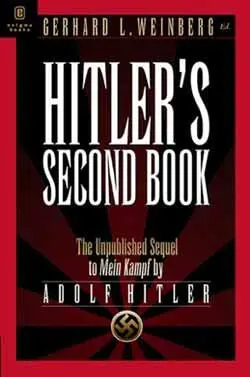
- Название:Hitler’s Second Book
- Автор:
- Издательство:Enigma Books
- Жанр:
- Год:2003
- Город:New York
- ISBN:978-1929631162
- Рейтинг книги:4 / 5. Голосов: 1
-
Избранное:Добавить в избранное
- Отзывы:
-
Ваша оценка:
Hitler’s Second Book: краткое содержание, описание и аннотация
Предлагаем к чтению аннотацию, описание, краткое содержание или предисловие (зависит от того, что написал сам автор книги «Hitler’s Second Book»). Если вы не нашли необходимую информацию о книге — напишите в комментариях, мы постараемся отыскать её.
* * * In 1958, while directing the microfilming and organization of a trove of archives that the U.S. forces had taken from the Nazis at the end of WWII, historian Weinberg (
) discovered the manuscript of a second book that Hitler had written but never published. The manuscript was published in German in 1961, accompanied by Weinberg’s annotations, but this is the first authoritative English version (a pirated and poor translation appeared in the 1960s). The text bears all of Hitler's hallmarks: rambling thoughts, half-baked ideas, pedantic writing-along with a terrifying, sustained belief in war and violence as the means to ensure that Germans would flourish. Compared to
, there are fewer pages devoted to Jews. Nonetheless, what comes across most strongly is Hitler’s abiding commitment to the principle of race and his identification of Jews as the enemy that threatened to undo all that Germans had created. Hitler dwells at length on foreign policy, and outlines a strategy of alliance with Fascist Italy and Great Britain. (He actually believed that Britain would accept a German-dominated European continent so long as Germany did not challenge the overseas British empire.) He also foresees an inevitable clash with the United States. This provides solid historical background on Hitler's thinking in the late 1920s, when his party was nothing more than a tiny, radical sect. Weinberg provides helpful notes and a very informative introduction.
Copyright 2003 Reed Business Information, Inc. “Politics is history in the making.”
Such were the words of Adolf Hitler in his untitled, unpublished, and long suppressed second work written only a few years after the publication of
.
Only two copies of the 200 page manuscript were originally made, and only one of these has ever been made public. Kept strictly secret under Hitler’s orders, the document was placed in an air raid shelter in 1935 where it remained until it’s discovery by an American officer in 1945.
Written in 1928, the authenticity of the book has been verified by Josef Berg (former employee of the Nazi publishing house Eher Verlag), and Telford Taylor (former Brigadier General U.S.A.R., and Chief Counsel at the Nuremburg war-crimes trials) who, after an analysis made in 1961, comments:
*as quoted by http://www.pharo.com/lost&found.htm
“If Hitler’s book of 1928 is read against the background of the intervening years, it should interest not scholars only, but the general reader.”*
Hitler’s Second Book — читать онлайн бесплатно полную книгу (весь текст) целиком
Ниже представлен текст книги, разбитый по страницам. Система сохранения места последней прочитанной страницы, позволяет с удобством читать онлайн бесплатно книгу «Hitler’s Second Book», без необходимости каждый раз заново искать на чём Вы остановились. Поставьте закладку, и сможете в любой момент перейти на страницу, на которой закончили чтение.
Интервал:
Закладка:
Lost territories will not be retrieved by protest actions, but rather by a victorious sword. Thus, whoever today desires the liberation of any territory whatsoever in the name of national honour must also be ready to stake all, with iron and blood, for the liberation, otherwise such a chatterbox should keep his mouth shut. Along with this, to be sure, follows the duty also of carefully considering whether we possess the power to carry out such a struggle, and secondly whether the blood risked leads, or can lead, to the desired success, and thirdly, whether the success achieved matches the blood that must be staked.
I most solemnly protest against the claim that a duty of national honour exists which compels us to have two million men bleed to death on the battlefield in order that, under the most favourable result, we may be able to enter a total of a quarter million men, women and children on our books. This is not national honour that is made manifest here, but rather a lack of principle, or madness. It is no national honour, however, for a Folk to be ruled by madmen.
Certainly a great Folk will protect even its last citizen with collective action. But it is an error to impute this to sentiment to honour, rather than primarily to a sagacious insight and human experience. As long as a nation tolerates an injustice that is inflicted on some of its citizens, it will slowly but increasingly weaken its own position, since such a tolerance would serve the inner strengthening of an aggressive minded enemy just as it grinds down trust in the strength of one’s own State. We know all too well what the consequences are in history of a constant yielding in little things, not to know how to be able to judge the necessary consequences in big things. Hence a solicitous State leadership will all the more preferably attend to the interests of its citizens in the smallest things, as with that the risk of its own commitment is reduced in proportion as that of the adversary rises. If today in any State an injustice is committed against an English citizen, and England undertakes her citizen’s defence, the danger of England being involved in a war on account of this one Englishman is no greater for England than for the other State, which inflicts the injustice. Hence the firm action of a government respected as such in defence of even a single person is altogether not an unbearable risk, since indeed the other State will have just as little interest in starting a war on account of a trifling injustice that may have been inflicted on a single person. A general conception of honour has been formulated on the basis of this knowledge and the thousand year old application of this principle, namely, that a powerful State take every individual citizen under its protection and defend him with all its might.
Further, through the nature of European hegemony, a certain practice has been developed in the course of time to demonstrate this conception of honour in more or less cheap examples, so as to raise the prestige of individual European States, or at least to give it a certain stability. As soon as an alleged, or even faked, injustice was committed against a Frenchman or an Englishman in certain countries that were weak and less powerful militarily, this subject’s defence with armed power was undertaken. That is to say, a couple of warships put on a military demonstration, which in the worst cases was firing practice with live ammunition, or an expeditionary force of some kind was landed with which the power to be punished was to be chastised. Not seldom, at the same time, the wish that thus an excuse for intervention might be obtained, was father to the thought.
It would probably never occur to the English even to exchange a note with North America on account of a trifling incident for which they would take bloody revenge on Liberia.
Thus, the more the defence of the individual citizen is undertaken on grounds of pure expediency and with every means in a strong State, the less can a Reich, made completely defenceless and powerless, be expected to undertake a foreign policy step on the grounds of so called national honour, which perforce must lead, after all, to the destruction of its last prospects for the future. For if the German Folk justifies its present border policy, espoused in the so called national circles, by the necessity of representing German honour, the result will not be the redemption of German honour, but rather the externalisation of German dishonour. That is to say, it is not at all dishonourable to have lost territories, but it is dishonourable to conduct a policy which must needs lead to a complete enslavement of one’s own Folk. And all this only so as to be able to give vent to just ugly talk and to avoid action. For this is just a question of empty talk. If we really wanted to establish a policy having national honour as its goal, then we must at least entrust this policy to persons worthy of esteem according to all common notions of honour. As long, however, as German domestic and foreign policy is conducted by forces which, with cynical smirks, proclaim in the Reich Parliament that for them there exists no Fatherland called Germany, for just so long will it be the first task of these national bourgeois and patriotic phrase mongering heroes merely to secure the simplest recognition of the idea of national honour in Germany through their domestic policy. But why do they not do it; indeed, on the contrary, why do they enter coalitions with avowed betrayers of the country at the expense of this so called national honour? Because otherwise a difficult struggle would be necessary, whose outcome they view with small confidence, and which, indeed, could lead to the destruction of their own existence. To be sure, this private existence of theirs is holier than the defence of national honour within the country. Yet they gladly risk the nation’s future existence for a couple of phrases.
The national border policy becomes downright senseless if we look beyond both the afflictions and tasks of the present to the necessity of shaping a life for our Folk in the future.
Hence the border policy of our bourgeois patriotic Fatherland circles is especially senseless because it requires the greatest blood stakes, and yet contains the smallest prospects for our Folk’s future.
The German Nation is less in a position today than in the years of peace to nourish itself on its own territory.
All the attempts — either through increasing land yields as such, or by cultivating the last fallow lands — to bring about an increase of the German production of foodstuffs, did not enable our Folk to nourish itself from its own soil. In fact, the Folk mass now living in Germany can no longer be satisfied with the yield of our soil.
Every further increase of these yields, however, would not be applied to the benefit of the increment to our population, but instead would be completely spent in satisfying the increase of the general living requirements of individuals. A model living standard is created here which is primarily determined by a knowledge of conditions and of life in the American Union. Just as the living requirements of rural communities rise as a result of the slow awareness and the influence of life in the big cities, so do the living requirements of entire nations rise under the influence of the life of better situated and richer nations. Not seldom a people’s living standard, which thirty years before would have appeared as a maximum, is regarded as inadequate simply for the reason that in the meanwhile knowledge has been acquired about the living standard of another Folk. Just as in general, man, even in the lowest circles, takes for granted appointments which eighty years before were unheard of luxuries even for the upper classes. The more space is bridged through modern technology, and especially communication, and nations are brought closer together, the more intensive their mutual relations become, the more also will living conditions reciprocally leave their mark on each other and seek to approximate one another. It is an erroneous opinion that in the long run one can hold a Folk of a definite cultural capacity and also of a real cultural importance to an otherwise generally valid living standard by an appeal to perceptible facts or even to ideals. The broad masses especially will show no understanding of this.
Читать дальшеИнтервал:
Закладка:
Похожие книги на «Hitler’s Second Book»
Представляем Вашему вниманию похожие книги на «Hitler’s Second Book» списком для выбора. Мы отобрали схожую по названию и смыслу литературу в надежде предоставить читателям больше вариантов отыскать новые, интересные, ещё непрочитанные произведения.







Обсуждение, отзывы о книге «Hitler’s Second Book» и просто собственные мнения читателей. Оставьте ваши комментарии, напишите, что Вы думаете о произведении, его смысле или главных героях. Укажите что конкретно понравилось, а что нет, и почему Вы так считаете.